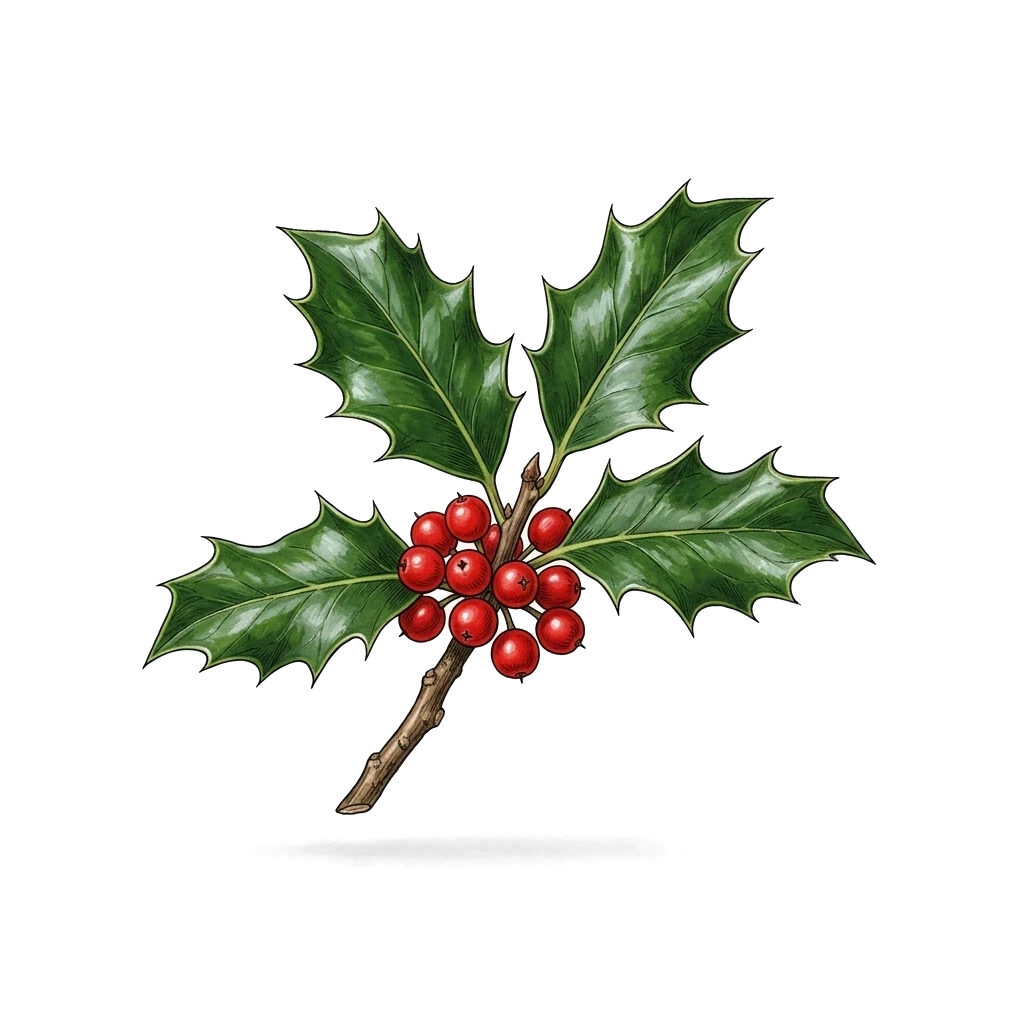
What does holly symbolize?
The holly meaning given today is protection, and it is an old one. The Roman writer Pliny the Elder says that the tree called aquifolia, which the notes to the 1855 translation identify as holly, “planted in a town or country-house, is a preservative against sorceries and spells.” The same notes add a caution: Dioscorides tells the same story of another shrub, and Pliny may have mixed the two up.
Kate Greenaway’s 1884 Language of Flowers gives holly “foresight.” The word itself goes back to the Old English holen, and dictionaries still define holly partly by its use: the branches are “traditionally used for Christmas decoration.”
“The Holly and the Ivy”
The folk song collector Cecil Sharp took down “The Holly and the Ivy” as Mrs. Mary Clayton sang it at Chipping Campden, in Gloucestershire, and printed it in his English Folk-Carols in 1911. Sharp filled out her words with a set recited to him by Mrs. Wyatt of East Harptree, in Somerset, and noted that the words were also printed on a broadside by Wadsworth of Birmingham.
The carol’s holly symbolism is set out verse by verse. “Of all the trees that are in the wood, / The holly bears the crown,” and then each part of the plant is laid beside the Christmas story: a blossom “as white as the lily flower,” a berry “as red as any blood,” a prickle “as sharp as any thorn” and a bark “as bitter as any gall,” each followed by “And Mary bore sweet Jesus Christ.”
The Green Knight’s holly bough
In Sir Gawain and the Green Knight, a poem that survives in a manuscript from the end of the 14th century, King Arthur is keeping Christmas at Camelot when, at the New Year feast, a huge knight, green from head to foot, comes in at the hall door. He wears no armor, and carries an axe in one hand and, in the other, in Jessie Weston’s 1898 prose version, “a holly-bough, that is greenest when the groves are bare.” What he asks for is a “Christmas jest”: one stroke of the axe, in exchange for a stroke of his own a year later.
“Heigh-ho, the holly” in Shakespeare
Holly turns up in a winter song in As You Like It, where Amiens sings “Blow, blow, thou winter wind,” whose refrain runs “Heigh-ho, sing heigh-ho, unto the green holly. / Most friendship is feigning, most loving mere folly.”
Holly colors
- Red berries
- Deep green leaves
- White flowers
The red is the berries, which appear only on pollinated female plants, from fall to spring. The flowers that come before them, in spring, are small, about a quarter of an inch, and greenish to white. Not every holly berry is red: depending on the kind, they can be black, gold or orange.
American holly vs. English holly
The Christmas holly of Europe and the native holly of the eastern United States look much alike, and both bear red fruit on spiny, evergreen leaves.
| Feature | English holly | American holly |
|---|---|---|
| Botanical name | Ilex aquifolium | Ilex opaca |
| Native range | Europe, North Africa, western Asia | Massachusetts and Pennsylvania south to Florida, west to Texas |
| Height | 30 to 50 feet | 40 to 60 feet |
| USDA zones | 7 to 8 | 5 to 9 |
| Berries | Red, ripening late summer to fall | Red or orange, on the tree September through February |
English holly is “the traditional Christmas holly in Europe,” but it is not reliably hardy in the northern US, and in the West it is on the invasive plant lists of Oregon, California and Alaska. American holly branches go into Christmas wreaths, and its fruit feeds songbirds, wild turkeys, quail, white-tailed deer and squirrels.
Delaware’s state tree
The American holly tree is Delaware’s state tree. The act that made it so, approved on May 1, 1939, has a single section, which adopts the American holly, Ilex opaca, “as the State Tree.”
The choice honored a business: holly was a major Delaware export industry in the first half of the 20th century, and by the 1930s the state was the leading producer in the nation. Milton and the country around it became known as “The Land of Holly,” and one of the trade’s pioneers was Charles G. Jones Sr. of Milton, known as “Jones, The Holly Wreath Man.”
The growing use of artificial goods and wage laws for piecework businesses ended the trade by the 1960s.
Male and female holly: why only some have berries
Hollies are dioecious: each plant is either male or female, and you need both to get fruit. Bees carry the pollen. A female sets berries only if a pollinating male grows nearby, and a few kinds, such as the English holly ‘J.C. van Tol’, are self-fertile and berry on their own.
Don’t trust the names. The Royal Horticultural Society points out that ‘Golden King’ is a female and ‘Silver Queen’ a male.
The usual advice is one male for every three to five females. As for distance, an Illinois Extension educator finds that plants in the same yard, within about 100 feet of each other, are close enough, though he knows of no research-based answer. Winterberry is more generous: one male, chosen to flower at the same time, can serve 10 to 20 females within 50 feet.
Types of holly
Ilex is a big genus, with 564 species in temperate and tropical forests on every continent but Antarctica. Eight of them, from NC State Extension’s plant pages:
-
English holly
Ilex aquifolium
The traditional Christmas holly of Europe, native to Europe, North Africa and western Asia. A slow-growing tree, 30 to 50 feet tall, with glossy, spiny, dark green leaves and red fruit
-
American holly
Ilex opaca
Native from Massachusetts and Pennsylvania south to Florida and west to Texas. Spiny leaves 2 to 4 inches long, and red or orange fruit on female trees from September through February
-
Chinese holly
Ilex cornuta
Also called horned holly, from China and Korea. Glossy, oblong leaves with three strong spines at the tip, and red fruit that lasts into winter
-
Japanese holly
Ilex crenata
A small-leaved holly from Japan and East Asia, often confused with boxwood. Its fruit is black
-
Blue holly
Ilex × meserveae
A cross of English holly and the East Asian Ilex rugosa, raised by Kathleen Meserve of St. James, New York, to stand cold northeastern winters. Blue-green leaves on purplish stems
-
Winterberry
Ilex verticillata
A deciduous holly native to eastern North America. The bright red fruit on female plants stays on the bare branches into winter
-
Inkberry
Ilex glabra
An evergreen holly with spineless leaves and jet-black fruit, native to the coastal plain from Nova Scotia to Florida and Louisiana
-
Yaupon
Ilex vomitoria
Native to the eastern United States and Mexico, with small, glossy leaves that are not prickly and translucent red berries. Its name comes from Catawban
How to grow holly
Growing holly
- Type
- Shrub or tree
- Blooms
- Spring
- Sun
- Full sun to part shade
- USDA zones
- 5–9
- Native to
- Worldwide, on every continent but Antarctica
Hollies prefer acidic, well-drained soil but tolerate many others, clay included; in alkaline soil their leaves turn yellow. Deciduous kinds generally do poorly in the heat and humidity of zones 8 and 9. NC State suggests the native species for native gardens, since birds eat the fruit.
Birds eat winterberry’s berries, but not as a first choice, which is one reason they last for most of the winter.
Is holly poisonous to dogs and cats?
Holly
- Pets
- Toxic to dogs, cats and horses
- People
- Listed as poisonous (low severity) The berries are the poisonous part.
In the US, if a pet may have eaten part of a plant, call your vet or the ASPCA Animal Poison Control Center at (888) 426-4435. If a person has, call Poison Control at 1-800-222-1222.
The ASPCA’s holly entry gives the American holly, Ilex opaca, as its scientific name and lists English holly, inkberry and winterberry among its other common names.
Holly bouquet ideas
Cut from a female plant if you want berries in the vase. The RHS notes that female hollies are the popular ones for Christmas decorations. For a December birthday, a few sprigs beside a bowl of paperwhite narcissus put the month’s two flowers together.
-
Holly and ivy
The carol’s pair in one jug. In Greenaway’s book holly means foresight and ivy fidelity and marriage, which makes it a winter wedding bunch too.
-
Bare winterberry branches
Winterberry drops its leaves and keeps its red fruit, so a few tall branches make a bouquet on their own, with nothing to strip.
-
Red and black berries
Inkberry’s jet-black fruit beside the red of English or American holly, for a darker, less expected winter bunch.
-
Holly and mistletoe
Holly’s foresight beside mistletoe, which Greenaway glosses "I surmount difficulties": a bunch for someone starting something hard in the new year.
Holly tattoo ideas
A holly tattoo is mostly the leaf: leathery and glossy, with spines along the edge. Add a few berries, each about a quarter of an inch, and it can’t be anything else.
-
A line of the carol
A single sprig with "The holly bears the crown" beneath it, or one of the verses: the berry "as red as any blood," the prickle "as sharp as any thorn."
-
The Green Knight’s bough
A holly branch held upright like a staff, for anyone who loves the old romances: the bough "greenest when the groves are bare."
-
His and hers
Two sprigs for a couple: one in flower, for the male plant, and one in berry, for the female. Most hollies need both to fruit.
-
Winterberry in snow
A bare, leafless twig studded with red berries, the deciduous holly as it looks in midwinter. It suits a fine-line style.