Where birthstone colors come from
There is no separate list of birthstone colors. The lists that GIA, the American Gem Society and Jewelers of America publish name stones, not shades, so the colors belong to the stones themselves.
Those stones go back to a list the US jewelry trade adopted in Kansas City in 1912. Our birthstones by month chart sets that list beside the older traditional one. Trade groups changed it in 1952, 2002 and 2016, adding zircon, tanzanite and spinel along the way.
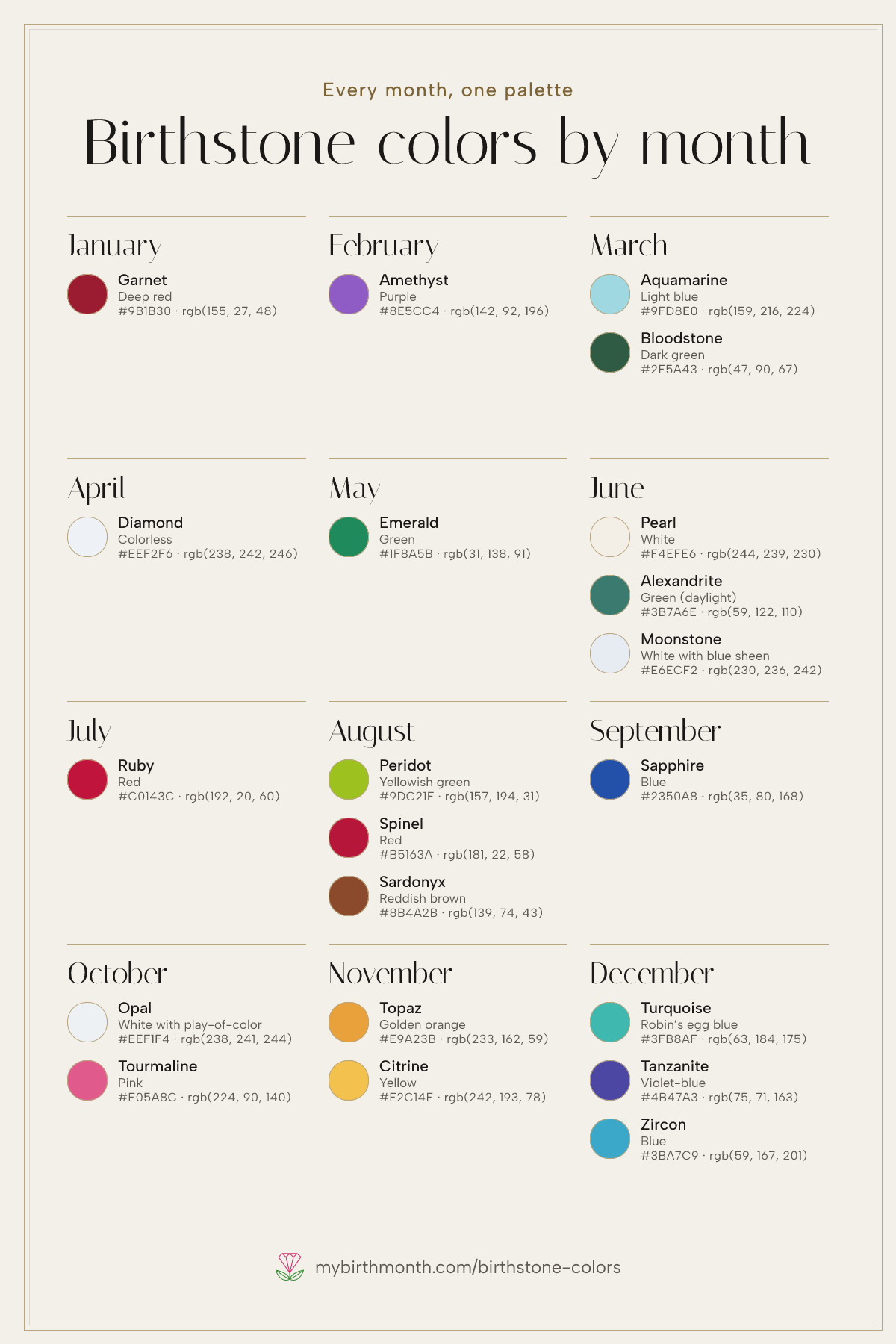
Where a month has one stone in one familiar color, most charts agree: garnet red for January, amethyst purple for February, emerald green for May. The rest is where charts part ways.
Why birthstone color charts disagree
Months with more than one stone
Six months have two or three birthstones, and each stone brings its own color.
- March pairs aquamarine, light blue to green-blue, with bloodstone, a dark green stone spotted with red.
- June has three very different looks: pearl in a wide array of colors, alexandrite that turns from green in daylight to red or purplish red under incandescent light, and moonstone, whose finest stones show a blue sheen.
- August has yellowish green peridot, spinel in red, pink, blue and more, and sardonyx, with bands of brownish red and white or black.
- October offers opal’s flashes of rainbow color and tourmaline, with pink and red among its most popular colors.
- November leans warm: citrine runs from yellow to brownish orange, and topaz is known for yellow, orange and pinkish orange imperial, though it also comes in blue, pink and violet.
- December is blue three ways: turquoise from blue to green, tanzanite from blue to violet, and blue zircon, commonly heat-treated to get that color.
Stones that come in every color
A few birthstones are known for one color but come in many. Sapphire is the classic case: it is famous for blue, yet corundum comes in nearly every color, and only the red kind is called ruby. Garnet runs from red through orange and yellow to vivid green.
Diamond comes in nearly every color, but most people picture it colorless. Truly colorless diamonds are scarce, since most have a tint of yellow or brown, and vividly colored ones, like the blue Hope, are rarer still. Few gems match tourmaline’s range of colors.
For these, the chart shows the color most people picture, and the small dots under each swatch show the others. Each month’s page goes into the full range: the January birthstone colors run to orange and green garnets, and the September birthstone colors include pink and padparadscha sapphire.
Lists that name different stones
Even the stones aren’t settled everywhere. Jewelers of America gives December blue topaz in place of zircon, so some December charts show blue topaz instead.
October’s pink has a history of its own. Tourmaline was already October’s alternate stone in 1912, and the 1952 list named it pink tourmaline. Pink still stands for October on many charts.
Birth month colors for parties and design
For a birthday theme, many people pair the birthstone with the month’s birth flower. The palettes below put each month’s stone colors next to its flowers’ leading colors, so a January party might combine garnet red with carnation red and snowdrop white.
-
January
- Garnet: deep red #9B1B30
- Carnation: light red #C8243C
- Snowdrop: white #F4F6F2
Every shade: January birthstone · January birth flower
-
February
- Amethyst: purple #8E5CC4
- Violet: purple #6A3FA0
- Primrose: pale yellow #F4E27A
Every shade: February birthstone · February birth flower
-
March
- Aquamarine: light blue #9FD8E0
- Bloodstone: dark green #2F5A43
- Daffodil: yellow #F7C948
Every shade: March birthstone · March birth flower
-
April
- Diamond: colorless #EEF2F6
- Daisy: white #FAFAF5
- Sweet pea: pink #F2A0C0
Every shade: April birthstone · April birth flower
-
May
- Emerald: green #1F8A5B
- Lily of the valley: white #F7F7F0
- Hawthorn: white #F7F3EE
Every shade: May birthstone · May birth flower
-
June
- Pearl: white #F4EFE6
- Alexandrite: green (daylight) #3B7A6E
- Moonstone: white with blue sheen #E6ECF2
- Rose: red #B3122E
- Honeysuckle: coral pink #E98C7A
Every shade: June birthstone · June birth flower
-
July
- Ruby: red #C0143C
- Larkspur: blue #5A5FC8
- Water lily: pink #F0A6C2
Every shade: July birthstone · July birth flower
-
August
- Peridot: yellowish green #9DC21F
- Spinel: red #B5163A
- Sardonyx: reddish brown #8B4A2B
- Gladiolus: pink #E9668F
- Poppy: red #D7261E
Every shade: August birthstone · August birth flower
-
September
- Sapphire: blue #2350A8
- Aster: purple #8A5FC2
- Morning glory: blue #3D6FD1
Every shade: September birthstone · September birth flower
-
October
- Opal: white with play-of-color #EEF1F4
- Tourmaline: pink #E05A8C
- Marigold: orange #F28C28
- Cosmos: pink #E97FAE
Every shade: October birthstone · October birth flower
-
November
- Topaz: golden orange #E9A23B
- Citrine: yellow #F2C14E
- Chrysanthemum: yellow #F2C230
Every shade: November birthstone · November birth flower
-
December
- Turquoise: robin’s egg blue #3FB8AF
- Tanzanite: violet-blue #4B47A3
- Zircon: blue #3BA7C9
- Narcissus (paperwhite): white #FAF8F0
- Holly: red berries #A51D2D
Every shade: December birthstone · December birth flower
Birth month colors from astrology
Some birth month color lists have nothing to do with gems. One of them, Colorstrology, comes from a book by astrologer Michele Bernhardt that gives every day of the year, and every month, a color of its own, drawn from astrology, numerology and color theory with a Pantone-inspired color system. Because its colors come from astrology rather than from gems, a list built on it can look nothing like the chart above.
How to use the hex codes
A hex code like the ones in the chart works in Canva, Figma, Google Slides, Cricut Design Space and many other design tools: paste it into the color picker. The RGB values do the same job in apps that ask for red, green and blue numbers, such as Google Slides and Figma.
The .ase file holds every color, grouped by month, and loads them all at once as swatches in Adobe Illustrator, Photoshop and InDesign. The JSON file holds the same names, hex codes and RGB values for anyone building a website or app.
Real stones vary far more than any swatch: even the most valued blue sapphires run from blue to violetish blue, and lesser ones can be greenish, grayish, too light or too dark. Treat these codes as a starting point, not a match for a particular gem.