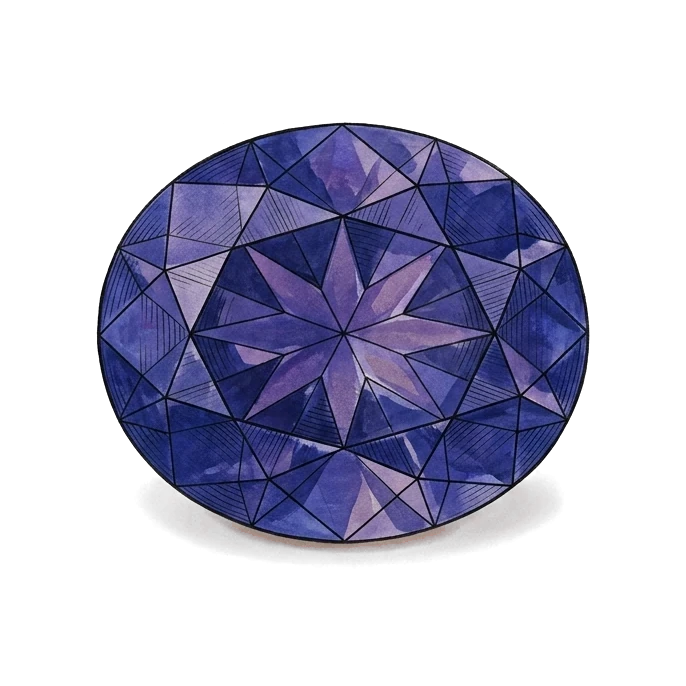
What does tanzanite mean?
Tanzanite’s meaning is its own short history. Gem crystals of violet-blue zoisite from Tanzania reached dealers in 1967, and Tiffany & Co. named the new gem after its country.
Tanzanite symbolism starts with that story: a vivid blue gem from one small corner of Africa, near Mount Kilimanjaro. Unlike opal or sapphire, it has no ancient or medieval lore.
Its place in tradition came in 2002. That October, the American Gem Trade Association added tanzanite to December’s birthstones, beside turquoise and zircon, after the trade’s associations agreed on it. Tanzanite is also the gem for the 24th wedding anniversary.
Who found tanzanite?
The usual account starts with a Maasai tribesman. In 1967 he came across a cluster of transparent violet-to-blue crystals at Merelani, in northern Tanzania, and told a local prospector, Manuel d’Souza. D’Souza registered four mining claims, thinking he had found sapphire, and within a short time 90 more claims appeared in the same 20-square-mile area.
The finder’s name varies with the telling. GIA’s gem encyclopedia credits a Maasai man named Ali Juuyawatu with the first crystal, while the American Gem Society speaks of Maasai herders who found blue crystals while tending their livestock.
How tanzanite got its name
Its colors confused people at first. Because the crystals flashed red, blue and yellow-green in different directions, they were mistaken for cordierite or dumortierite, until X-ray photographs made at the University of Heidelberg and in London showed they were zoisite.
Zoisite, it was argued, was a rather unexciting name for such handsome stones, and “tanzanite” was proposed in 1968 as the name of the variety. The American Gem Society adds that “blue zoisite” sounded a little too much like “suicide.”
Tiffany & Co. became the gem’s main distributor, named it after Tanzania and promoted it with a big publicity campaign in 1968. With its vivid color, high clarity and the large stones it could be cut into, it quickly became a sensation. By 2002, the head of the American Gem Trade Association called it the second most popular colored gem in the US, behind sapphire.
Tanzanite color: why it’s blue and violet
Tanzanite color runs from violet blue through bluish violet to violet purple. The most prized stones are a strongly saturated pure blue or violetish blue, and exceptional ones show red flashes too.
Those flashes come from pleochroism: tanzanite shows a different color along each of its three crystal directions. In 1969, the Harvard mineralogist C. S. Hurlbut Jr. described them as red-violet, deep blue and yellow-green. Depending on how it is cut, a finished gem can look like a sapphire or even an amethyst.
The light you see it in moves the color too. Cool light, like daylight-equivalent fluorescent, brings out the blue, and warm light makes the same stone look more violet to purple.
-

Violetish blue
The finest color: an intense blue with a touch of violet, much like fine sapphire. It is most often found in stones of 5 carats or more.
#3B42B0
-

Pure blue
A strongly saturated blue. It lies along the crystal’s short axis, so large blue stones are harder to cut and cost more than purple ones.
#3A4FA8
-

Bluish violet
GIA’s range runs from violet blue through bluish violet to violet purple. Warm light pushes any tanzanite toward violet, cool daylight toward blue.
#4B47A3
-

Violet purple
More plentiful than strong blue. Cutting for this color wastes less rough, so a violet-purple stone can be larger.
#6B3FA0
-

Pale lavender
Light, pastel tones are more common and cost less. Accent stones under a carat are usually this light.
#A9A6D8
-

Brownish zoisite
How most tanzanite comes out of the ground. Gentle heating removes the brown and leaves blue to violet.
#8A6B4F
-

“Fancy” tanzanite Zoisite
Unheated stones from the same mines in greenish, golden, pink or purplish pink colors. GIA calls these colors zoisite.
#C99A3E
-

Green zoisite Zoisite
Transparent green zoisite from Merelani, described in 1992 and colored by chromium and vanadium. Some sellers call it “green tanzanite.”
#4E8C5A
-

Thulite Zoisite
Pink, translucent to opaque zoisite, named after Thule, an ancient name for Norway, one of the places it is found.
#D07C98
-

Anyolite (ruby in zoisite) Zoisite
Chrome-green zoisite holding large, opaque rubies and black hornblende, from Longido, Tanzania. The name comes from the Maasai word for “green.”
#3F7F3C
Why almost all tanzanite is heated
Most tanzanite begins as brownish zoisite. Heated at low temperatures, it loses its brown and turns blue or purplish blue. The new color is permanent, and the heating adds no durability concerns.
Heating also changes how the stone flashes. A 2020 study of stones heated to 550°C found their three colors reduced to two, violet and blue, and pointed to vanadium as the key coloring agent. Hurlbut had already traced the color to vanadium in 1969, and noted that heated crystals turn sapphire-blue.
Because heating is the rule, the International Gem Society tells buyers to assume every blue to violet tanzanite has been heated, and calls the treatment stable.
Blue or violet: the cutter decides
Blue usually lies along the crystal’s short axis, so a large blue stone is hard to cut. That makes blue rarer than purple, and it commands a premium.
Cutting for bluish purple wastes less rough. So every crystal forces a trade: keep the weight and settle for purple, or give up rough to bring out the prized blue.
Size plays its part as well. Fine, deep color is most often found in stones of 5 carats or more, and accent stones under a carat are usually lighter.
Zoisite: tanzanite’s family
Tanzanite is one variety of the mineral zoisite, which is named after Baron Sigmund Zois. Gem zoisite can also be gray, green, brown, pink or yellowish. Some sellers call the pink, green and yellow stones tanzanite, but GIA calls them zoisite.
Transparent green zoisite from the Merelani Hills was reported in 1992. Its gem properties match tanzanite’s, but its pleochroic colors differ, and chromium and vanadium give it its green. Some sellers call it “green tanzanite,” a name the International Gem Society finds confusing.
Two more zoisites aren’t transparent at all. Thulite is pink and takes its name from Thule, an ancient name for Norway. Anyolite, or ruby in zoisite, is chrome-green zoisite holding opaque rubies, and its name comes from the Maasai word for “green.”
Unheated tanzanite in unusual shades is sold as “fancy” tanzanite. One dealer’s rough, shown at Tucson in 2014, came in greenish, golden, green-blue, pink and purplish pink. A year later the same dealer told Gems & Gemology that many stones promoted as unheated are really the products of heating that didn’t fully work.
Is tanzanite good for everyday wear?
| Hardness | 6–7 on the Mohs scale |
|---|---|
| Everyday ring? | Everyday, with care Fine in a ring if you take it off for chores and sports. Safest in earrings and pendants. |
| Family | Zoisite |
| Main sources | Tanzania (Merelani Hills only) |
| Treatments | Almost all is heated from brownish zoisite, and the color is permanent. A few stones are coated to deepen their color. |
| Lab-grown | None is known to date, though imitations are common. |
| Anniversary | 24th wedding anniversary |
Not in a ring worn every day. With a hardness of 6 to 7 and poor toughness, tanzanite isn’t an ideal daily ring stone, especially for an active person. A setting that surrounds it with metal or other gems helps protect it.
It shrugs off normal heat, everyday chemicals and light. Very high heat or a sudden change in temperature can crack it, though, and hydrochloric and hydrofluoric acids attack it.
Where tanzanite is found: the Merelani Hills
The Merelani Hills of northern Tanzania are the only place on earth where tanzanite is mined commercially. That single source is why GIA calls it rarer than diamond.
Mount Kilimanjaro rises north of the mines. In the large mechanized operations, thousands of workers recover tanzanite from shafts more than 100 meters (over 300 feet) deep. The same area also produces green grossular garnet.
The government divided the mines into four blocks in 1990, and Block C is larger than the other three combined. Some sellers claim one block gives better stones. The International Gem Society says there’s no difference in quality between them, and no way to tell which mine a stone came from.
Tanzania guards the area closely. Under its 2019 regulations, the Mirerani Controlled Area, as the law spells it, must have a wall or other enclosure built by the government, and everyone has to enter and leave through the main gate. Miners and their workers need an identification card, and visitors a pass from the gate that lets them stay only from 7 a.m. to 7 p.m.
Exports run through licenses as well. When GIA’s field gemologists visited in 2016, miners sold to licensed brokers, who may buy and move gems within Tanzania, and the brokers sold to licensed master dealers, mostly in Dar es Salaam and Arusha, who are allowed to export.
Famous tanzanites
The great tanzanites are museum pieces and mine records. The Smithsonian’s 122.70-carat gem is a deep violet-blue, and the museum names the most valuable color as a deep sapphire blue with highlights of intense violet.
-
The Smithsonian’s 122.70-carat tanzanite
Obtained in 1971
A deep violet-blue gem in the National Gem Collection, catalog number NMNH G4876. It came to the museum in an exchange.
-
The Petersen Tanzanite Brooch
Designed in 1991
A platinum flower brooch designed by Harry Winston, Inc., set with a matched pair of tanzanites of about 30 carats and about 24 carats of diamonds. The tanzanite “flowers” come off to be worn as earrings. Given to the Smithsonian in 2002.
-
Harvard’s 52-gram crystal
Described in 1969
The largest of the 26 crystals in C. S. Hurlbut Jr.’s study of gem zoisite from Tanzania, which found 17 crystal forms never recorded before. It was then in Harvard’s collection.
-
The Mawenzi
Announced in 2005
A 16,839-carat piece of rough found by the mining company TanzaniteOne, which reported it as the largest single piece of tanzanite ever mined. The company named it after Kilimanjaro’s second-highest peak.
-
A 27.59-carat “fancy” tanzanite
Shown in 2015
An unheated, natural-color zoisite, mostly greenish yellow with flashes of lilac pink: a reminder that zoisite comes in more than blue.
Tanzanite names to watch for
Most of tanzanite’s misleading names stretch the word to other colors of zoisite, or dress up a seller’s own grading. As the International Gem Society puts it, zoisite that isn’t blue should simply be called zoisite.
| Sold as | What it is |
|---|---|
| Pink tanzanite | Pink zoisite: GIA keeps the name tanzanite for blue to violet |
| Green tanzanite | Green zoisite |
| Yellow tanzanite | Yellow zoisite |
| “Fancy” tanzanite | Unheated zoisite in colors other than blue to violet |
| AAA tanzanite | A seller’s own grade: no standard grading scale exists for tanzanite |
| D-Block tanzanite | Ordinary tanzanite: stones from the different mine blocks can’t be told apart |
How to buy tanzanite
Color comes first. Most buyers prefer a deep, saturated blue, some favor an intense bluish purple, and paler colors cost less. Then look at:
- Clarity: tanzanite is usually free of inclusions you can see. Fractures and other flaws that threaten its durability lower the value, and on rare occasions inclusions make a cat’s-eye.
- Cut: cushions and ovals are the most common shapes. A well-cut stone returns light evenly across its whole face, and poorly cut gems are much harder to sell.
- Paperwork: GIA doesn’t grade tanzanite, but its identification report describes the stone and notes any treatment it can detect.
Coated and oiled tanzanite, and what must be disclosed
Heating is expected. Other treatments are not, and they are rarer: pale tanzanite is sometimes coated to deepen its blue-violet.
In 2008, GIA researchers examined 23 coated tanzanites whose coating held cobalt, zinc, tin and lead. The small ones gave themselves away by their unusually intense color and what the microscope showed, but the two stones of more than 3 carats showed only small clues at high magnification.
GIA’s lab found a new kind in 2014: five tanzanites coated with titanium on their pavilions, the facets underneath. Where the coating had worn, along facet edges and at chips, the color was paler.
Oil turns up too. Gems & Gemology has shown a 115-carat tanzanite whose fissures only became obvious once the oil hiding them was removed.
A coating that wears away isn’t permanent, and the FTC’s guides say a seller must disclose a treatment that isn’t. The full rule is in our guide to treated topaz.
Lab-grown and imitation tanzanite
No lab-grown tanzanite is known so far, but there are plenty of imitations. Since at least 1995, glass, YAG (yttrium aluminum garnet) and synthetic corundum have been made to look like tanzanite, and standard gem tests such as refractive index, specific gravity and pleochroism separate them.
By 2002, glass and synthetic forsterite were the two most common fakes. A dichroscope, a small handheld viewer, catches glass at once, because glass shows none of tanzanite’s pleochroism.
Forsterite has fooled buyers on the spot. JCK reported in 2005 on a stone a tourist in Tanzania had bought as fine tanzanite, which turned out to be synthetic forsterite with a much lower refractive index.
| Type | What to know |
|---|---|
| Natural | Mined. Almost all is heated from brownish zoisite, and the color is permanent. A few stones are coated to deepen their color. |
| Lab-grown | None is known to date, though imitations are common. |
| Imitation | Glass and lab-made forsterite are the most common. YAG and lab-grown corundum have been used too. |
| Type | Price |
|---|---|
| Light, 1–2 carats | $70–$150 |
| Medium, 1–2 carats | $110–$350 |
| Deep, 1–2 carats | $150–$500 |
| Deep, 3 carats and up | $400–$1,500 |
Prices vary with size, color, clarity and seller. They’re a guide to what shops ask, not a valuation or an investment view.
How to clean tanzanite
Cleaning tanzanite
- Warm soapy water, soft brush
- Safe
- Ultrasonic cleaner
- Never
- Steam cleaner
- Never
It may crack in very high heat or sudden temperature changes.
Warm, soapy water is the way to clean tanzanite, and ultrasonic and steam cleaners are never recommended. The International Gem Society suggests a soft brush and a mild detergent, and keeping the stone away from rough handling.