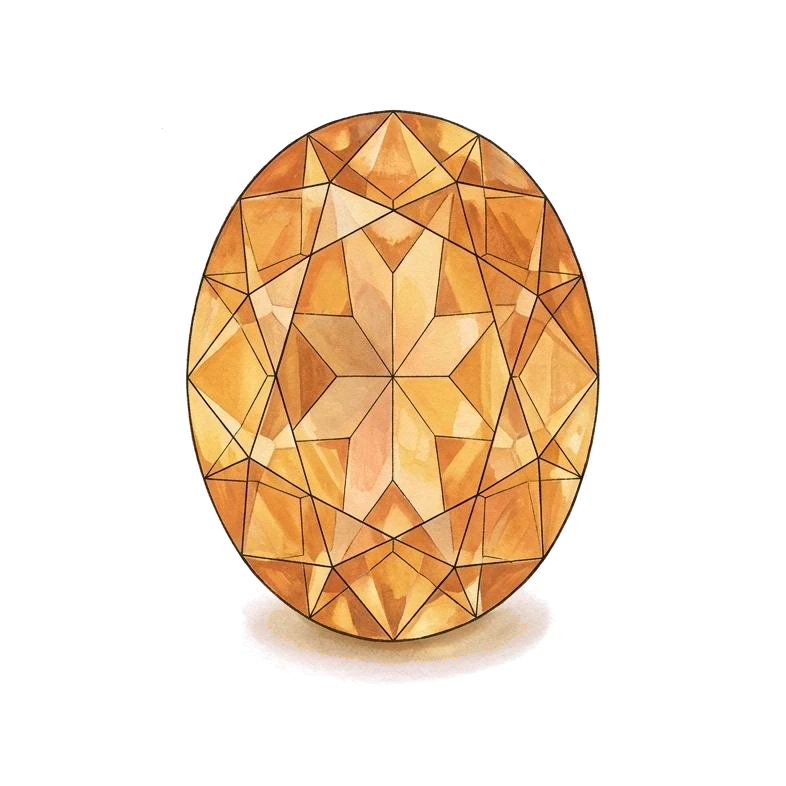
Topaz colors: what’s natural and what’s treated
Many people know topaz as an inexpensive blue gem, and that blue is hardly ever natural. The real topaz color range is far wider: brown, yellow, orange, red, pink, purple, green and blue, in many tones.
So what color is topaz in nature? Most often colorless.
Its colors come from traces of other elements and from flaws in the crystal, not from its own chemistry. Chromium gives the pinks, reds and violets, while defects at the atomic level give yellow, brown and blue.
-
Imperial
Medium reddish orange to orange-red, and one of the most expensive topaz colors. Many dealers call it imperial only if it shows a reddish tint from some angles.
#E2632B
-

Golden yellow
Yellow without the red overtones of imperial topaz. Far more abundant, so less valuable.
#EDB33F
-

Pink
Colored by chromium, and often called rose topaz. Some pink is heated yellowish pink topaz.
#E68AB4
-
Red
One of the most sought-after colors, under half of 1 percent of facet-grade topaz. Chromium causes it.
#B42F36
-

Natural light blue
Pale blue occurs in nature, as in Mason County, Texas. Strong natural blue is extremely rare.
#BCD9E6
-

Treated blue
Colorless topaz, irradiated and then heated. The color is permanent, and almost all strong blue topaz is made this way.
#5DADE2
-
Sherry
Yellowish brown or brownish yellow to orange, named after the wine. Sometimes sold as precious topaz.
#C98A34
-

Reddish purple
Chromium also causes violet and purple. GIA shows a reddish purple pear from Brazil’s Capão mine as the gem’s top color.
#9C3B78
-
Brown
A common color, caused by flaws in the crystal at the atomic level. Brown topaz is sometimes mistaken for smoky quartz.
#8B5E3C
-

Colorless
The most common topaz in nature, and plentiful. It is the starting point for treated blue topaz.
#EEF0EF
Each swatch is a typical shade rather than a measured one. Topaz is also pleochroic, so one stone can show different colors from different directions.
Natural topaz color
Untreated topaz runs from colorless through yellow, brown and orange to pink, violet, light blue and, very rarely, red. Brown is common, and so is golden yellow, which is worth much less than imperial topaz. Pale blue occurs naturally too, in Mason County, Texas, for one, but strong natural blue is extremely rare.
In the trade, yellowish brown to orange stones are called sherry topaz, after the wine, or precious topaz. The second name sets them apart from citrine and smoky quartz, which look similar and cost less.
Imperial topaz
Imperial topaz is a medium reddish orange to orange-red, one of the most expensive topaz colors. GIA’s November birthstone page casts the net wider, from orange to pinkish orange.
There’s no official definition. Many dealers insist on a reddish tint seen from some angles, often at the ends of pear and oval cuts, and GIA’s advice is that the color, not the word “imperial,” sets the value.
The only commercial deposits of imperial topaz so far are around Ouro Preto, Brazil. The name is usually traced to Russia, where the Urals were the main source in the 1800s and the finest stones were kept for the czar’s family. In Brazil, people often tie it instead to an 1881 visit by Emperor Pedro II to Ouro Preto, when he was given a reddish topaz.
Pink topaz
Natural pink topaz owes its color to chromium. Often called rose topaz, it costs far less than a pink diamond and often comes in bigger sizes than pink diamond or pink sapphire. The rarest topaz color of all is a vivid purplish pink.
Northwestern Pakistan is known for it. Ghundao Hill, near Katlang, has been mined since 1972, and its prized pink with a tinge of violet, which some call cyclamen pink, turns up only rarely.
Some pink topaz is heated. Heating can turn some yellow, orange and brown topaz pink or red, and it can strip the yellow out of yellowish pink stones to leave a purer pink. The change is stable, and it usually can’t be detected.
Blue topaz: almost always treated
Nature makes topaz colorless far more often than blue. Treaters irradiate colorless topaz and then heat it, and the vast majority of blue topaz on sale today is made this way, with a permanent color.
Electrons at 10 million electron volts, for instance, give a sky blue. Colorless topaz was first irradiated to blue in 1957, and the treated gem reached the market in the 1970s. GIA’s treatment guide goes further: it says strong blue doesn’t occur naturally in topaz at all, so a strong blue stone is taken to be irradiated.
National rules control the release of irradiated topaz, and the US standard is a small fraction of the background radiation everyone meets every day. Sky, Swiss and London blue, and what each name means, are on our blue topaz page.
Blue topaz is also where the birthstone lists part ways. GIA’s topaz guide and Jewelers of America give it to December, while the December guides of GIA and the American Gem Society name turquoise, tanzanite and zircon instead.
Mystic topaz and other coatings
Mystic topaz is colorless topaz with a thin artificial film on its surface that throws a rainbow of colors. The film is made of metal oxides. It was once described as “diffused” color, a misleading word, since in most cases the color stays on the surface.
The coating holds up to normal wear but can scratch, especially along facet edges, and abrasive cleaners or a jeweler’s buffing wheel take it off.
Treated topaz and what sellers must disclose
In the US, the FTC’s Jewelry Guides say a seller must disclose a gem treatment that isn’t permanent, that creates special care needs or that significantly affects the stone’s value. Online and catalog sellers should say so in the product description. GIA puts it more simply: anyone selling a treated gem, even one consumer to another, is legally required to disclose it.
GIA’s guide to gem treatments lists all three for topaz: irradiation and heat for blue, heat for pink and coatings for “mystic” stones. GIA doesn’t grade topaz, but its identification report says whether a stone is natural or lab-grown and names any treatment it can detect.
Topaz meaning and lore
Even the name points to the wrong stone. Most authorities trace it to Topazios, the old Greek name for a small island in the Red Sea, today’s Zabargad, though some scholars prefer a Sanskrit word for “fire.” The island never produced topaz: it was a source of peridot, which people confused with topaz until modern mineralogy.
Pliny told the island’s story. Quoting Juba, he wrote that it lay in fog, so sailors often had to search for it, and that its name came from a word for “to seek.” A royal officer brought its first stones to Queen Berenice, mother of the second Ptolemy, and she was delighted.
Pliny’s “topazos” was prized for its green tints, and Kunz took it to be the stone we call peridot.
Topaz’s own lore is about strength and calm. The ancient Greeks believed it gave them strength, and from the 1300s to the 1600s Europeans thought it could break magic spells and dispel anger. In India, many have long believed that topaz worn above the heart brings long life, beauty and intelligence.
Medieval magic went further. The “Book of Wings,” a treatise on engraved stones from about the 13th century, held that a falcon engraved on a topaz would win the goodwill of kings, princes and magnates. An old list of dream meanings Kunz printed reads a dream of topaz as a sign that no harm will come.
For centuries, the name covered more than one mineral. Traditionally any transparent yellow, brown or orange gem was called topaz, which is how citrine, a quartz, came to share topaz’s name and its lore.
Topaz in the Bible
The King James Version names topaz five times. It is the second stone of the high priest’s breastplate, in Exodus 28:17 and 39:10. Job 28:19 says of wisdom that “the topaz of Ethiopia shall not equal it,” Ezekiel 28:13 lists it among the stones that covered the king of Tyre in Eden, and Revelation 21:20 makes it the ninth foundation of the New Jerusalem.
What those writers meant by topaz is another matter. Kunz had little doubt that the breastplate’s Hebrew piṭdah was the ancients’ topaz, which usually meant our peridot. Yet he noted the word may come from the Sanskrit for “yellow,” perhaps meaning our topaz. Elsewhere he judged that topaz itself probably wasn’t known in Egypt before 500 or 600 BC.
Andreas of Caesarea, a bishop who probably wrote in the 10th century, read Revelation’s ninth stone as a symbol of St. Matthew. He called that topaz “of a ruddy color” and linked it with the apostle’s fiery zeal.
Is topaz good for everyday wear?
| Hardness | 8 on the Mohs scale |
|---|---|
| Everyday ring? | Everyday, with care Fine in a ring if you take it off for chores and sports. Safest in earrings and pendants. |
| Family | Topaz |
| Main sources | Brazil, Pakistan, Nigeria, Namibia, Madagascar, Sri Lanka |
| Treatments | Most blue topaz is colorless topaz, irradiated and heated. The color is permanent. Heating can turn some yellowish pink topaz a purer pink. “Mystic” topaz has a thin coating that abrasive cleaners remove. |
| Lab-grown | Topaz has been grown in labs, but lab-grown topaz isn’t usually sold. |
| Anniversary | 4th (blue topaz) and 23rd (imperial topaz) wedding anniversary |
Topaz is hard, at 8 on the Mohs scale, but it isn’t tough. It splits easily in one direction, along its cleavage, so a hard blow can crack it, and so can extreme pressure or a sudden change in temperature.
To lower the risk, cutters set the cleavage at about a 15-degree angle to the table, the large top facet. Jewelers prefer protective settings for valuable topaz, or pieces that see little wear, like pendants and pins.
Where topaz is found
Brazil’s Minas Gerais state has been mined for topaz for more than two centuries, and it gives yellow, orange, red, pink, violet and blends of red with orange or purple. Pakistan is known for pink. Other major sources include Namibia, Nigeria, Madagascar, Mexico, Myanmar, Sri Lanka, the United States and the old mines of Russia.
Topaz grows huge. Its biggest crystals are weighed in kilos, not carats, and one transparent crystal from Minas Gerais weighs 596 pounds. Pale crystals like these were once too dull to cut, but today they are the raw material for treated blue topaz.
Topaz state gems: Utah and Texas
Topaz is Utah’s state gem. It is found in Beaver, Juab and Tooele Counties, and the Thomas Range in western Utah gives a rich sherry-amber topaz that turns rose-pink or clear in sunlight.
Texas chose Texas Blue Topaz as its state gem in 1969, and in 1977 it adopted the Lone Star Cut as its official gemstone cut. The stones come from Mason County, where some topaz is naturally blue, and the cut shows a five-pointed star through the top of the stone.
Famous topaz gems
Because topaz grows so large, many of its famous stones are giants, and museums like to show them. Others, like the red Whitney Flame, are prized for their color.
-
The American Golden topaz
Cut in the late 1980s
A 22,892.5-carat gem with 172 facets, cut by Leon Agee over two years from a stream-rounded cobble from Minas Gerais, Brazil. The Smithsonian counts it among the world’s largest gemstones.
-
The Whitney Flame Topaz
Acquired in 2018
A 48.86-carat red imperial topaz from Ouro Preto, Brazil, colored by traces of chromium. The Smithsonian calls it one of the finest imperial topazes in the world.
-
The Blaze imperial topaz
A 97.45-carat imperial topaz at the Field Museum in Chicago, the largest owned by any museum. It is set in a rose-gold necklace ringed with diamond-studded gold flames.
-
The Ostro Stone
On show since 2016
A 9,381-carat blue topaz, about two kilograms, cut from rough found in Minas Gerais, Brazil. Its blue comes from treating the rough, and it is on permanent loan to the Natural History Museum in London.
-
The Texas governor’s crystal
A 925-carat crystal from Mason County, found in 1904, sat on the governor’s desk in 1969 when Texas made blue topaz its state gem. It is now at the University of Texas at Austin.
-
Agricola’s inscribed topaz
A topaz owned by a Neapolitan, Hadrianus Gulielmus, and engraved in ancient Roman letters. Its Latin says that nature fails, fortune changes and God sees all.
Topaz names to watch for
Old habits linger in the trade. Citrine was called “topaz quartz” by the miners who first found it, and brown quartz is still sometimes called “smoky topaz.” The FTC’s guides name topaz outright: calling something “topaz” without a qualifier is deceptive unless it is mined topaz.
Other names borrow “topaz” for yellow sapphire, or use other gems’ names for topaz itself.
| Sold as | What it is |
|---|---|
| Gold topaz | Citrine (quartz) |
| Madeira topaz | Citrine (quartz) |
| Spanish topaz | Citrine (quartz) |
| Topaz quartz | Citrine (an old name, given by its first miners) |
| Smoky topaz | Smoky quartz |
| Oriental topaz | Yellow sapphire |
| King’s topaz | Yellow sapphire |
| Palmyra topaz | Brown synthetic sapphire |
| Brazilian ruby | Red or pink topaz |
| Brazilian aquamarine | Blue-green topaz |
| Saxon diamond | Colorless topaz |
How to buy topaz
Color matters most, and each color is judged on its own terms. Then check clarity, cut and size:
- Clarity: faceted blue topaz is almost always clean to the eye. Rarer colors, such as imperial and pink, show inclusions more often and can still be valuable.
- Cut: topaz crystals are long, so they are often cut as long ovals or pears, and strongly colored rough often goes into an emerald cut to keep its color and weight.
- Size: blue topaz costs little more per carat as it gets bigger. Imperial topaz rises steeply per carat with size.
- Treatment: ask whether a pink, blue or rainbow-colored stone has been treated. A treatment that significantly affects its value has to be disclosed.
| Type | What to know |
|---|---|
| Natural | Mined. Most blue topaz is colorless topaz, irradiated and heated. The color is permanent. Heating can turn some yellowish pink topaz a purer pink. “Mystic” topaz has a thin coating that abrasive cleaners remove. |
| Lab-grown | Topaz has been grown in labs, but lab-grown topaz isn’t usually sold. |
| Imitation | Citrine and smoky quartz, which look similar and are often passed off as topaz. |
| Type | Price |
|---|---|
| Sky blue, 1–5 carats | $5–$10 |
| London blue, 1–5 carats | $7–$30 |
| Imperial, 1 carat and up | $500–$1,500 |
Prices vary with size, color, clarity and seller. They’re a guide to what shops ask, not a valuation or an investment view.
How to clean topaz
Cleaning topaz
- Warm soapy water, soft brush
- Safe
- Ultrasonic cleaner
- Never
- Steam cleaner
- Never
High heat or sudden temperature changes can crack it, and long sunlight can fade some yellow to brown stones.
Warm, soapy water is the safe way to clean topaz. Skip steam and ultrasonic cleaners, since heat and an ultrasonic’s shaking can both split it along its cleavage. Keep it out of long sun and heat too, which can fade some yellow, brown and reddish brown stones.
Mystic topaz needs gentler care: only a mild soap solution, never abrasive cleaners or a buffing wheel. When it’s not being worn, wrap a coated stone in something soft and keep it dry.