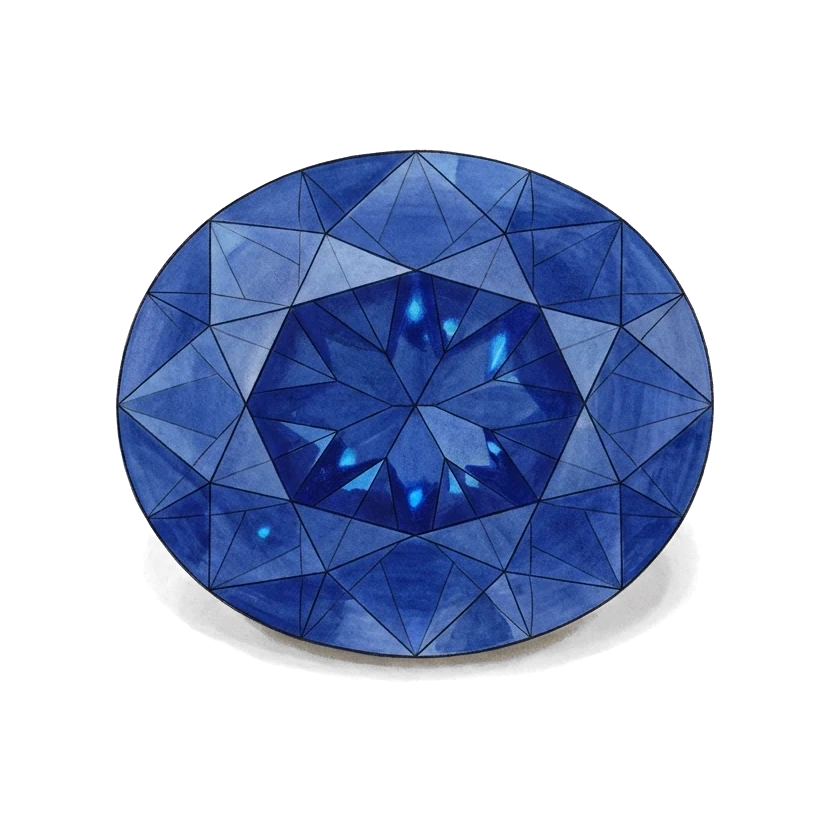
What does the September birthstone mean?
Sapphire’s name comes from the Greek sappheiros. The sapphire birthstone traditionally stands for sincerity, truth, faithfulness and nobility, and the stone has long been linked with royalty and romance.
Ancient Greek and Roman elites believed blue sapphires protected them from harm and envy, medieval clerics wore them as a symbol of Heaven, and ancient Persians believed the earth rested on a giant sapphire that colored the sky.
Sapphire in the Bible, the star sapphire’s lore and famous stones from the Star of India to Princess Diana’s engagement ring are in our guide to sapphire meaning and symbolism.
September birthstone color: sapphire blue and beyond
The classic September color is blue, and a few old sources set the standard for it:
- Kashmir: blues found after a Himalayan landslide around 1881, mined only sporadically since.
- Myanmar (Burma): rich, intense blues from the Mogok valley.
- Sri Lanka: mined for more than 2,000 years. Milky “geuda” sapphires from there can be heated to a rich blue.
Madagascar, Australia, Thailand and Montana in the US produce plenty of sapphires too.
-
 Blue
-
 Pink
-
 Yellow
-
 Pinkish orange (padparadscha)
Is sapphire good for everyday wear?
| Hardness | 9 on the Mohs scale |
|---|---|
| Everyday ring? | Great for everyday Hard and tough enough for a ring worn every day. |
| Family | Corundum |
| Main sources | Sri Lanka, Madagascar, Myanmar, Australia, Thailand, United States (Montana) |
| Treatments | Heating is common and permanent. Less often, stones are diffusion-treated, fracture-filled or dyed. |
| Lab-grown | Yes. Lab-grown sapphire is made to order with consistent color, so it’s far less rare than natural sapphire of the same clarity. |
| Anniversary | 5th and 45th wedding anniversary |
Sapphire rates 9 on the Mohs scale, is very tough and has no cleavage, so it holds up in a ring you wear every day.
How to buy a sapphire: treatments, lab-grown and prices
Heat treatment is common, permanent and widely accepted. Other treatments are rarer and less stable. Lattice diffusion can leave color so shallow that it’s lost if the stone is chipped or recut, and fracture fillings and dyes can be damaged by mild acids like lemon juice. Before you buy, ask whether the stone is treated and how.
| Type | What to know |
|---|---|
| Natural | Mined. Heating is common and permanent. Less often, stones are diffusion-treated, fracture-filled or dyed. |
| Lab-grown | Real sapphire, made in a lab. Lab-grown sapphire is made to order with consistent color, so it’s far less rare than natural sapphire of the same clarity. |
| Type | Price |
|---|---|
| Blue, from 1 carat | $300–$3,000 |
| Blue, from 2 carats | $600–$6,000 |
| Pink, 1 carat and up | $400–$2,000 |
| Untreated, 1 carat and up | $1,000–$25,000 |
Prices vary with size, color, clarity and seller. They’re a guide to what shops ask, not a valuation or an investment view.
How to clean and care for sapphire
Cleaning sapphire
- Warm soapy water, soft brush
- Safe
- Ultrasonic cleaner
- Usually safe
- Steam cleaner
- Usually safe
Soapy water and machines suit untreated, heated or diffusion-treated stones. Fracture-filled or dyed sapphires need a damp cloth only.
Warm soapy water is always safe for sapphire. Ultrasonic and steam cleaners are usually fine for untreated, heated and diffusion-treated stones, while fracture-filled or dyed ones should only be wiped with a damp cloth.
September birthstone gift ideas
-
A sapphire ring
Tough enough for daily wear, so a blue sapphire ring can be worn for a lifetime.
-
A pink or yellow sapphire
Still a September birthstone, and often less expensive than a fine blue.
-
Sapphire stud earrings
Small blue studs are a classic that suits every age.
-
A 5th- or 45th-anniversary gift
Sapphire is the traditional gem for both anniversaries.
Sapphire colors for parties and design
Every sapphire counts as a birthstone for September, so the palette mixes sapphire blue with pink, yellow and peach. Here are the shades as hex and RGB values.
- Blue Sapphire #2350A8 rgb(35, 80, 168)
- Pink Sapphire #E06F9F rgb(224, 111, 159)
- Yellow Sapphire #F2C14E rgb(242, 193, 78)
- Pinkish orange (padparadscha) Sapphire #F49A7A rgb(244, 154, 122)
Every month’s stones in one palette, with a free download: birthstone colors by month.