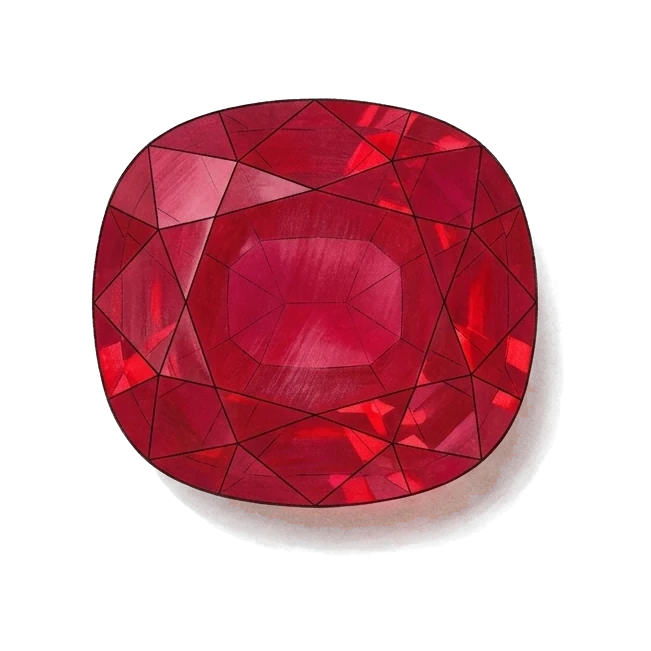
What does the July birthstone mean?
Ruby takes its name from the Latin ruber, “red.” In ancient India it was the king of precious stones, a symbol of power and youthful energy.
Medieval Europeans believed rubies brought wisdom, wealth and success in love. The older lore, from Burmese soldiers who set rubies under their skin to a stone said to darken before disaster, is in our guide to ruby meaning and history.
The ruby birthstone wasn’t always July’s. Kunz’s older “Sentiments of the months” list gave July turquoise and December ruby, and the 1912 US list swapped them.
July birthstone color: shades of ruby red
Ruby’s color comes from chromium, and the finest is a deep red with a hint of purple, known in the trade as pigeon’s blood. The best-known sources:
- Myanmar (Burma): the Mogok valley has produced fine rubies for more than five centuries.
- Mozambique: the Montepuez mines are a newer, prolific source whose rubies have been compared with Mogok’s.
- Vietnam: Luc Yen rubies range from red to purplish red.
-
 Red
-
 Pinkish red
-
 Purplish red
Is ruby good for everyday wear?
| Hardness | 9 on the Mohs scale |
|---|---|
| Everyday ring? | Great for everyday Hard and tough enough for a ring worn every day. |
| Family | Corundum |
| Main sources | Myanmar, Mozambique, Vietnam, Thailand, Sri Lanka, Tanzania |
| Treatments | Heating is common and stable. Lower grades may be glass-filled, which costs far less and needs gentler care. US law requires sellers to disclose treatments that affect value. |
| Lab-grown | Yes. Made in labs since 1902, when Auguste Verneuil announced his flame-fusion process. |
| Anniversary | 15th and 40th wedding anniversary |
Ruby’s hardness is second only to diamond, so it suits a ring worn every day. Treatments change that: glass-filled rubies are more fragile and need far gentler handling.
How to buy a ruby: treatments, lab-grown and prices
Heat treatment is common and accepted by the trade as stable. Rubies may also be diffusion-treated or dyed, and in lower grades glass is used to fill fractures and cavities. In the US, sellers must disclose treatments that affect a gem’s value, so always ask how a ruby was treated.
| Type | What to know |
|---|---|
| Natural | Mined. Heating is common and stable. Lower grades may be glass-filled, which costs far less and needs gentler care. US law requires sellers to disclose treatments that affect value. |
| Lab-grown | Real ruby, made in a lab. Made in labs since 1902, when Auguste Verneuil announced his flame-fusion process. |
| Type | Price |
|---|---|
| Fracture-filled, 1 carat and up | $15–$80 |
| Heated, 1 carat and up | $250–$10,000 |
| Untreated, 1 carat and up | $2,000–$20,000 |
Prices vary with size, color, clarity and seller. They’re a guide to what shops ask, not a valuation or an investment view.
The table shows why treatment matters more than almost anything: a fracture-filled ruby and an untreated one of the same size can differ in price many times over.
How to clean and care for ruby
Cleaning ruby
- Warm soapy water, soft brush
- Usually safe
- Ultrasonic cleaner
- Usually safe
- Steam cleaner
- Usually safe
Soapy water and machines suit untreated, heated or diffusion-treated stones. Glass-filled or dyed rubies need a damp cloth only.
Warm soapy water and a soft brush are safe for almost any ruby. Ultrasonic and steam cleaners are usually fine for untreated, heated and diffusion-treated stones, but glass-filled or dyed rubies should only be wiped with a damp cloth.
July birthstone gift ideas
-
A ruby ring
Hard enough for daily wear, so a small untreated or heated ruby makes a ring for life.
-
Ruby stud earrings
Small heated rubies give a strong red at a gentler price.
-
A lab-grown ruby
The same red corundum for a fraction of the price, if you want a big stone.
-
A 15th- or 40th-anniversary gift
Ruby is the traditional gem for both anniversaries.
Ruby colors for parties and design
Ruby red works for July birthdays and Fourth of July parties alike. Here are the shades as hex and RGB values.
- Red Ruby #C0143C rgb(192, 20, 60)
- Pinkish red Ruby #D63E66 rgb(214, 62, 102)
- Purplish red Ruby #9E1645 rgb(158, 22, 69)
Every month’s stones in one palette, with a free download: birthstone colors by month.