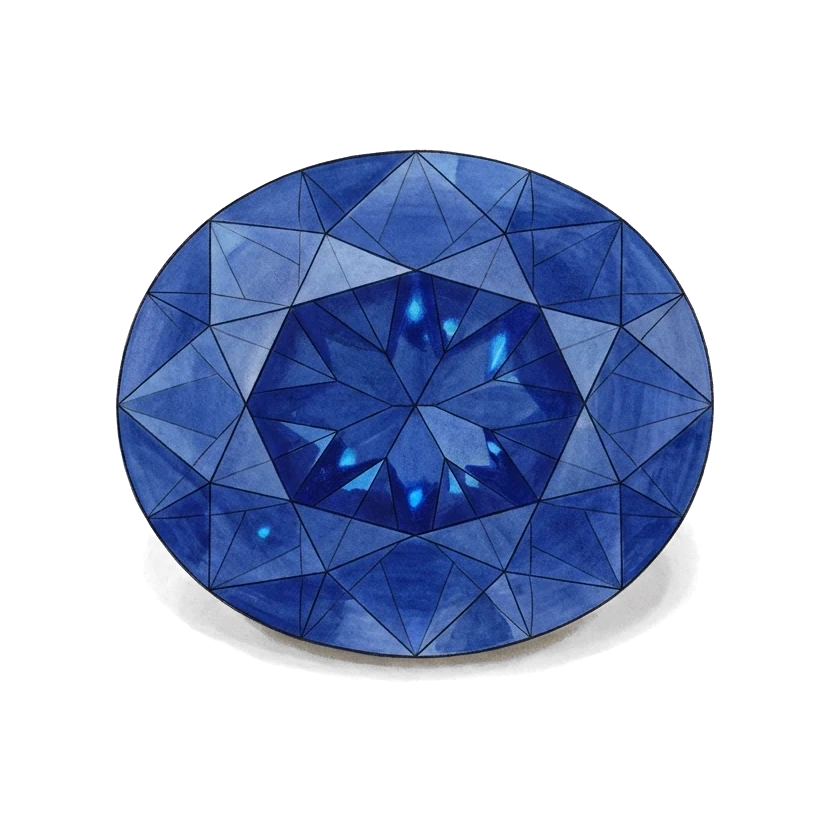
What does sapphire mean?
Tradition gives sapphire four meanings: nobility, truth, sincerity and faithfulness. Kings and clergy have worn it on their robes for centuries, and its blue is still the yardstick for every other blue gem, from topaz to tanzanite.
The name comes from the Greek sappheiros, which probably meant lapis lazuli rather than the stone we call sapphire today. Much of its early lore may have been written about lapis too, but later readers took it all as sapphire’s.
In sapphire symbolism, power and the sacred go together. Sapphire was believed to:
- Guard its owner. The ancient writer Damigeron says kings wore it around the neck as a defense against harm, and that it kept off envy and drew divine favor.
- Banish fraud. Around 1100, Marbodus, Bishop of Rennes, called it the gem of gems, a title other writers gave ruby, and a stone so like the pure sky that it might be called sacred.
- Open the oracles. The same bishop wrote that necromancers prized it above every other stone, since it let them understand the most obscure oracles.
- Keep the peace. Other times and places credited it with guarding chastity and making peace between enemies.
Medieval clergy wore blue sapphires as a symbol of Heaven, and in Marbodus’s day sapphire was coming to be seen as the right stone for a churchman’s ring.
Blue sapphire meaning: the color of the sky
Nearly every blue sapphire meaning starts with the sky. In Sanskrit the stone is nîla, “blue,” and Hindu tradition held that wearing one made the planet Saturn favorable. It also sorted sapphires into four shades, one for each caste, and said only your own caste’s stone would do you good.
Kunz called sapphire the gem of autumn, “the blue of the autumn sky,” and a symbol of truth, sincerity and constancy. Next to its sister gem, the ruby, he saw in it “calm and tried affection, not ardent passion.”
Sapphire in the Bible
The Bible’s sapphires belong to heaven. In Exodus 24:10, Moses and seventy elders of Israel see under God’s feet “as it were a paved work of a sapphire stone,” and in Ezekiel’s vision (1:26) the throne above the firmament has “the appearance of a sapphire stone.” A tradition held that the Law given to Moses was carved on tablets of sapphire.
Sapphire is also the fifth stone of the high priest’s breastplate (in the King James Version, the middle stone of the second row, Exodus 28:18), and the second foundation stone of the New Jerusalem in Revelation 21:19. In the 800s, Archbishop Rabanus Maurus of Mainz read that foundation stone as “the height of celestial hope.”
The Hebrew word is sappir, and Kunz was sure it couldn’t have meant our sapphire. Theophrastus and Pliny describe their sapphirus as a stone with golden spots, which fits lapis lazuli flecked with pyrite, a stone Egypt prized. And true sapphire isn’t found in pieces big enough for stone tablets.
Sapphire colors: blue and every other shade
Corundum is made of only aluminum and oxygen, and in its purest form it’s colorless. Traces of other elements give it color.
Iron and titanium make blue sapphire, and only a few hundredths of a percent are enough. The more iron, the darker the blue.
Add chromium instead and you get pink sapphire or, deeper still, ruby. Red is the one color a sapphire can’t be: red corundum is ruby, and every other color is sapphire. Jewelers call those other colors fancy sapphires, and they became widely known after finds in East Africa and Madagascar in the 1990s.
-

Blue sapphire
The classic. The most valued blues are velvety blue to violetish blue, neither too light nor too dark.
#1F4E9C
-

Pink sapphire
Chromium, the element that makes ruby red, turns it pink.
#E0679A
-

Padparadscha
Light to medium pinkish orange, named after the lotus flower. Extremely rare.
#F2967A
-

Yellow sapphire
Light to dark, from greenish yellow to orangy yellow. The finest is a vivid yellow.
#F2C232
-

Orange sapphire
The finest is a strong, pure orange to red-orange.
#E8781F
-

Purple sapphire
Reddish purple to violetish purple, with purple always the main color.
#6E3A8C
-

Green sapphire
A mix of yellow and blue sapphire color. Evenly saturated greens are rare.
#4F7F5A
-

White sapphire
Colorless corundum. Once a diamond imitation, now often set as accent stones.
#E6EAEE
-


Color-change sapphire
Blue to violet in daylight, purple under a lamp. The stronger the change, the higher the value.
Daylight #3D5BA9
Lamplight #7B3F86
-

Star sapphire
Needles of rutile reflect light in a six-rayed star across a cabochon.
#5A7BB0
Color decides a sapphire’s value more than anything else, and the more intense and even it is, the better. In the trade, “sapphire” on its own still means blue.
Padparadscha sapphire, the lotus color
Padparadscha is a pinkish orange to orange-pink, light to medium in tone. People describe it as salmon or sunset, and the name refers to the color of a lotus blossom.
At first, only stones from Sri Lanka were sold under the name, and Sri Lankans still hold the color dear. It’s extremely rare, and usually worth much more than many other fancy colors.
Star sapphire
A star sapphire shows a star of light that glides across its surface as the stone moves. Tiny needles of rutile, which gemologists call silk, reflect the light in lines that cross at the top of the stone.
Most stars have six rays. Twelve-rayed stars are rare, and need a second set of needles, of hematite.
The star only shows in a domed cabochon, never a faceted stone, and it can appear in any color of corundum. A red one is called a star ruby. Black star sapphires are really yellow, green or blue: hematite needles make them look black.
Color-change sapphire
Some sapphires change color with the light, most often from blue in daylight to purple under a lamp. A few rare ones turn from green to reddish brown. The stronger the change, the more the stone is worth.
One of them inspired a story. A sapphire that looked blue by day and violet by candlelight, owned in the 18th century by a Polish count, became the “Saphire Merveilleux” of a tale by Madame de Genlis.
In it the stone tests a woman’s fidelity, and whether she passes depends on when the test begins. The real stone passed through the Duke of Orléans’s collection and was later shown at London’s South Kensington Museum.
Is sapphire good for everyday wear?
| Hardness | 9 on the Mohs scale |
|---|---|
| Everyday ring? | Great for everyday Hard and tough enough for a ring worn every day. |
| Family | Corundum |
| Main sources | Sri Lanka, Madagascar, Myanmar, Australia, Thailand, United States (Montana) |
| Treatments | Heating is common and permanent. Less often, stones are diffusion-treated, fracture-filled or dyed. |
| Lab-grown | Yes. Lab-grown sapphire is made to order with consistent color, so it’s far less rare than natural sapphire of the same clarity. |
| Anniversary | 5th and 45th wedding anniversary |
Sapphire is so durable that lab-grown sapphire makes the windows of supermarket scanners and spacecraft. Its hardness, its excellent toughness and its lack of cleavage make it a safe choice for a ring worn every day.
The exceptions come from treatments and cuts. Color added by lattice diffusion can sit so close to the surface that a chip or a recut removes it. Black star sapphires tend to break along parallel planes, so cutters keep them very flat.
Where sapphires are found
Kashmir, Myanmar and Sri Lanka are the three classic sources.
- Kashmir: around 1881 a landslide high in the Himalayas exposed a pocket of velvety “cornflower” blue crystals. The Maharaja of Kashmir and his army took control of the find, and thousands of fine crystals came out between 1882 and 1887. Output has been sporadic since, but those stones still set the standard for blue.
- Myanmar: in the Mogok valley, sapphire turns up beside ruby, though in much smaller amounts. Burmese sapphire is prized for its rich, intense blue.
- Sri Lanka: mined for more than 2,000 years from river gravels, and the home of padparadscha.
Madagascar is a newer major source, and its best blues rival the classic ones. Sapphires also come from Tanzania, Australia, Thailand, Cambodia and Montana, and Thailand’s Chanthaburi cuts and treats many of the stones from Myanmar and Cambodia.
Famous sapphires
Two of the biggest, the Star of India and the Logan Sapphire, came from Sri Lanka and now sit in American museums. Kunz wrote about the Star of India in 1913, when it had found a home in New York’s American Museum of Natural History after a hazy history of some three centuries.
-
The Star of India
Just over 563 carats, from Sri Lanka. The museum calls it the world’s largest gem-quality blue star sapphire, and its star shows on both sides.
-
The Logan Sapphire
Given in 1960
A 423-carat blue sapphire from Sri Lanka, set in a brooch with twenty diamonds: the heaviest mounted gem in the Smithsonian’s National Gem Collection.
-
The Star of Asia
A 330-carat star sapphire, also at the Smithsonian’s National Museum of Natural History.
-
The Rockefeller Sapphire
Bought in 1934
A 62.02-carat step-cut stone from Myanmar that John D. Rockefeller Jr. bought from an Indian maharaja.
-
The Stuart Sapphire
A large oval sapphire of about 104 carats at the back of the Imperial State Crown. James II is said to have smuggled it abroad when he fled England in 1688.
-
St. Edward’s Sapphire
At the center of the Imperial State Crown’s top cross. Tradition says Edward the Confessor wore it in a ring and it was found in his tomb in 1163.
-
The royal engagement ring
A 12-carat blue sapphire ringed with diamonds, given to Lady Diana Spencer and later, by her son, to Catherine Middleton.
Sapphire names to watch for
Blue stones have often borrowed sapphire’s name. The reverse happens too: yellow and violet sapphires have gone by “Oriental” topaz and amethyst.
| Sold as | What it is |
|---|---|
| Brazilian sapphire | Blue tourmaline |
| Ural sapphire | Blue tourmaline |
| Water sapphire | Iolite (cordierite) |
| Oriental topaz or King’s topaz | Yellow sapphire |
| Oriental amethyst | Violet sapphire |
| Blue alexandrite | Color-change sapphire |
How to buy a sapphire
Color comes first. The most valued blue sapphires are velvety blue to violetish blue, in a medium to medium-dark tone with strong to vivid saturation. Grayish, too light or too dark blues are worth less.
- Clarity: most blue sapphires have some inclusions, but fewer than rubies. Inclusions usually lower the value, with one famous exception: tiny inclusions give the finest Kashmir stones their velvety look.
- Cut: sapphire looks different from different directions, often greenish blue one way and violetish blue the other. A good cutter turns the violetish blue face up.
- Stars: look for a sharp, straight star centered on the top of the stone, with rays that reach the edges and glide smoothly as you rock it.
- Origin names: “Kashmir” or “Burmese” usually describe the finest stones from that source, but no source yields stones of one color and quality only.
Most commercial blue sapphires weigh under five carats. Big sapphires are easier to find than big rubies, though size raises the price of fine stones more than commercial ones. Heat treatment is routine and permanent, so ask whether a stone is treated, and how.
Lab-grown sapphire is nothing new: some of the earliest pieces are set in Art Nouveau and Art Deco jewelry. Color-change lab sapphire has imitated alexandrite since the early 1900s.
| Type | What to know |
|---|---|
| Natural | Mined. Heating is common and permanent. Less often, stones are diffusion-treated, fracture-filled or dyed. |
| Lab-grown | Real sapphire, made in a lab. Lab-grown sapphire is made to order with consistent color, so it’s far less rare than natural sapphire of the same clarity. |
| Type | Price |
|---|---|
| Blue, from 1 carat | $300–$3,000 |
| Blue, from 2 carats | $600–$6,000 |
| Pink, 1 carat and up | $400–$2,000 |
| Untreated, 1 carat and up | $1,000–$25,000 |
Prices vary with size, color, clarity and seller. They’re a guide to what shops ask, not a valuation or an investment view.
How to clean sapphire
Cleaning sapphire
- Warm soapy water, soft brush
- Safe
- Ultrasonic cleaner
- Usually safe
- Steam cleaner
- Usually safe
Soapy water and machines suit untreated, heated or diffusion-treated stones. Fracture-filled or dyed sapphires need a damp cloth only.
Warm, soapy water is always safe for sapphire. Keep acids away from fracture-filled or dyed stones: even mild ones, like lemon juice, can damage them.