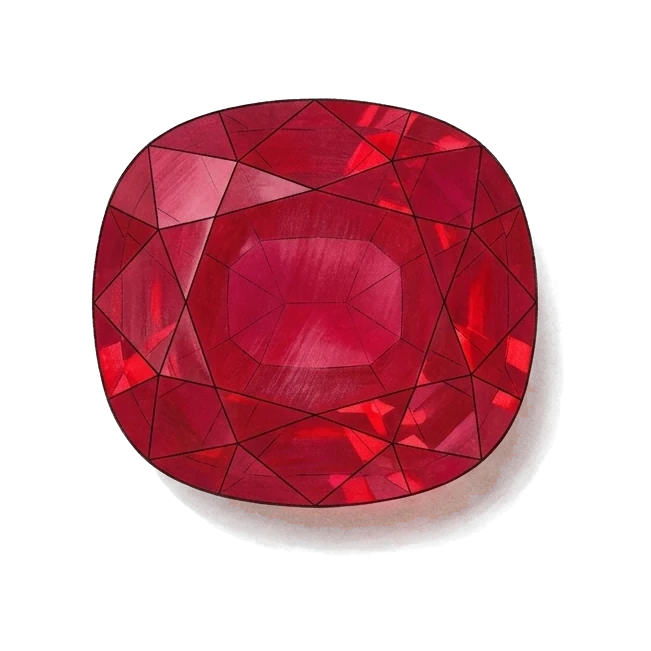
What does ruby mean?
The name comes from the Latin ruber, “red,” and the color explains most of ruby symbolism. To early cultures its red was the red of blood, and rubies were believed to hold the power of life.
India prized it above every other gem. Sanskrit calls it ratnaraj, “king of precious stones,” and ratnanâyaka, “leader of precious stones,” and one shade has its own name, padmarâga, “red as the lotus.” Ancient Hindus believed that whoever offered fine rubies to the god Krishna would be reborn as an emperor.
Ruby was believed to:
- Keep its owner safe. Hindu tradition sorted rubies into four castes. Owning the highest, a Brahmin ruby, meant you could live among enemies without fear, as long as the stone was kept away from lesser rubies that would weaken it.
- Make a warrior invincible. In Burma, wearing a ruby wasn’t enough: soldiers set the stone into their own flesh, believing no spear, sword or gun could then wound them.
- Burn with a fire of its own. Its glow was said to shine through clothing, and a ruby dropped in water was believed to make it boil.
- Guard house and harvest. A 14th-century treatise attributed to Sir John Mandeville promised its owner peace with all men and vineyards safe from storms, best of all if the ruby was worn on the left side.
Medieval Europe gave it the same rank. A French lapidary called it “the lord of stones” and “the gem of gems,” and a verse lapidary named it the most precious of the twelve stones God made at the Creation.
Dark rubies and star rubies were thought of as “male” stones, lighter ones as “female.” Today the ruby stone meaning comes down to passion, power and success in love, and as a symbol of passion it remains the classic romantic gift.
Ruby in the Bible
In the King James Version, rubies are nearly always a measure of worth. Wisdom “is better than rubies,” and the virtuous woman’s “price is far above rubies.” In Job, “the price of wisdom is above rubies,” in the same verse that names coral and pearls.
Translators can’t be sure which stone the Hebrew meant. Kunz thought “garnet” might be a better reading of Job’s gem.
The high priest’s breastplate raises the same doubt. Its fourth stone, which the KJV calls “emerald” and the Latin Vulgate “carbunculus,” may have been a ruby by the time the historian Josephus saw it, but in Kunz’s view not in the original, since there’s no proof ruby was known in ancient Egypt. The breastplate’s story is told with garnet in the Bible.
Ruby color: from orangy red to purplish red
Pure corundum is colorless. Traces of chromium turn it red, from orangy red to purplish red, and the more chromium, the stronger the red.
Chromium also makes ruby fluoresce, so the finest stones glow red even in sunlight. That glow is how the first laser, built in 1960, made its light.
Where a ruby grows changes how it looks. The most famous rubies, from Myanmar, the Himalayas and northern Vietnam, form in marble, which holds little iron, so many have an intense red and a strong glow. Rubies from basalt can carry more iron, which makes them darker and masks the fluorescence.
-
Pigeon’s blood
The trade’s historic name for red to slightly purplish or pinkish red with a soft red glow. A traditional description, and easily misread.
#A50F2D
-
Marble-hosted ruby
Found in marble in Myanmar, Vietnam and the Himalayas. Little iron, so many glow red even in sunlight.
#C8102E
-
Basalt-hosted ruby
Found in basalt. Its higher iron can make it darker and mask the red glow.
#7E1A2C
-
Luc Yen, Vietnam
Red to purplish red, mined in northern Vietnam since the late 20th century.
#B0144F
-
Montepuez, Mozambique
Found in 2009. Within a decade, Mozambique was the most productive source of gem ruby.
#B5132F
-
Star ruby
Crossing needles of rutile show a six-rayed star when the stone is cut as a cabochon.
#9E2A48
-
Trapiche ruby
Six ruby sectors split by yellow or white arms: a fixed star built into the crystal.
#8E1F33
Pigeon blood ruby
The finest color is a pure, vibrant red to slightly purplish red, neither so dark that it loses brightness nor so light that it looks pink. The trade calls the best “pigeon’s blood,” a term that historically meant red to slightly purplish or pinkish red with a soft red glow. GIA warns that such names are easily misread: no source yields only one quality, and new mines can match the classic ones.
Ruby or pink sapphire?
Ruby and sapphire are the same mineral, so where a light ruby ends and a pink sapphire begins is a judgment call. “Ruby” once covered every shade of red, pink included, and in Sri Lanka pink stones were always called ruby. GIA’s lab calls corundum ruby only when red is its dominant hue, judged against graded comparison stones called masterstones.
Pink sapphires cost far less than rubies, and GIA’s advice is that the best color is the one you like most.
Star ruby and trapiche ruby
Fine needles of the mineral rutile, called silk, are common in ruby. Where they cross, a stone cut as a dome-shaped cabochon shows a six-rayed star: that’s a star ruby.
Trapiche ruby, described from Southeast Asia, works differently. Its six ruby sectors are divided by yellow or white arms, so its star is fixed in the crystal itself.
Is ruby good for everyday wear?
| Hardness | 9 on the Mohs scale |
|---|---|
| Everyday ring? | Great for everyday Hard and tough enough for a ring worn every day. |
| Family | Corundum |
| Main sources | Myanmar, Mozambique, Vietnam, Thailand, Sri Lanka, Tanzania |
| Treatments | Heating is common and stable. Lower grades may be glass-filled, which costs far less and needs gentler care. US law requires sellers to disclose treatments that affect value. |
| Lab-grown | Yes. Made in labs since 1902, when Auguste Verneuil announced his flame-fusion process. |
| Anniversary | 15th and 40th wedding anniversary |
At 9 on the Mohs scale, ruby is second only to diamond in hardness. GIA calls it relatively hard and tough, a great choice for jewelry worn every day, and heat treatment holds up to normal wear and care. Big fractures that reach the surface are the weak point, and they can threaten a stone’s durability.
Glass-filled rubies need much more care. The gem labs warn that the glass may not survive high heat or chemicals, and recommend taking such a stone out of its setting before any jewelry repair.
Where rubies are found
Burma, now Myanmar, has been a ruby source since at least AD 600. Its Mogok valley has produced fine rubies for more than five centuries. In 1913, Kunz placed pigeon’s-blood rubies in Burma, pomegranate-red ones in Ceylon (now Sri Lanka) and garnet-hued ones in Siam (now Thailand).
The map has changed since. The Thailand–Cambodia border was the main source for much of the late 1900s, and Vietnam’s Luc Yen and Quy Chau regions have yielded fine rubies since the late 20th century.
Rubies were found near Montepuez, Mozambique, in April 2009, and within a decade Mozambique became the world’s most productive source of gem ruby. Afghanistan, Tajikistan, Pakistan, Sri Lanka, Kenya, Tanzania and Madagascar produce rubies too.
Famous rubies
Some of history’s most famous “rubies” aren’t rubies at all. The Black Prince’s Ruby in Britain’s Imperial State Crown is red spinel, and the two weren’t clearly told apart until the 18th century. The real thing keeps breaking auction records: in 2015 a ruby set the highest price per carat ever paid at auction for a colored gem.
-
The Estrela de Fura
Sold in 2023
A 55.22-carat ruby from Mozambique, cut from a 101-carat crystal. At $34.8 million it became the largest and most expensive ruby sold at auction.
-
The Sunrise Ruby
Sold in 2015
A 25.59-carat unheated Burmese ruby of pigeon’s blood red, set in a Cartier ring and sold at Sotheby’s.
-
The Carmen Lúcia Ruby
Mined at Mogok in the 1930s, this 23.10-carat stone is the largest faceted ruby in the Smithsonian’s National Gem Collection.
-
The Rosser Reeves Star Ruby
Given in 1965
A 138.7-carat star ruby from Sri Lanka, which the Smithsonian calls possibly the largest and finest in the world. Reeves carried it as a lucky stone.
-
The DeLong Star Ruby
A 100.3-carat star ruby from Burma (Myanmar). Thieves took it from the American Museum of Natural History in 1964, and it came back only after a ransom was paid.
-
Harry Winston’s ruby slippers
Real ruby slippers, set with 4,600 rubies, made for the 50th anniversary of The Wizard of Oz.
Ruby names to watch for
Ruby’s name has long been borrowed for other red stones. In trade names, a “ruby” with a place name in front, such as Cape, Bohemian or Siberian ruby, is usually a garnet, tourmaline or topaz.
| Sold as | What it is |
|---|---|
| Balas ruby | Red spinel (an old name) |
| Siberian ruby | Red tourmaline (rubellite) |
| Brazilian ruby | Red or pink topaz |
| Bohemian ruby | Pyrope garnet or rose quartz |
| Cape ruby | Pyrope garnet |
| Adelaide ruby | Almandine garnet |
| A heavily glass-filled “ruby” | A ruby-glass composite, to the major gem labs |
How to buy a ruby
Color matters most: in most markets, pure red costs the most, and orange or purple overtones lower the price. Then look at:
- Inclusions. Some are expected, since inclusion-free rubies are practically nonexistent. They lower the value sharply when you can see them easily or they cloud the stone. Intact silk shows the ruby wasn’t heated at very high temperatures, though a gentler heating is still possible.
- Cut. Most rubies are ovals or cushions. Cutters often keep weight by cutting shallow, which leaves a see-through “window” in the middle of the stone.
- Size. Commercial rubies come in a wide range of sizes, but fine rubies over a carat are very rare, and the price per carat climbs steeply with size.
- Treatment. Heating to remove purplish tints and silk is common and stable. Ask how a ruby was treated, and get a lab report for an important stone.
Lab-grown ruby has a long head start. It was the first gem ever made in a laboratory: Auguste Verneuil announced his flame-fusion process in 1902, and synthetic corundum is now grown by so many methods that it comes at many price levels, from very affordable to very expensive.
| Type | What to know |
|---|---|
| Natural | Mined. Heating is common and stable. Lower grades may be glass-filled, which costs far less and needs gentler care. US law requires sellers to disclose treatments that affect value. |
| Lab-grown | Real ruby, made in a lab. Made in labs since 1902, when Auguste Verneuil announced his flame-fusion process. |
| Type | Price |
|---|---|
| Fracture-filled, 1 carat and up | $15–$80 |
| Heated, 1 carat and up | $250–$10,000 |
| Untreated, 1 carat and up | $2,000–$20,000 |
Prices vary with size, color, clarity and seller. They’re a guide to what shops ask, not a valuation or an investment view.
How to clean ruby
Cleaning ruby
- Warm soapy water, soft brush
- Usually safe
- Ultrasonic cleaner
- Usually safe
- Steam cleaner
- Usually safe
Soapy water and machines suit untreated, heated or diffusion-treated stones. Glass-filled or dyed rubies need a damp cloth only.
GIA’s advice is short: warm, soapy water and a soft brush in most cases. Save the ultrasonic or steam cleaner for rubies that are untreated, heated or diffusion-treated. A glass-filled or dyed ruby gets nothing harsher than a damp cloth.