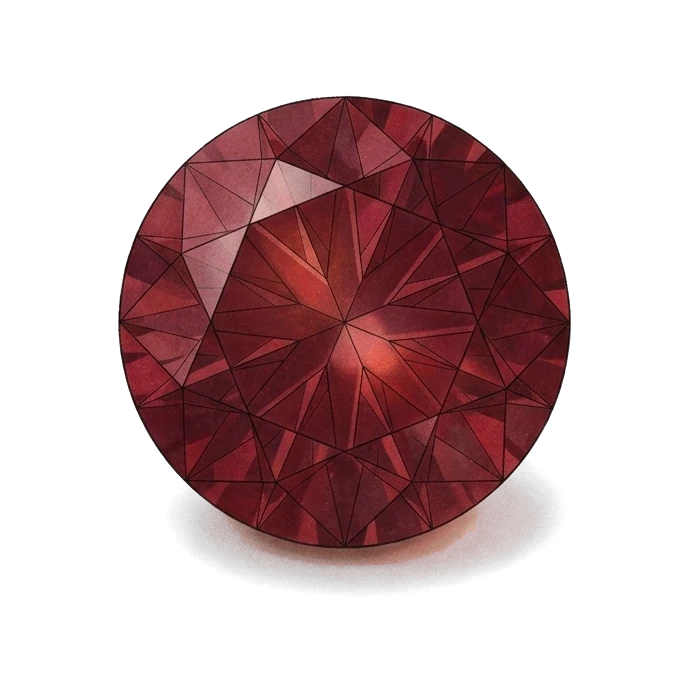
What color is garnet?
Red, most of the time. Red garnet is one of the most common and widespread gems there is.
The name doesn’t belong to one mineral, though. Garnets share a crystal structure and differ in chemistry, and between them, garnet colors cover nearly every hue, a few blues included. GIA counts more than twenty species. Five matter in jewelry: pyrope, almandine, spessartine, grossular and andradite.
-

Pyrope
Purple to orangy red: the classic red garnet.
#9B1B30
-

Almandine
Purple to orangy red, and common in large sizes.
#7A1E3A
-

Rhodolite Pyrope and almandine
The purplish red variety.
#A3305F
-

Spessartine
Orange in many shades, often with inclusions you can see.
#E0731F
-

Hessonite Grossular
Orange to brownish red, with a swirled look inside that the trade calls “roiled.”
#B4541F
-

Tsavorite Grossular
Green. Most comes from Kenya, Tanzania and Madagascar, and large stones are rare.
#1E8A4C
-

Demantoid Andradite
Green with strong fire. Its “horsetail” inclusions can raise its value.
#5AA83C
-


Color-change garnet
Changes color in different lighting, much like alexandrite.
Daylight #5C6AA6
Lamplight #7D4C8C
The hex codes are the colors we use for each swatch, so you can match “garnet red” or tsavorite green in a design. A real stone’s color also depends on its cut and the light you see it in.
Red garnet: pyrope, almandine and rhodolite
Red garnets are usually clean to the eye and cut in standard shapes and sizes, which is why they turn up so often in ready-made jewelry. Rhodolite is a pyrope-almandine mix, and it’s far from the only blend: many garnets combine two or more species.
Orange garnet: spessartine and hessonite
Spessartine is the orange garnet, and old finds from Virginia still matter to collectors. Hessonite, a kind of grossular, is the browner of the two.
Both tend to show inclusions you can see without a loupe, unlike most red garnets.
Green garnet: tsavorite and demantoid
Tsavorite is green grossular. Campbell Bridges mined it in Kenya, near Tsavo National Park. It needs unusual rock chemistry to form, which makes it rarer than red garnet.
Demantoid, a green andradite, is the garnet with fire: well cut, it scatters light into flashes of color. It’s also one of the few gems where an inclusion adds value, and collectors look for its “horsetails.”
Color change garnet
These are the garnets that can look blue: some shift from blue to purple as the light changes. The first “blue” garnets on the market came from a deposit near Bekily, Madagascar, and turn from blue-green in daylight to purple under a lamp. Others go from purple in daylight to purplish pink under a lamp.
The trade calls almost all of them pyrope-spessartine. Vanadium, sometimes with chromium, causes the change.
How strong the effect is varies a lot. Garnets from Tranoroa, also in Madagascar, carry the same elements but only move from brownish purple-red to purplish red.
Where a color shift garnet ends and a color change garnet begins is a judgment call: researchers have proposed several cutoffs, and a 2015 study in GIA’s journal calls the whole idea “inherently subjective.” A strong, attractive change does raise a garnet’s value considerably.
It’s the same trick that made alexandrite famous, and the study of the Bekily stones calls their change “alexandrite-like.” The two are different minerals, though: alexandrite is a chrysoberyl, and harder than any garnet.
What does garnet mean?
The garnet meaning in birthstone charts is constancy, friendship and fidelity. Those are the words of the old January verse that the gemologist George F. Kunz recorded in The Curious Lore of Precious Stones (1913). The stone’s older reputation is about protection, and much of it was written under another name.
For centuries red garnets were called carbuncle, a word used for almost any red stone. Carbuncle was said to be one of four precious stones God gave King Solomon. In Pliny’s day, the first century AD, red garnets were among the most widely traded gems.
Their blood-red color shaped the lore. Red stones were believed to make the wearer safe from wounds, and Kunz records the opposite idea too: in 1892, fighters on the Kashmir frontier fired garnets as bullets against British troops, expecting a red stone to wound more deeply than lead.
Garnet in the Bible
The King James Version doesn’t name garnet, but it does name the carbuncle, and that’s where garnet’s biblical story lies. The fourth stone of the high priest’s breastplate, the Hebrew nophek, became anthrax in the Greek Septuagint and carbunculus in the Latin Vulgate. Both mean “a glowing coal,” a name given to brilliant red stones like ruby and fine garnets.
Kunz found no sign that ruby was known in ancient Egypt, so he thought the nophek of Moses’ day was most likely almandine garnet, engraved with the name of Judah. The translations don’t line up neatly: the King James Version puts its “carbuncle” third and “emerald” fourth. Carbuncles turn up again in Isaiah 54, which promises “gates of carbuncles,” one of the passages behind the jeweled city of Revelation.
Is garnet hard enough for everyday wear?
| Hardness | 6.5–7.5 on the Mohs scale |
|---|---|
| Everyday ring? | Everyday, with care Fine in a ring if you take it off for chores and sports. Safest in earrings and pendants. |
| Family | Garnet group |
| Main sources | East Africa, Namibia, Sri Lanka, India, Brazil, Myanmar |
| Treatments | Most garnets are untreated. A few are fracture-filled with a glass-like material and need gentler care. |
| Anniversary | 2nd wedding anniversary |
Not every garnet is a good choice for a ring worn every day, but all of them are ideal for earrings, brooches and pendants. Rubbed against harder gems like diamond, ruby or sapphire, a garnet can be scratched, so keep pieces apart in the jewelry box.
Where garnet is found
Red garnet forms in metamorphic rock and is found on every continent. New deposits still turn up, such as one in the Lao Cai province of northern Vietnam.
The rarer greens come from fewer places. Most bright green tsavorite on the market is from Kenya, Tanzania and Madagascar, and Namibia now produces demantoid.
Famous garnets
People have worn garnet for more than 5,000 years, and it has often gone by the name of another red stone.
-
An Egyptian garnet necklace
About 3800 BC
Red garnet beads from a grave, more than 5,000 years old.
-
Bohemian garnet jewelry
From about 1500
Garnet deposits found in central Europe fed a regional jewelry trade that peaked in the late 1800s.
-
The “Ring of St. Elizabeth”
Shown in 1891
Exhibited in Düsseldorf as holding a luminous ruby, it turned out to be set with a large, almost flat garnet.
-
Fabergé’s demantoids
The jeweler to the Russian imperial court made intricate designs around green demantoid garnet.
Garnet names that aren’t what they seem
Several trade names pass garnet off as something else. An “Arizona ruby” or a “Cape ruby” is pyrope, and “Siberian chrysolite” is demantoid.
| Sold as | What it is |
|---|---|
| Arizona ruby | Pyrope garnet |
| Cape ruby | Pyrope garnet |
| Adelaide ruby | Almandine garnet |
| Californian ruby | Hessonite (grossular garnet) |
| Siberian chrysolite | Demantoid garnet |
| Transvaal jade | Green hydrogrossular garnet |
How to buy a garnet
Color comes first. Garnet includes affordable dark reds, rare and valuable greens, and many colors in between. Within a variety, these are the things that move the price:
- Clarity: red garnets are usually eye-clean. Spessartine and hessonite often aren’t, and in demantoid, horsetail inclusions can raise the value.
- Cut: red garnets come in calibrated sizes, cabochons and beads. Tsavorite is cut to keep weight, and demantoid to exact proportions that show off its fire.
- Size: almandine is common in large stones, so a bigger one doesn’t cost much more per carat. Tsavorite and demantoid are mostly small, and large ones are worth far more.
| Type | What to know |
|---|---|
| Natural | Mined. Most garnets are untreated. A few are fracture-filled with a glass-like material and need gentler care. |
| Imitation | Lab-made YAG and GGG share garnet's crystal structure but aren't garnet. Both were sold mainly as diamond imitations. |
| Type | Price |
|---|---|
| Common red (pyrope, almandine) | A few dollars |
| Rare green (tsavorite, demantoid) | Into the thousands |
Fine East African tsavorite can reach about $5,000 per carat.
Prices vary with size, color, clarity and seller. They’re a guide to what shops ask, not a valuation or an investment view.
How to clean garnet
Cleaning garnet
- Warm soapy water, soft brush
- Safe
- Ultrasonic cleaner
- Usually safe
- Steam cleaner
- Not recommended
Skip the ultrasonic for stones with fractures or fillings.
If you don’t know whether a garnet has been fracture-filled, treat it as if it has: warm soapy water and a soft brush, never steam.