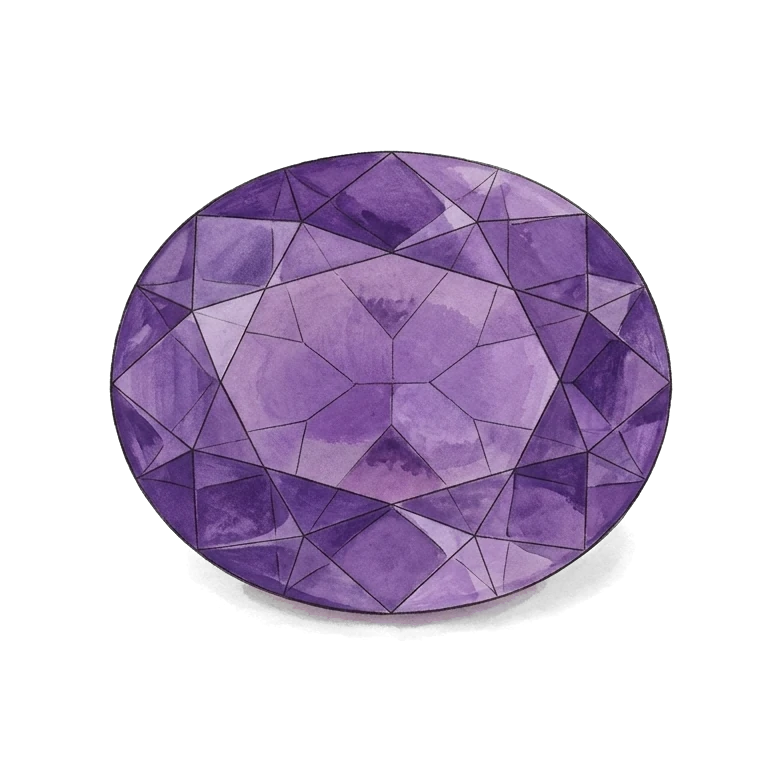
What does amethyst mean?
The word comes from the Greek amethystos, “not drunk.” Because the stone shares the color of red wine, the Greeks linked it to Dionysus, the god the Romans called Bacchus, and believed that wearing it kept you sober.
That was only the start of the amethyst meaning. Legends had it keep soldiers and merchants clear-headed and quick-witted, and Renaissance Europeans thought it could calm lovers carried away by passion. The astrologer Camillo Leonardi went further: for him it controlled evil thoughts, quickened the intelligence and made men shrewd in business, as the gemologist George F. Kunz records in The Curious Lore of Precious Stones (1913).
Other traditions read it differently. Its Hebrew name suggests a stone of dreams and visions. In ancient Egypt it was carved into heart-shaped amulets, and Kunz notes two of them in Cairo’s Boulaq Museum.
The legend of Bacchus and Amethyst
Kunz retells the best-known legend from a French poem. Bacchus, slighted, swore his tigers would devour the first person he met. That turned out to be Amethyst, a young woman on her way to worship Diana, who saved her by turning her into white stone. Ashamed, Bacchus poured wine over the stone, and it has been violet ever since.
Kunz had a down-to-earth theory of his own. Some stones the ancients called amethyst were probably purple garnet, and water poured into a cup of reddish stone looks like wine yet can be drunk “with impunity.”
A royal and religious stone
Much of amethyst symbolism comes from its purple, long a color of rank. Fine stones have been set in crown jewels and church jewelry for ages, they sit on bishops’ fingers and in the British coronation regalia, and amethyst is one of the emblems of the twelve apostles.
For most of history it was also expensive: fine amethyst cost as much as ruby and emerald until the 19th century.
Amethyst in the Bible
Amethyst is the last stone of the third row in the high priest’s breastplate (Exodus 28:19), and the twelfth foundation stone of the New Jerusalem in Revelation 21. Kunz found every authority agreed that the Hebrew aḥlamah meant amethyst, a purple quartz rather than the violet sapphire called “Oriental amethyst.” The name engraved on it was Dan.
Medieval readers gave the foundation stone a meaning of its own. Rabanus Maurus, Archbishop of Mainz in the 800s, saw in it “the constant thought of the heavenly kingdom in humble souls.” Andreas, a bishop of Caesarea, matched it to the apostle Matthias, chosen to take the place of Judas.
Amethyst color: from lilac to deep purple
Amethyst ranges from pale lilac to deep purple. The finest amethyst color is a strong reddish purple to purple with no visible color zoning, though pastel shades have plenty of fans.
-

Pale lilac
Light, pastel purple, which has wide appeal. Rough from Rio Grande do Sul, in Brazil, tends to be lighter.
#C9A8E0
-

Reddish purple
The finest color: strong reddish purple to purple, with no visible color zoning.
#7E2F8E
-

Raspberry
Highly saturated, often from Zambia, and usually more included than Brazilian amethyst.
#9B2D6F
-

Dark purple
Deep and rich, though a stone that’s too dark can look black in dim light.
#4B1F70
Brownish or bronze tints, weak color and uneven zoning all lower the value.
Bolivia’s Anahí mine produces ametrine, crystals that are half amethyst and half citrine. A Spanish conquistador found the mine in the 1600s and received it as a dowry when he married Anahí, a princess of the Ayoreo people. It was then forgotten for three centuries and found again in the 1960s.
Is amethyst good for everyday wear?
| Hardness | 7 on the Mohs scale |
|---|---|
| Everyday ring? | Great for everyday Hard and tough enough for a ring worn every day. |
| Family | Quartz |
| Main sources | Brazil, Zambia, Bolivia, United States (Arizona) |
| Treatments | Often heated, which can lighten very dark stones. The change is permanent. |
| Lab-grown | Yes. It has been made since the 1970s and is hard to tell from mined amethyst without lab testing. |
| Anniversary | 6th wedding anniversary |
At 7 on the Mohs scale, amethyst is fine for a ring worn every day. Over the years it can pick up wear and need repolishing, and harder gems such as rubies, sapphires and diamonds will scratch it.
Where amethyst is found
Russia supplied most amethyst until the 19th century. Then miners struck large deposits in Brazil. Brazil is still a major supplier, above all the state of Rio Grande do Sul, and Brazilian amethyst sometimes forms in geodes you can stand inside.
Zambia’s Kariba mine is one of the largest producers in the world. In Arizona, the Four Peaks mine sits in the Mazatzal Mountains outside Phoenix, with no water or power on site, and yields very fine dark purple and purplish red crystals.
Famous amethysts
-
Catherine the Great’s amethysts
1729–1796
The Russian empress favored amethyst necklaces, earrings and other ornaments.
-
The Duchess of Windsor’s bib necklace
Worn in 1953
A Cartier necklace of 28 step-cut amethysts and a large heart-shaped one, with turquoise and diamonds, worn to a gala at Versailles.
-
St. Valentine’s ring
Tradition says the saint wore an amethyst engraved with a little Cupid. Kunz thought the story doubtful, though not impossible.
-
A 164-pound crystal
A doubly terminated amethyst crystal of 164 pounds has been displayed at the GIA Museum.
Names to watch for
Not every “amethyst” is quartz. An “Oriental amethyst” is violet sapphire, and Kunz made the same point a century ago.
| Sold as | What it is |
|---|---|
| Oriental amethyst | Violet sapphire |
| Lithia amethyst | Kunzite (spodumene) |
How to buy amethyst
Start with the color, as above. Most faceted amethyst is eye-clean, and an eye-clean stone is worth more than an included one of the same color. Included rough with good color usually becomes cabochons and beads, and the clearest of those sell at a substantial premium.
You’ll find it in every standard shape, in designer cuts and in carvings. Big stones don’t carry a steep premium per carat, which makes amethyst a favorite for a large center stone.
Pale quartz is sometimes dyed purple. Sellers must say whether an amethyst is natural or lab-grown, and while a lab can tell, the test often isn’t done because of the cost and time.
| Type | What to know |
|---|---|
| Natural | Mined. Often heated, which can lighten very dark stones. The change is permanent. |
| Lab-grown | Real amethyst, made in a lab. It has been made since the 1970s and is hard to tell from mined amethyst without lab testing. |
| Type | Price |
|---|---|
| 1–10 carats | $5–$50 |
| Over 10 carats | $10–$80 |
Prices vary with size, color, clarity and seller. They’re a guide to what shops ask, not a valuation or an investment view.
How to clean and care for amethyst
Cleaning amethyst
- Warm soapy water, soft brush
- Safe
- Ultrasonic cleaner
- Usually safe
- Steam cleaner
- Not recommended
Keep it out of strong sunlight for long stretches. Some amethyst fades.
Ultrasonic cleaners are usually fine, steam isn’t, and a soft brush with mild soap is safest. Since some amethyst fades in strong light, GIA’s advice is not to wear it to the beach every day.