What does citrine mean?
The name says what it looks like. It is believed to come from the French citron, “lemon,” and the International Gem Society traces it to the Old French citrin, “yellow.”
Most of its lore came from another stone. Before modern gemology, citrine’s tawny color made people take it for topaz, so they believed it had the same powers: it was thought to soothe tempers and calm whoever wore it. So the citrine stone meaning, a calm, even temper, is a belief it borrowed from topaz.
Citrine has been reported in Roman jewelry, and it was especially popular in the colorful Scottish jewelry of the Victorian era. Natural citrine is rare, but Victorian gems have surfaced, among them an ornate brooch thought to date from the 1860s.
Citrine symbolism today
Citrine’s fame is recent. The International Gem Society says it was so plentiful that it got little respect, until earth-tone fashion and home shopping networks, selling its shades as “butterscotch” and “whiskey,” helped change that. Today it’s the top-selling yellow-to-orange gem, and the gem of the 13th wedding anniversary.
Look up citrine crystal meaning and you’ll often see it sold as the “merchant’s stone,” a stone of money and success. That role has no old source we know of: the lore that citrine really has is the calm, even temper it borrowed from topaz.
Citrine and topaz: a long mix-up
Citrine’s yellow comes from iron, in colors long associated with topaz, and the two still get confused although they are different minerals. In the past citrine commonly went by topaz names, and some sellers still pass cheap citrine off as the costlier stone.
Today GIA puts it the other way round: citrine is an attractive alternative to topaz, and to yellow sapphire too.
Citrine color: from lemon yellow to Madeira orange
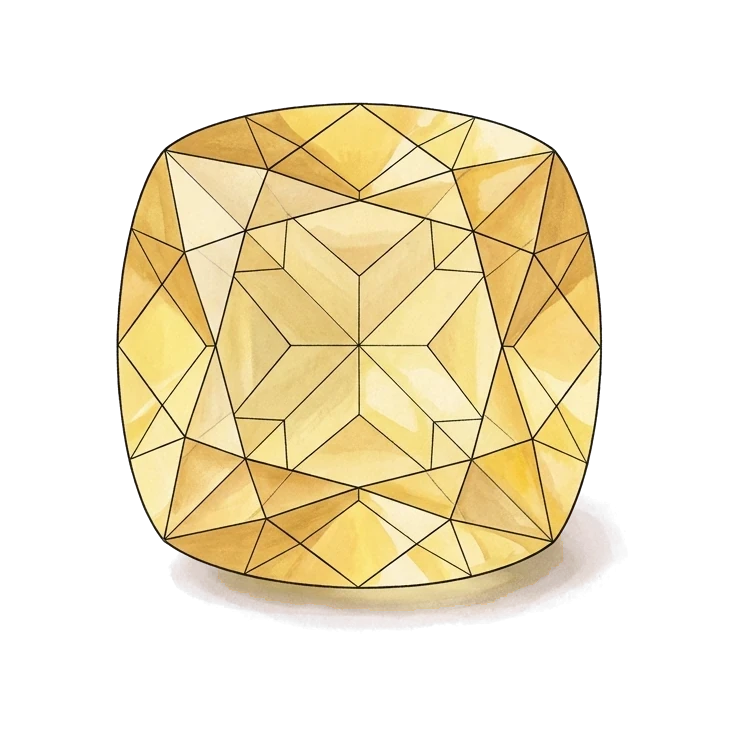
Citrine is the transparent, pale yellow to brownish orange variety of quartz, and a trace of iron in its structure makes it yellow to orange. In Bolivian ametrine, the citrine color appears to come from tiny clusters of iron.
The finest citrine color is saturated, from yellow to reddish orange and even orangy red, with little or no brown. Taste runs a little browner: the most popular shade on the market today is an earthy, deep brownish or reddish orange.
One deep orange has a name of its own. “Madeira” means a rich orange with red flashes, a color and not a place, and it comes from heating citrine with the right iron content.
-

Lemon yellow
The pale end of the range. Natural citrine usually comes in pale yellows, often with a smoky tone.
#F3E27A
-

Golden yellow
A saturated yellow with no brownish tint, among the finest citrine colors.
#F2C14E
-

Madeira
A rich orange with red flashes. The name describes a color, not a place, and heating produces it.
#C9561E
-

Orangy red
The far end of the range, and highly valued when saturated.
#B23A1C
-

Brownish orange
An earthy deep orange, the most popular shade today, though the finest stones show no brown.
#A8612A
-

Lime citrine
A lime green-yellow that can come from heating smoky quartz.
#C8CF4A
-

Anahí citrine
Natural, unheated citrine from Bolivia, orange-yellow to brownish or greenish yellow.
#D9A43A
-

Ametrine
Amethyst and citrine colors in one crystal. The only commercial source of natural ametrine is the Anahí mine in Bolivia.
#9A6AA8
Ametrine: amethyst and citrine in one crystal
Ametrine is quartz with both the purple of amethyst and the orange of citrine in the same gem. The only commercial source of natural ametrine is the Anahí mine in eastern Bolivia, near the Brazilian border, and it came back onto the market in the 1970s.
Fine ametrine pairs a medium dark to moderately strong orange with a vivid to strong purple. Dealers want the two colors about half and half, meeting at a sharp line across the middle of the stone.
Synthetic ametrine from Russia has been sold since 1994. A gemologist can tell it apart by the angle of the color boundary: in natural ametrine it runs roughly parallel to the crystal’s optic axis, and in synthetics it crosses at a slant.
Is citrine good for everyday wear?
| Hardness | 7 on the Mohs scale |
|---|---|
| Everyday ring? | Great for everyday Hard and tough enough for a ring worn every day. |
| Family | Quartz |
| Main sources | Brazil, Bolivia, Madagascar, Spain, Uruguay, Mexico |
| Treatments | Most citrine sold is heated amethyst, and some is heated smoky quartz. |
| Lab-grown | Yes. It is grown in water under heat and pressure (the hydrothermal method), the only way to grow quartz. Most citrine on sale is heated amethyst instead. |
| Anniversary | 13th wedding anniversary |
At 7 on the Mohs scale, with good toughness, citrine is usually durable enough for normal wear and care. It has no cleavage, so it suits any kind of jewelry. The thing to watch is temperature, since abrupt changes can fracture it.
Where citrine is found
The top sources are Bolivia, Spain, Madagascar, Mexico and Uruguay. The amethyst that is usually heated into citrine comes mostly from Brazil. Giant hollow amethyst geodes from places like Brazil are often heated whole, turning them into citrine “cathedrals.”
Bolivia’s Anahí mine is an important source of natural, unheated citrine. In 2011 a dealer told GIA of a new find from the Kitwe area of Zambia, sold to him as natural color. The stones GIA examined ranged from pale, slightly brownish yellow to brownish orangy yellow.
Famous citrines
Huge citrines exist, some of thousands of carats, and the Smithsonian holds several Brazilian giants. Citrine jewelry is another story: the museum’s first piece went on display only in December 2015.
-
The Jolie Citrine Necklace
Given in 2015
Designed by Angelina Jolie Pitt and Robert Procop: 64 cushion-cut citrines and a 177.11-carat pear-shaped citrine drop in 18-karat gold. Its curator called it the first piece of citrine jewelry in the National Gem Collection.
-
The Smithsonian’s 2,277-carat citrine
A medium yellow-orange modified oval brilliant from Brazil. Its record credits the cutting to Art Grant.
-
The 1,180-carat Minas Gerais citrine
A medium dark brownish orange round brilliant from Minas Gerais, Brazil, in the Smithsonian’s Chamberlain Collection.
-
The 781-carat step-cut citrine
A medium yellow-orange rectangular step cut, also from Minas Gerais, in the Smithsonian’s gem collection.
Citrine names to watch for
Most misleading citrine names borrow from topaz. Madeira, Spanish, Serra and gold topaz are all citrine. So were the older “Brazilian topaz” and “topaz quartz.”
| Sold as | What it is |
|---|---|
| Madeira topaz | Citrine (quartz) |
| Gold topaz | Citrine (quartz) |
| Spanish topaz | Citrine (quartz) |
| Serra topaz | Citrine (quartz) |
| Brazilian topaz | Citrine (an old name) |
| Topaz quartz | Citrine (an old name) |
How to buy citrine
Color sets the price. The most saturated yellows, oranges and reddish tones sit at the top, and pale or smoky stones at the bottom. Then look at:
- Clarity. Much of the faceted citrine on the market is eye-clean, and visible inclusions in a pale stone lower its value sharply.
- Cut. Citrine comes in standard shapes and calibrated sizes, and designers and carvers also give it unusual custom cuts.
- Size. Stones up to 20 carats are easy to find in jewelry, and a large citrine costs little more per carat than a small one.
Natural citrine vs. heated citrine
Natural citrine is rare, and most citrine on the market is heated amethyst. Heat turns some pale violet amethyst yellow, and the amethyst’s original hue can set how rich the yellow becomes. Heated smoky quartz is another source, and it can give a lime-colored citrine.
Color is a clue, not proof. Natural stones usually come in pale yellows, often with smoky tones, while heated amethyst gives the stronger yellows and the orange-red to orangy brown shades. The heating is usually done right at the mine, and it’s a stable treatment the trade fully accepts.
Even a lab can struggle. When GIA examined the Zambian citrine, its inclusions proved the quartz natural, but the lab note could only assume the color was natural, as the supplier said. To tell natural citrine from synthetic, labs rely on inclusions or trace elements, since an infrared feature that helps confirm natural amethyst is often missing in citrine.
GIA does offer a report for citrine, but few people order one, because of its cost compared with the value of most citrine.
Lab-grown citrine
Heated or not, citrine is real quartz. Lab-grown citrine exists too: quartz is grown in laboratories for industry and to make lab-grown amethyst, and some of it becomes citrine.
Quartz can only be grown by the hydrothermal method, from a heated water solution under pressure. The first was made in the 1890s, but synthetic quartz wasn’t widely sold until World War II.
| Type | What to know |
|---|---|
| Natural | Mined. Most citrine sold is heated amethyst, and some is heated smoky quartz. |
| Lab-grown | Real citrine, made in a lab. It is grown in water under heat and pressure (the hydrothermal method), the only way to grow quartz. Most citrine on sale is heated amethyst instead. |
| Type | Price |
|---|---|
| Light color, 1 carat | $10–$25 |
| Medium color, 1 carat | $15–$35 |
| Deep color, 1 carat | $20–$60 |
Prices vary with size, color, clarity and seller. They’re a guide to what shops ask, not a valuation or an investment view.
How to clean citrine
Cleaning citrine
- Warm soapy water, soft brush
- Safe
- Ultrasonic cleaner
- Usually safe
- Steam cleaner
- Not recommended
High heat or a sudden change in temperature could crack it.
Warm, soapy water is safe. An ultrasonic cleaner is usually fine too, but skip the steamer: high heat could crack the stone. For the same reason, keep citrine away from sudden swings in temperature.