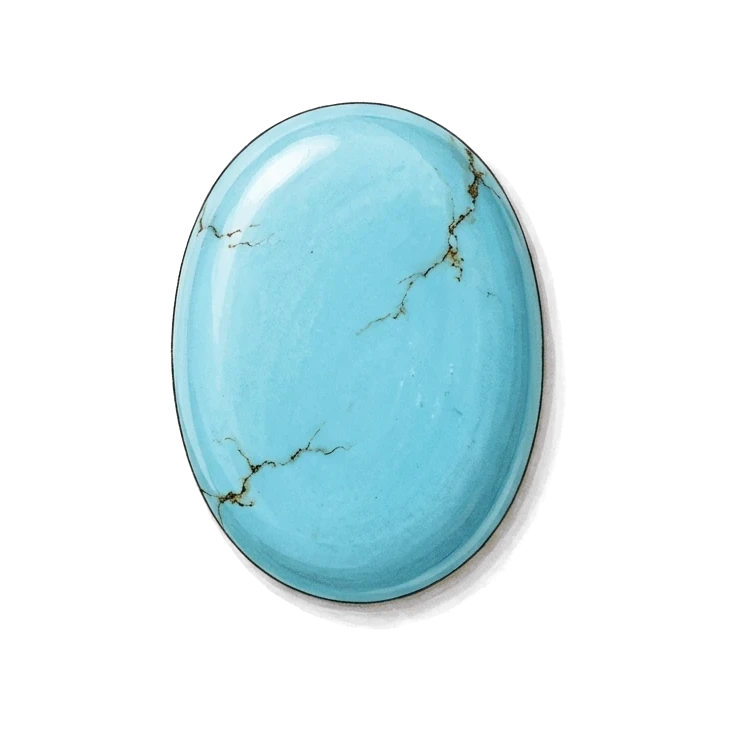
What does turquoise mean?
Protection. Through most of its history, turquoise has been a guard against harm: it has long been believed to bring health, good fortune and protection from evil, and it is the national gem of Tibet. From the 13th century, Europeans believed it kept its wearer from injury in a fall, especially from horseback.
The name is a souvenir of the trade route. It comes from the French pierre tourques, “Turkish stone,” a name that took hold in the 13th century, probably because the gem first reached Europe from Turkish sources. The most important mines lay farther east, in Persia.
The gemologist George F. Kunz gathered much of this lore in The Curious Lore of Precious Stones (1913). Turquoise was believed to:
- Keep a rider safe. Volmar’s 13th-century Steinbuch, a book of stones, promised that “whoever owns the true turquoise set in gold will not injure any of his limbs when he falls.” The Turks were said to hang turquoises on their horses’ bridles and frontlets as amulets, a custom also followed in Samarkand and Persia.
- Warn of disaster. It was said to break into pieces as danger approached, and to lose its luster when its owner fell sick or neared death.
- Work only as a gift. Its powers were said to exist only in a turquoise that had been given, never in one you bought for yourself.
- Bring wealth with the new moon. Hindu mystics held that seeing a turquoise right after the new moon ensured great wealth. A Persian saying advised seeing the new moon’s reflection on a friend’s face, a copy of the Koran or a turquoise.
One turquoise story Kunz tells in full belongs to Anselmus de Boot, court physician to Emperor Rudolph II. His father cheaply bought a turquoise that a Spaniard had owned for 30 years, its color by then entirely gone, and gave it to his son, since its virtues were said to work only in a gift. De Boot had his arms engraved on it and wore it as a signet, and within a month its color had come back.
Later, riding at night on a dangerous road, de Boot was thrown when his horse stumbled, and neither horse nor rider was hurt. The next morning, about a quarter of the turquoise had broken away. When he later strained himself lifting a heavy pole, he found the stone broken in two.
Kunz offered a plainer reason why a turquoise might seem to fade with its owner’s health: the stone is affected to some extent by the secretions of the skin. Turquoise is also the gem for the 11th wedding anniversary.
Turquoise in ancient Egypt and Persia
Turquoise buried in Egyptian tombs is among the world’s oldest jewelry, and GIA dates it to about 4000 BC. The Egyptians called it mefkat, a word that also meant joy and delight.
It was rarer in Egypt than its fame suggests. The main supply came from mines at Wadi Maghara and Serabit el-Khadim, in the southwest Sinai, and at Serabit el-Khadim a Middle Kingdom temple honored Hathor, sometimes called the lady or mistress of turquoise. Egyptian craftsmen made it into amulets, beads and inlays, mostly for gold jewelry.
Persia’s mines, near Nishapur in the northeast of today’s Iran, have been the most important since ancient times, and their output can be traced back to at least the 10th century. Nishapur lay on the caravan routes that ran east across Central Asia, which helped turquoise travel widely. Kunz called turquoise the Persians’ national stone.
Turquoise among the Aztecs
Turquoise mattered deeply to the Aztecs, and it fills their poetry and rituals. They used it for the jewelry, shields, knife handles and mirrors of rulers, priests and others of high rank.
The finest kind, according to the Spanish friar Bernardino de Sahagún, was called teuxivitl, “turquoise of the gods.” No one was allowed to own or wear it, because it was kept for the service of the gods.
Scholars long assumed the Aztecs and Mixtecs imported their turquoise from what is now the American Southwest. A 2018 study of tiles from Mexico City’s Templo Mayor found chemical signatures that point to a source within Mesoamerica instead, though no ancient mine there has been found.
Turquoise in the American Southwest
For Native American peoples of the Southwest, turquoise was a ceremonial gem and a medium of exchange, worn in jewelry and amulets. It still is a living tradition. In Turquoise, Water, Sky, published by the Museum of New Mexico Press, Maxine McBrinn and Ross Altshuler note that at Southwestern Native gatherings, ceremonial or civic, almost everyone, old and young, wears turquoise jewelry.
In their account, turquoise symbolism in the Southwest has more to do with water than with sky. The Zuni word for it can be translated as “sky stone,” but in the dry Southwest the stone’s stronger link is to water, and for Pueblo people, wearing turquoise can be likened to a prayer for rain. For the Navajo, it is closely tied to health, safety and protection, and to the sun, the south and Mount Taylor in New Mexico, one of the four sacred mountains that bound the Navajo world.
Two older records, from Kunz (who drew on ethnographers’ reports) and GIA:
- Apache: turquoise could be found by following a rainbow to its end, and a turquoise fixed to a bow or gun made the shot go true. The Apache name for it, duklij, means a green or a blue stone.
- Navajo: in ceremonial sand paintings, the rain-making gods wear necklaces of coral and turquoise.
Turquoise color: sky blue, green and matrix
What color is turquoise? It runs from dull greens through grass greens to a bright, medium sky blue. It’s semitranslucent to opaque, often mottled, and sometimes splotched with darker patches.
The most prized color is an even, intense medium blue, traditionally from Iran’s Nishapur district. GIA rates green to greenish blue stones as less desirable than pure blue ones. Traders call top blue “Persian blue” even when it wasn’t mined in Iran, and turquoise is also sold as “robin’s egg blue” and “sky blue.”
Not everyone ranks the colors that way. The Indian Arts and Crafts Board, part of the US Department of the Interior, says natural blue and green turquoise are both the most sought after, and neither is worth more than the other.
-

Persian blue
An even, intense medium blue with no matrix: the most prized color. Named for Iran’s Nishapur district, though traders use it for top blue from anywhere.
#2E9CCA
-

Robin’s egg blue
One of the trade names for turquoise blue, along with sky blue and Persian blue.
#3FB8AF
-

Greenish blue
GIA ranks it below pure blue. The Indian Arts and Crafts Board says natural blue and green are equally sought after.
#4FA89A
-

Grass green
The green end of a range that runs from dull greens to sky blue.
#6E9F4E
-

Spiderweb matrix
Host rock in thin, web-like lines across the stone. Second in value only to turquoise with no matrix at all.
#46AFC6
-

Brown or tan matrix
Veins of the rock it formed in: dark brown from limonite, tan from sandstone.
#5BB3B1
-

White (chalk)
The most common color, but too soft to cut or polish as mined, so it’s used only once treated.
#E6ECE8
Not the stone: the web color “turquoise” The CSS color of that name is #40E0D0. It’s greener and brighter than most of the gem. CSS also has paleturquoise (#AFEEEE), mediumturquoise (#48D1CC) and darkturquoise (#00CED1).
Many turquoises also carry matrix, remnants of the rock they formed in: limonite leaves dark brown markings and sandstone tan ones. Stones with no matrix at all fetch the highest prices, and thin, web-like “spiderweb” matrix ranks second.
The web color turquoise
Search “turquoise color” and most results are about the web color, not the gem. In CSS, the color named turquoise is a bright aqua that is greener than most turquoise gems, and it comes with three relatives: paleturquoise, mediumturquoise and darkturquoise. All four codes are under the swatches above.
Is turquoise good for everyday wear?
| Hardness | 5–6 on the Mohs scale |
|---|---|
| Everyday ring? | Occasional wear Too soft or fragile for a daily ring. Best in earrings, pendants and rings for special days. |
| Family | Turquoise |
| Main sources | China, United States (Arizona, Nevada), Iran |
| Treatments | Most is stabilized with resin to harden it, and some is dyed or waxed. Ask before you buy. |
| Lab-grown | Gilson’s lab-made turquoise was the only true synthetic on the market in a 1983 Gems & Gemology study, though it held other compounds too. Some labs count it an imitation. |
| Anniversary | 11th wedding anniversary |
Turquoise is fairly soft, at 5 to 6 on the Mohs scale, which is part of why it carves so well. It’s also porous. Fine-textured, less porous stones take a waxy polish and are worth more, while coarse, porous ones look duller.
That porosity is the stone’s weak point. Natural turquoise is very sensitive to chemicals and can be damaged by perspiration, which is one reason it is so often hardened with plastic. Keep it away from high heat as well, which can discolor it or make it break.
Where turquoise comes from
Turquoise forms in only a few places on earth, in dry, barren regions where acidic, copper-rich groundwater seeps down and reacts with minerals containing phosphorus and aluminum. The result is a hydrated phosphate of copper and aluminum.
Today China is the world’s largest producer, and most of its gem-quality turquoise comes from Hubei Province.
In the US, New Mexico was the leading producer until the 1920s, and most American turquoise now comes from Arizona and Nevada. The most commonly sold American turquoise is from Arizona’s Sleeping Beauty and Kingman mines, and turquoise from mines such as Lone Mountain, #8, Lander Blue and Bisbee is highly regarded for its color, matrix and history. Sleeping Beauty has since closed to turquoise mining, after more than four decades as a prolific producer.
Famous turquoise pieces
Turquoise’s famous pieces are mosaics and jewelry more than single stones. Aztec and Mixtec artists covered carved wood, and even a human skull, in small turquoise tiles.
Egypt’s jewelers set it with gold. The pectoral of Sithathoryunet, from about 1887–1878 BC, joins turquoise with carnelian, lapis lazuli and garnet. Much later, turquoise took the place of emeralds in a diadem Napoleon gave to Empress Marie Louise.
-
The pectoral of Sithathoryunet
About 1887–1878 BC
A gold pectoral built around the name of King Senwosret II and inlaid with carnelian, lapis lazuli, garnet and turquoise. It was found in the tomb of Princess Sithathoryunet at Lahun and is now at the Met.
-
The double-headed serpent
Made 1400–1521
An Aztec-Mixtec chest ornament carved from a single piece of Spanish cedar and covered in a mosaic of turquoise and red shell, with white shell teeth. It is in the British Museum.
-
The mask of Tezcatlipoca
Made 1400–1521
A human skull covered in a mosaic of turquoise and lignite, with eyes of polished pyrite. It is believed to show Tezcatlipoca, the “Smoking Mirror,” and is in the British Museum.
-
The Pueblo Bonito turquoise basket
Found in George H. Pepper’s excavations
A cylindrical basket three inches across and six inches long, coated with gum and set with 1,214 small pieces of turquoise in a complete mosaic. Kunz thought it probably had a ceremonial use.
-
The Marie Louise Diadem
Turquoise set 1956–1962
Napoleon gave it to Empress Marie Louise when they married, set with Colombian emeralds. Van Cleef & Arpels sold the emeralds and set 79 Persian turquoises, 540 carats in all, in their place. It is at the Smithsonian.
Turquoise names to watch for
Imitations of turquoise are old and common. Dyed magnesite has been used for years, and dyed calcite and dolomite turn up too, while dyed howlite, once another common one, is hardly used anymore. Dyed magnesite can be given a fake matrix to look like spiderweb turquoise.
A name with “turquoise” in it doesn’t make a stone turquoise. “Viennese turquoise” is clay tinted blue, and most “reconstructed turquoise” tested for a 1983 Gems & Gemology study contained no turquoise at all. Experts even disagree about Gilson turquoise, made in a lab: the 1983 study found real turquoise in it, mixed with other compounds, while the German lab EPI counts the name among those that wrongly use the word.
| Sold as | What it is |
|---|---|
| Viennese turquoise | Clay tinted blue |
| Turkenite | Dyed magnesite or calcite, or rarely howlite |
| White turquoise | Can be undyed magnesite |
| Reconstructed turquoise | In a 1983 Gems & Gemology study, dyed gibbsite filled with plastic, with no turquoise in it |
| Gilson turquoise | Lab-made; a 1983 Gems & Gemology study found turquoise in it, mixed with other compounds |
Natural, stabilized or imitation: how to buy turquoise
When you buy a turquoise stone, ask whether it is natural, not whether it’s real. The Indian Arts and Crafts Board puts natural turquoise, which came out of the ground with no treatment, at only about 15% of the world’s supply, and says about 85% is too soft to cut or polish as mined. Other estimates agree that most is treated: the FTC says the majority of turquoise used today is stabilized, and the International Gem Society that almost all but the finest is.
Turquoise is judged on its color, its texture and how much matrix it has. Cutters often work around large areas of matrix to get evenly colored pieces. Most turquoise is cut as cabochons, and it’s also made into beads and flat inlay pieces, while lower grades are tumbled into nuggets.
Stabilized turquoise and other treatments
The terms to know, as the Indian Arts and Crafts Board defines them:
- Stabilized: combined with colorless resins (plastics) under vacuum or pressure, to harden the stone and darken its color.
- Oiled or waxed: soaked or cooked in oil or wax to darken it.
- Dyed: colored to deepen its blue, or to paint on a fake matrix.
- Blocked: chips and fragments mixed with epoxy and formed into blocks for cutting.
- Enhanced: a patented process that darkens low or medium grades to look like a higher one.
Plastic impregnation began in the late 1960s, at first for turquoise too porous to cut. Since then it has spread to good-quality stones as well, to make them more durable.
The Zachery treatment is a proprietary process, and by 1999 it had been used on millions of carats of turquoise over the previous decade. It reduces porosity and helps the stone take a polish, and it may or may not improve the color. It adds no plastic, and most Zachery-treated stones can be identified only by chemical analysis, since they hold more potassium than untreated turquoise.
How to tell if turquoise is real
Not by its veins. Dark spots and veins no longer prove a stone is turquoise, since imitations and reconstructed stones can be given a convincing fake matrix of ink or black cement. Look closely at the cracks and hollows of the surface instead: on a dyed or painted stone, that is where the color or cement tends to remain. Measuring its specific gravity, or density, often gives a useful hint too.
Beyond that, it takes a lab. A gemologist’s routine tests can’t reliably tell natural, treated and imitation turquoise apart. Infrared spectroscopy combined with X-ray powder diffraction can, and needs only about 3 milligrams of the stone, ground to powder. Zachery-treated turquoise is harder still, since most of it shows up only in a chemical analysis.
For anything valuable, the paperwork is your best protection: ask for a written receipt that says whether the turquoise is natural, stabilized or treated, and which mine it came from.
What sellers must disclose
Treatments that change a stone’s value have to be disclosed in the US, under the rules our guide to treated topaz sets out.
Imitations face a stricter rule. A stone with no turquoise in it can’t be sold as “turquoise” unless the word “imitation” or “simulated” comes right before it, and a lab-made stone must be clearly labeled as one.
Native American jewelry has its own laws. The federal Indian Arts and Crafts Act makes it illegal to sell anything in a way that falsely suggests it is Native American made, but it doesn’t cover the materials. New Mexico’s Indian Arts and Crafts Sales Act goes further and requires the seller to disclose the materials in writing.
When you buy, get a written receipt that names the artist and their tribal affiliation, the mine the turquoise came from, and whether it is natural, stabilized or treated. No eye test is foolproof: telling natural from treated turquoise, or spotting an imitation, is hard even with a gemologist’s routine tests.
| Type | What to know |
|---|---|
| Natural | Mined. Most is stabilized with resin to harden it, and some is dyed or waxed. Ask before you buy. |
| Lab-grown | Gilson’s lab-made turquoise was the only true synthetic on the market in a 1983 Gems & Gemology study, though it held other compounds too. Some labs count it an imitation. |
| Imitation | Dyed magnesite (sometimes sold as “Turkenite”), dyed calcite or dolomite, pressed, dyed powder and, now rarely, dyed howlite. |
| Type | Price |
|---|---|
| Stabilized | $1–$8 |
| Natural (untreated) | $2–$150 |
Prices vary with size, color, clarity and seller. They’re a guide to what shops ask, not a valuation or an investment view.
How to clean turquoise
Cleaning turquoise
- Warm soapy water, soft brush
- Safe
- Ultrasonic cleaner
- Never
- Steam cleaner
- Never
Acids can damage it. Cosmetics, skin oils and sweat can discolor it, and high heat can discolor or break it.
Clean it with warm, soapy water and nothing harsher, and never with steam or an ultrasonic cleaner. Heat or solvents can damage the treated surface of some turquoise.