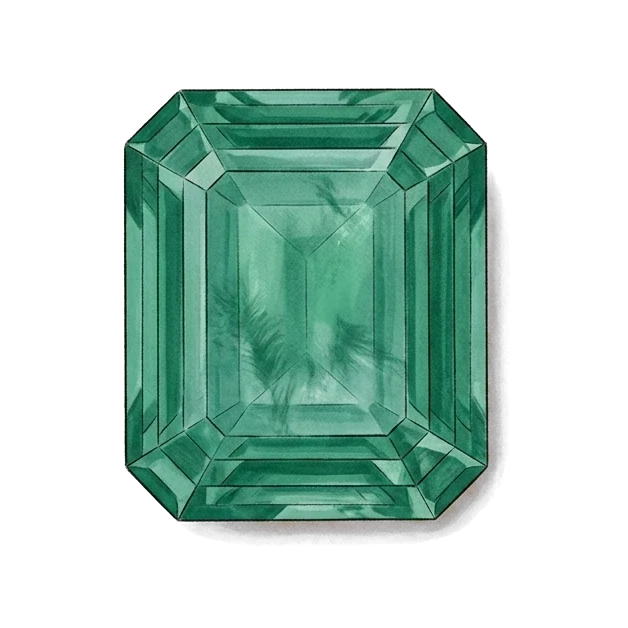
What does emerald mean?
The name goes back to smaragdus, the ancient Greek word for green, and nearly all of emerald symbolism comes from that color. Pagan writers gave the stone to Venus, for green stood for the growing, fertile side of nature. Christians later made green stones a sign of the resurrection and of a new, purer life.
GIA sees in its green the new growth of spring, which makes it a fitting stone for May.
The lore went much further. Emerald was believed to:
- Show the future, if you placed it under your tongue.
- Reveal the truth, including whether a lover’s oath was true or false.
- Break spells. Magicians were said to find their arts useless with an emerald nearby.
- Sharpen the mind, making its owner quick-witted, eloquent and better at remembering.
Cardano, a writer Kunz often quotes, accepted that emerald quickened the intelligence, and argued that it therefore made people more honest, since “dishonesty is nothing but ignorance, stupidity, and ill-nature.” The claim that it also made people rich he doubted: his own experience said otherwise.
Not every story was flattering. Emerald was linked to Venus, yet it was also thought to resist passion. The medieval scholar Albertus Magnus told of King Bela IV of Hungary, whose emerald ring broke into three pieces when he embraced his wife.
Emerald in the Bible
Emerald is one of the stones in the high priest’s breastplate. The third stone, the Hebrew bareketh, is smaragdus in the Greek Septuagint, in Josephus and in the Latin Vulgate. The King James Version, which follows a different order, puts its emerald fourth.
Kunz saw no reason to doubt that bareketh meant emerald, since emerald was mined in Nubia and used in Egypt before the Christian era. Still, smaragdus could cover other green stones, and the oldest breastplate may have held green feldspar instead.
In Revelation, the rainbow around God’s throne is “in sight like unto an emerald,” and emerald is the fourth foundation stone of the New Jerusalem. In the 800s, Archbishop Rabanus Maurus of Mainz read it as “the strength of faith in adversity.”
Rabbinical legend adds that God gave King Solomon four precious stones, emerald among them, and that together they gave him power over all creation.
Emerald green: what makes a fine color
The emerald stone has been the standard for green among colored stones for thousands of years. The finest is bluish green to pure green, vivid and not too dark, with the color spread evenly and the stone highly transparent.
Chromium, vanadium and iron cause the color, and their mix sets the exact shade. Colombian emeralds are said to be warmer and Zambian ones cooler and bluer, but in truth the two overlap.
-

Muzo, Colombia
Known for darker tones of pure green.
#16794A
-

Chivor, Colombia
Lighter in tone and slightly bluish green.
#2A8C78
-

Coscuez, Colombia
Slightly yellowish green.
#4A9A3C
-

Zambian emerald
Bluish green and darker in tone, from the Ndola Rural area.
#17685A
-

Trapiche emerald
Its inclusions form rays in a star-like pattern.
#2E6E4A
Too yellow or too blue, and the stone is no longer emerald but another beryl, worth far less. A green that’s too light is called green beryl by most gemologists and labs, though they don’t agree on exactly where “too light” begins. GIA settles it with lab-graded comparison stones.
Is emerald good for everyday wear?
| Hardness | 7.5–8 on the Mohs scale |
|---|---|
| Everyday ring? | Everyday, with care Fine in a ring if you take it off for chores and sports. Safest in earrings and pendants. |
| Family | Beryl |
| Main sources | Colombia, Zambia, Brazil, Pakistan, Afghanistan |
| Treatments | Usually treated. Oil, wax or resin fills surface-reaching fractures, and some pale stones are dyed. |
| Lab-grown | Yes |
| Anniversary | 20th and 35th wedding anniversary |
Hardness isn’t the problem. Almost every emerald has fractures, and emerald is more brittle than ruby or sapphire, so a careless knock in daily wear can damage it.
The emerald cut helps: its corners are cut off, which protects them and gives prongs a safer place to hold.
Where emeralds are found
The first known emerald mines were in Egypt, worked from at least 330 BC into the 1700s, and Cleopatra was known for her love of the stone. The oldest emeralds, from South Africa, are about 2.97 billion years old.
Colombia has produced the finest emeralds for more than 500 years, above all at Muzo, Chivor and Coscuez. The Incas had used emeralds in jewelry and ceremonies for 500 years before Spanish explorers arrived. The Spanish traded them for gold and silver, which opened the eyes of European and Asian royalty to the stone.
Brazil’s Minas Gerais, Zambia, Pakistan and Afghanistan are important today. Zimbabwe’s Sandawana mine is known for tiny emeralds that are still intensely green: its cut stones average between a twentieth and a quarter of a carat.
Famous emeralds
Kunz tells of the greatest emerald story that has no stone to show.
When the Spanish conquered Peru, an emerald “almost as large as an ostrich egg” was worshipped in the city of Manta as a goddess called Umiña. The priests asked pilgrims for emeralds as gifts, calling them her daughters. They hid the mother stone so well that the conquering Spaniards never found it.
-
The Crown of the Andes
A gold crown made in colonial South America, set with a 24-carat center emerald and 442 more.
-
The Atocha emeralds
17th century
Emeralds and gold recovered from the wreck of the Spanish galleon Nuestra Señora de Atocha.
-
The Hooker Emerald
A 75.47-carat stone once worn by Abdul Hamid II, the last sultan of the Ottoman Empire.
-
The Mogul talisman
A 78-carat emerald of the Mogul emperors of Delhi, inscribed in Persian: “He who possesses this charm shall enjoy the special protection of God.”
-
Elizabeth Taylor’s emerald pendant
Sold in 2011
It fetched $6,578,500 at auction, or $280,000 a carat.
Emerald names to watch for
Cheaper green stones have borrowed emerald’s name in the trade, and a stone too pale to count can still be sold as one.
| Sold as | What it is |
|---|---|
| African emerald | Green fluorite |
| Lithia emerald | Hiddenite (spodumene) |
| A very pale “emerald” | Green beryl, to most gem labs |
How to buy an emerald
Color comes first, and in the finer qualities the differences take a trained eye. Then look at clarity:
- Inclusions are normal. Most emeralds have some you can see without a loupe, and the trade accepts them. Their mossy look has earned them the name jardin, French for garden. Eye-clean emeralds are rare and especially valuable.
- Transparency matters more. Inclusions that cloud the stone cut its value sharply.
- Ask about treatment. Emeralds are often treated: oil, wax or resin fills fractures that reach the surface, and some pale stones are dyed. GIA’s Emerald Report rates the clarity enhancement as minor, moderate or significant.
Quality for quality, emerald gets much more expensive as it gets bigger, and for a center stone, one to five carats is the popular range. Emerald is also less dense than diamond, so a one-carat emerald looks bigger than a one-carat diamond.
| Type | What to know |
|---|---|
| Natural | Mined. Usually treated. Oil, wax or resin fills surface-reaching fractures, and some pale stones are dyed. |
| Lab-grown | Real emerald, made in a lab. Sellers must say it’s lab-grown. |
| Type | Price |
|---|---|
| 1–2 carats | $80–$1,500 |
| Over 2 carats | $80–$3,500 |
Prices vary with size, color, clarity and seller. They’re a guide to what shops ask, not a valuation or an investment view.
How to clean emerald
Cleaning emerald
- Warm soapy water, soft brush
- Safe
- Ultrasonic cleaner
- Never
- Steam cleaner
- Not recommended
Avoid heat, sudden pressure changes and harsh chemicals. Even hot dishwater can damage filled stones.
Never use an ultrasonic cleaner: its shaking and heat can make the filler sweat out of the fractures. Even hot dishwater can harm a filled stone, so clean it gently with a soft brush and warm, soapy water.