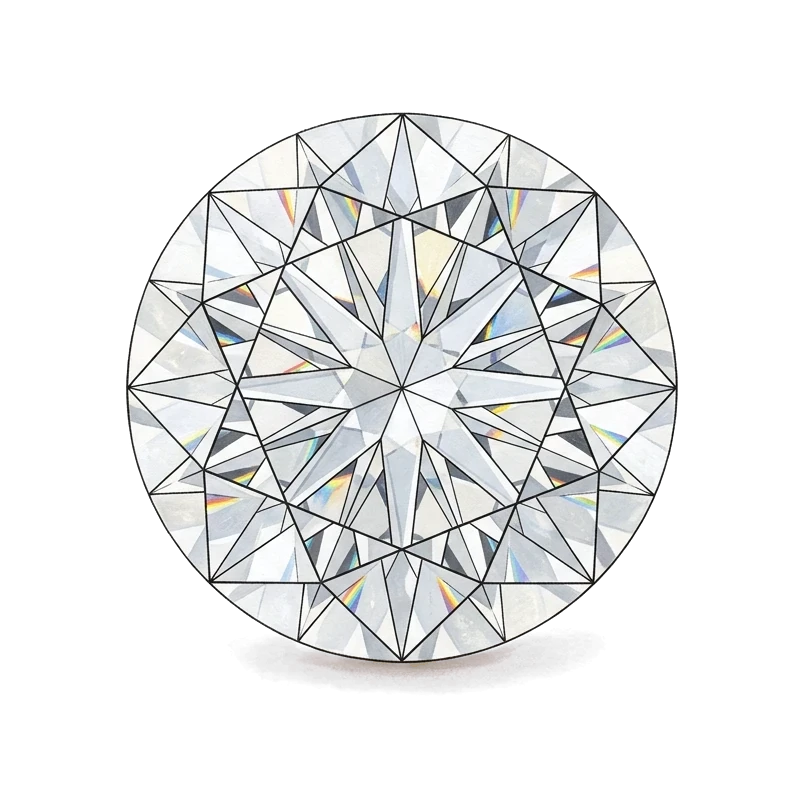
What does a diamond symbolize?
Strength first of all. The name comes from the Greek adamas, “invincible” or “unbreakable,” and almost every old belief about the stone grew out of its hardness or its clarity. Wearing one was supposed to bring victory, and with it strength, fortitude and courage.
In The Curious Lore of Precious Stones (1913), George F. Kunz called the diamond the “king-gem” and the pearl the “queen-gem”: one an emblem of fearlessness, the other of modesty and purity. He thought that made it fitting to give the two together.
Kunz also collected the stranger side of diamond symbolism:
- A guard against the dark. The medieval writer Marbodus wrote that a diamond set in gold and worn on the left arm drove away ghosts of the night.
- The devil’s enemy. For St. Hildegard, the devil hated the diamond because it resisted his power by day and by night.
- A peacemaker. The writer Rueus called it “a gem of reconciliation,” since it was thought to strengthen a husband’s love for his wife.
- A test of innocence. The Talmud describes a gem worn by the high priest, perhaps a diamond, that dimmed in the presence of the guilty and shone brighter for the innocent.
Not everyone agreed. Cardano thought a diamond made its owner unhappy: it gave courage, but “there is nothing that contributes more to our safety than prudence and fear.”
A diamond for lasting love
The romantic meaning is the newest layer. Diamonds became fashionable among Europe’s elite in the 1400s. Today a diamond engagement ring stands for love and marriage almost everywhere in the world.
Is the diamond in the Bible?
Possibly. The King James Version and Luther’s German Bible both put a diamond in the second row of the high priest’s breastplate. Their source is the Hebrew yahalom, read as “the smiter,” a fitting name for a stone that can cut all others.
Kunz didn’t believe it. Diamonds weren’t used to engrave other stones that early, so he preferred the traditional reading of yahalom as onyx.
He doubted, too, that the ancients knew the diamond at all. A second-century poem promised that the evil eye had no power over anyone wearing “the diamond as a charm,” but its adamas, he thought, was probably white sapphire or quartz.
Diamond colors: colorless to fancy
Most diamonds fall in the normal color range, from colorless to light yellow or brown, graded on GIA’s D-to-Z scale. Colorless stones are scarce, since most diamonds have a tint of yellow or brown, and even a slight tint makes a big difference to the price.
Fancy color diamonds are the exception. They’re yellows and browns stronger than Z, or any other color, and only about one diamond in 10,000 has one. Here the rule flips: the stronger and purer the color, the more the stone is worth.
-

Colorless
The top of GIA’s D-to-Z color scale, and the rarest diamonds in the normal range.
#EEF2F6
-
Near-colorless to light yellow
Most diamonds have a tint of yellow or brown, and the grade drops as it gets stronger.
#F3EBCF
-
Fancy yellow
Yellow beyond the Z grade. With brown, the most common fancy color.
#F2D16B
-
Fancy brown
Common, and usually worth less than the rarer fancy colors.
#9C6B3F
-
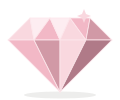
Fancy pink
Rare, and with blue and green among the most valued fancy hues.
#F2B8C6
-

Fancy blue
Less than one boron atom per million carbon atoms can turn a diamond blue.
#8FB8DE
-
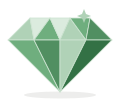
Fancy green
Among the rarest colors, with red, purple and orange.
#6FAE7E
-
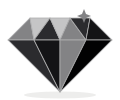
Black
Black, gray and white diamonds count as fancy colors too.
#2B2B2E
Red, green, purple and orange are the rarest fancy colors, followed by pink and blue. Yellow and brown are the most common and usually cost less. Many natural fancy colors are soft rather than vivid, so a large, intense stone is extremely rare.
The 4Cs of diamonds: how quality is graded
Jewelers grade diamonds with the system GIA set out in the 1950s, built on four factors: color, clarity, cut and carat weight. Three of them go back much further: color, clarity and weight were the basis of a grading system in India more than 2,000 years ago.
- Color. At GIA’s lab, a diamond is compared with masterstones of known color on the D-to-Z scale. About 35 percent of gem diamonds fluoresce under UV light, usually blue. Strong blue can make a yellowish stone look whiter in sunlight, but too much can make it look cloudy.
- Clarity. There are 11 grades, from Flawless down to Included, judged at 10x magnification. Flawless stones are so rare that you can spend a lifetime in the trade without seeing one. Most diamonds sold sit in the middle, with inclusions visible only under the loupe.
- Cut. Proportions, symmetry and polish decide how a diamond handles light: its brightness, its fire (flashes of color) and its scintillation. Shapes other than the round brilliant, like the oval, pear or princess, are called fancy cuts.
- Carat weight. A carat is 0.2 gram, divided into 100 points. Bigger diamonds are rarer, so they cost more per carat, and a stone just over a “magic size” like one carat can cost up to 20 percent more than one a few points under.
Behind every grade is rarity: the scarcer a quality, the more a diamond that has it is worth.
Is a diamond good for everyday wear?
| Hardness | 10 on the Mohs scale |
|---|---|
| Everyday ring? | Great for everyday Hard and tough enough for a ring worn every day. |
| Family | Diamond |
| Main sources | Russia, Botswana, Canada, DR Congo, South Africa, Australia |
| Treatments | Some are fracture-filled or color-treated. A grading report says so. |
| Lab-grown | Yes. It costs a fraction of the price of a mined diamond of the same size and grade. |
| Anniversary | 60th and 75th wedding anniversary |
Diamond forms under heat and pressure about 100 miles below the surface, and its carbon atoms are bonded the same way in every direction. Graphite is carbon too, soft enough to write with. Diamond is so hard that only another diamond can scratch it.
That makes it the safest choice for a ring worn every day, though not an indestructible one. Hardness isn’t toughness: a sharp knock can still chip a diamond, so it’s worth having the setting checked now and then.
Where diamonds are found
Diamond is the only gem made of a single element, typically about 99.95 percent carbon. Most diamonds formed more than a billion years ago, and a typical mine yields about one part diamond to a million parts rock.
Production has grown enormously. In the 1870s the world mined well under a million carats a year, and by the 1990s it passed 100 million.
Botswana’s Jwaneng mine opened in 1982 and made the country one of the world’s top producers, and Australia and Canada joined the major sources in the 1980s and 1990s. Russia is now one of the largest producers by both volume and value.
Famous diamonds
-
The Hope diamond
Sold to Louis XIV in 1668
Traced to India’s Golconda mines, it was known at the French court as the French Blue. Today it’s a 45.52-carat blue.
-
The Cullinan
Found in 1905
At 3,106 carats, the largest diamond ever found. Its biggest cut stone, the 530-carat Cullinan I, is set in the British royal scepter.
-
The Pink Star
Auctioned in 2017
A 59.60-carat pink diamond that became the most expensive gem ever sold at auction.
-
The Black Orloff
A 67.50-carat cushion-cut black diamond, reportedly cut from 195-carat rough.
Stones sold as diamonds
Old trade names lent the word to cheaper clear stones: quartz, zircon, topaz and even glass.
| Sold as | What it is |
|---|---|
| Arkansas diamond | Rock crystal (quartz) |
| Alaska diamond | Rock crystal (quartz) |
| Ceylon diamond | Colorless zircon |
| Matura diamond | Colorless heated zircon |
| Saxon diamond | Colorless topaz |
| Strass diamond | Glass |
Lab-grown or mined: what the label has to say
A lab-grown diamond has essentially the same chemical, physical and optical properties as a mined one. The label is where they part ways. Under US rules, “diamond” on its own means a mined stone, and a lab-grown one must say “laboratory-grown,” “laboratory-created” or something just as clear right before the word.
A seller may call it “cultured” only with that same disclosure, and “faux” doesn’t count as one. The other big difference is price, and the gap grows with size, as the price table shows.
| Type | What to know |
|---|---|
| Natural | Mined. Some are fracture-filled or color-treated. A grading report says so. |
| Lab-grown | Real diamond, made in a lab. It costs a fraction of the price of a mined diamond of the same size and grade. |
| Imitation | Cubic zirconia, moissanite and glass look like diamond but are different materials. |
| Type | Price |
|---|---|
| Natural, 1 carat | $3,200–$4,700 |
| Lab-grown, 1 carat | $450–$700 |
| Natural, 2 carats | $18,600–$20,000 |
| Lab-grown, 2 carats | $1,000–$1,200 |
Each range runs from the lowest to the highest median asking price at the sellers and price trackers cited, rounded. Lab-grown prices fell by about a quarter in the year to October 2026.
Prices vary with size, color, clarity and seller. They’re a guide to what shops ask, not a valuation or an investment view.
How to clean a diamond
Cleaning diamond
- Warm soapy water, soft brush
- Safe
- Ultrasonic cleaner
- Use with caution
- Steam cleaner
- Use with caution
GIA leaves ultrasonic and steam cleaning to a jeweler, who checks for loose stones first. Never use an ultrasonic on a fracture-filled stone.
A diamond is usually tough enough for an ultrasonic cleaner, but not if it has many inclusions or has been treated. For those, use a lint-free cloth or warm water, mild soap and a soft toothbrush.