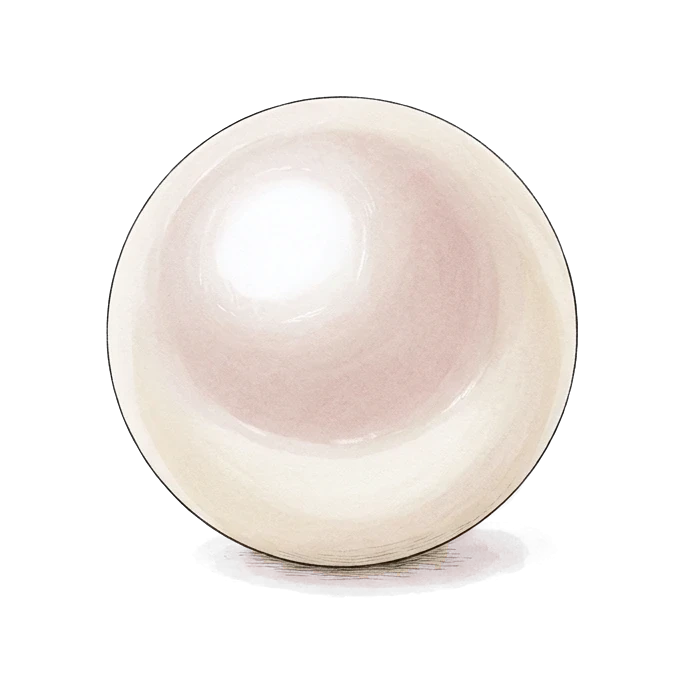
What does a pearl symbolize?
Purity, above all. In Europe pearls stood for modesty, chastity and purity, and their link with humility and innocence made them a traditional wedding gift.
Kunz’s 1913 book on gem lore calls the pearl the “queen-gem” to the diamond’s “king-gem,” an emblem of modesty and purity.
Much of pearl symbolism comes from water. Pearls grow in ponds, lakes and seas, and they’ve long carried the mystery and life-giving power people saw there. Their round shape tied them to the moon in many cultures.
Where pearls came from was a puzzle for centuries, and every culture had its answer:
- The Middle East: teardrops fallen from heaven.
- China: the brain of a dragon. Pearls were also thought to protect against fire and fire-breathing dragons.
- Columbus’s Europe: dew drops, formed into pearls by the mollusk.
Pearls in the Bible
The best-known pearl in the Bible is in a parable. In Matthew 13, the kingdom of heaven is like a merchant who finds “one pearl of great price” and sells all he has to buy it. Earlier in the same gospel comes the warning not to cast “pearls before swine.”
Pearls also stand for what is most precious. The Book of Job says wisdom is worth more than coral or pearls, and in Revelation each of the twelve gates of the New Jerusalem is made “of one pearl.”
Pearls through history
A Chinese historian wrote the oldest known record of pearls in 2206 BC. Divers have taken them from the Arabian Gulf for at least 5,000 years, from the Strait of Mannar since 2000 BC and from the Red Sea since 300 BC.
When Columbus met people wearing pearls on his voyages of 1498 and 1502, the waters of today’s Venezuela and Panama became a new source. Within a hundred years they were in decline, with overfishing among the causes. Japanese pioneers produced whole cultured pearls around 1900, and by the 1920s cultured pearls were commercially important, just as natural pearls were growing scarce.
Types of pearls and pearl colors
There are four main types of cultured pearls: akoya, South Sea, Tahitian and freshwater. The type tells you a lot about a pearl’s color and size. Here they are, with South Sea pearls in both white and gold, plus natural pearls:
-

Akoya Saltwater cultured
From Japan and China. White or cream akoyas are the classic strand.
#F4EFE6
-

South Sea Saltwater cultured
Australia, Indonesia and the Philippines. Large, with thick nacre, white to silver.
#E9E6DF
-
Golden South Sea Saltwater cultured
Golden instead of white, depending on the oyster that grows it.
#D9B65E
-

Tahitian Saltwater cultured
French Polynesia. Gray, black or brown, often with green, blue, purple or pink overtones.
#3A3A3F
-

Freshwater Freshwater cultured
Mostly from China, in the widest range of sizes, shapes and colors.
#EBCFCF
-

Natural pearl
Grown with no human help at all, and rare today.
#F1E9DA
White and cream are the most familiar pearl colors, and black, gray and silver are fairly common, but pearls come in every hue. Their color has up to three layers:
- Bodycolor: the main color every pearl has.
- Overtone: a translucent tint lying over it, usually pink (sometimes called rosé), green, purple or blue.
- Orient: a shimmer of rainbow colors on or just below the surface, which only some pearls show.
Natural vs. cultured pearls
A natural pearl forms around a microscopic irritant inside a mollusk, with no human help of any kind. Cultured pearls need people.
A technician implants a shell bead with a small piece of mantle tissue into a host mollusk, or slips in pieces of tissue alone, and the mollusk coats them with nacre until the pearls are harvested.
Saltwater cultured pearls are always grown on a bead. Freshwater ones usually grow from tissue alone, often with many pearls in one mollusk. Thousands of years of pearl fishing have wiped out most natural pearl beds, so cultured pearls make up the vast majority of pearls sold today.
Is pearl durable enough for everyday wear?
| Hardness | 2.5–3 on the Mohs scale |
|---|---|
| Everyday ring? | Occasional wear Too soft or fragile for a daily ring. Best in earrings, pendants and rings for special days. |
| Family | Organic gem |
| Main sources | China (freshwater), Japan and China (Akoya), Australia to the Philippines (South Sea), French Polynesia (Tahitian) |
| Lab-grown | Pearls aren't made in labs. Almost all sold today are cultured, grown by a mollusk after a farmer implants a bead or tissue. |
| Anniversary | 3rd and 30th wedding anniversary |
Pearls are soft, at 2.5 to 3 on the Mohs scale, so they scratch easily. Store them apart from other gems and metal jewelry. A pearl with thin nacre is weaker too: if you can see the bead through it, or the pearl looks dull and chalky, it won’t wear as well.
Where pearls come from
Pearl farms need clean water, so most sit far from cities, often in beautiful places.
- Akoya: Japan and China, especially the southern coasts of Guangdong and Guangxi provinces.
- South Sea: from northern Australia through Indonesia to Southeast Asia, with large farms in the Philippines.
- Tahitian: French Polynesia, including the Gambier Islands and the Tuamotu Archipelago.
- Freshwater: China, by far the main source.
Natural pearls came from the Persian Gulf, the waters off Sri Lanka, China’s rivers and lakes and the rivers of Europe. Only small quantities are still found in the old fishing grounds.
Famous pearls
-
La Peregrina
Found in the 1500s
A 50.56-carat natural pearl from the Gulf of Panama. Richard Burton gave it to Elizabeth Taylor in 1969, and the Cartier necklace holding it sold for $11.8 million in 2011.
-
Philip II’s great pearl
Given in 1595
A pear-shaped pearl, a gift of the Spanish king, hung from the cross the prior of El Escorial wore in processions.
-
Mikimoto’s cultured pearl
1893
Kokichi Mikimoto succeeded in culturing a pearl in Japan.
-
The Cartier mansion
1917
Pierre Cartier traded a double strand of natural pearls for a mansion at 653 Fifth Avenue in New York.
Pearl names that aren’t what they seem
US rules are strict about the word. On its own, “pearl” means a natural pearl.
A cultured pearl must be called cultured, and an imitation must be called imitation, artificial or simulated, with that word right before “pearl.” So “faux” or “fashion” pearls are imitations, and a “synthetic” pearl doesn’t exist under the rules: the word can’t be used for cultured or imitation pearls.
| Sold as | What it is |
|---|---|
| Faux or fashion pearl | An imitation pearl |
| “Kultured” or semi-cultured pearl | An imitation pearl, not a cultured one |
| Synthetic pearl | A cultured or imitation pearl. No pearl is synthetic |
| “Oriental” cultured pearl | A misnomer: “Oriental” may only describe a natural saltwater pearl of the Persian Gulf type |
How to buy pearls
GIA judges pearls on seven value factors:
- Size. Bigger pearls of the same type are rarer and worth more.
- Shape. Round is the hardest shape to culture, so it’s the rarest, though fine drops, ovals and baroque (irregular) pearls have their fans.
- Color. Prices follow supply and demand, and fashion plays a part.
- Luster. Possibly the most important factor. Look for bright, sharp reflections on the surface.
- Surface. A few small marks hidden by a drill hole matter little. Many or deep ones lower the value and can weaken the pearl.
- Nacre. Thick nacre gives better luster and a pearl that lasts.
- Matching. In a strand or a pair of earrings, the pearls should match in all of the above.
| Type | What to know |
|---|---|
| Natural | Grown by a wild mollusk with no help from people. Natural pearls are rare and expensive today. |
| Lab-grown | Pearls aren't made in labs. Almost all sold today are cultured, grown by a mollusk after a farmer implants a bead or tissue. |
| Imitation | Imitation pearls are manufactured to look like pearls. US rules require the word “imitation,” “artificial” or “simulated” before “pearl.” |
| Type | Price |
|---|---|
| AA+ grade | $580 |
| AAA grade | $795–$840 |
| Hanadama (top grade) | $1,400 |
Asking prices at two US pearl specialists. Smaller pearls, silver settings and lower grades cost less.
Prices vary with size, color, clarity and seller. They’re a guide to what shops ask, not a valuation or an investment view.
How to clean and care for pearls
Cleaning pearl
- Warm soapy water, soft brush
- Usually safe
- Ultrasonic cleaner
- Never
- Steam cleaner
- Never
Wipe pearls with a soft damp cloth after each wear and use soapy water only now and then. Put on perfume, hair spray and makeup first, and never store pearls in plastic.
Put pearls on last, after perfume, hair spray and makeup, and wipe them with a soft, damp cloth after each wear. Never keep them in a plastic bag, which can give off a chemical that damages their surface.