What does alexandrite mean?
Alexandrite meaning starts with the stone’s name. Rich deposits of a new color-changing stone were found in Russia’s Ural Mountains in 1830, and it was named for the young Alexander II, heir to the throne. Its red and green caught the country’s attention because they matched the military colors of imperial Russia.
Writing in 1913, George F. Kunz counted alexandrite among the few stones to win a talismanic reputation “in our time.” With red and green as Russia’s national colors, it became a great favorite there and was looked on as a stone of good omen. Alexander himself became the tsar who freed Russia’s serfs, and he was assassinated in 1881.
That’s the whole of its traditional meaning. Alexandrite was found far too late for ancient or medieval lore, and we know of no older source for the ideas of change and balance you’ll see attached to it elsewhere. They’re modern readings of its color change.
Alexandrite color change: emerald by day, ruby by night
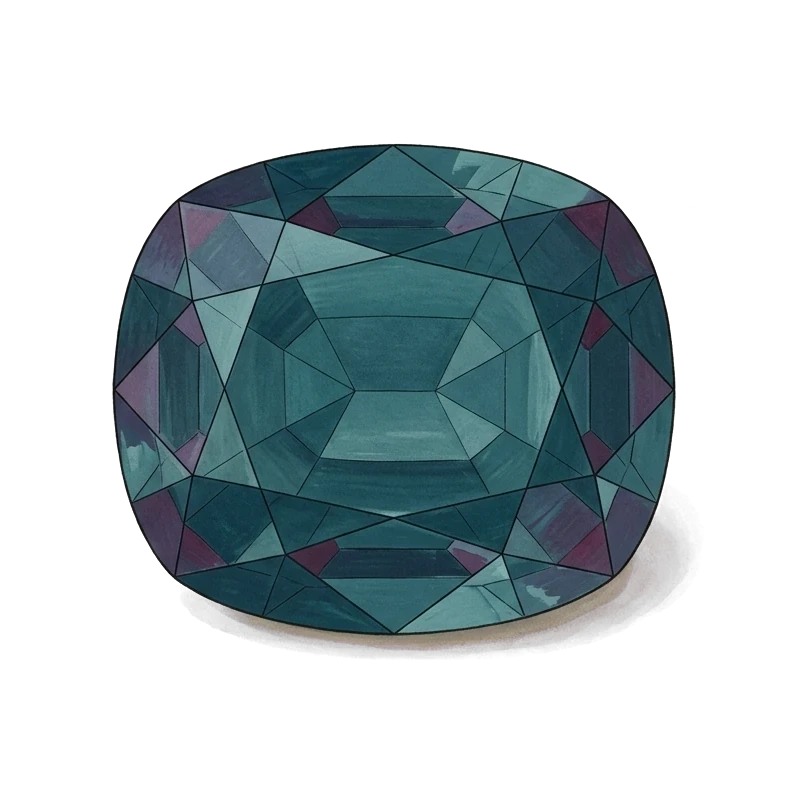
Alexandrite is green in daylight or fluorescent light and turns brownish or purplish red in the warm light of a lamp or candle. Gem lovers sum it up as “emerald by day, ruby by night.”
The change comes from the way the mineral absorbs light. An absorption band at about 580 nanometers lets it shift between red and green as the light source changes.
Alexandrite is also strongly pleochroic, showing green, orange and purplish red from different directions, but that isn’t what causes the color change.
-


Russian alexandrite
Bluish green to purplish red: still the standard. The original mines are mostly worked out.
Daylight #2E7D73
Lamplight #8E3B6E
-


Sri Lankan alexandrite
Often larger, but its green leans yellow and its red leans brown.
Daylight #6E8A3C
Lamplight #7E3F36
-


Brazilian alexandrite
Some rival the Russian colors, though Brazil now produces less.
Daylight #3C8070
Lamplight #873B66
-


Cat’s-eye alexandrite
Parallel needle inclusions add a cat’s-eye to the color change. Extremely rare.
Daylight #557D52
Lamplight #7D4660
Other gems change color too, among them a few garnets and sapphires. Alexandrite’s change is so striking that the effect itself is often called the alexandrite effect. If you’re comparing, see our section on color change garnet.
Is alexandrite good for everyday wear?
| Hardness | 8.5 on the Mohs scale |
|---|---|
| Everyday ring? | Great for everyday Hard and tough enough for a ring worn every day. |
| Family | Chrysoberyl |
| Main sources | Brazil, Sri Lanka, East Africa, Russia (historic) |
| Lab-grown | Yes. It costs nowhere near as much per carat as natural alexandrite. |
| Anniversary | 55th wedding anniversary |
Yes. Alexandrite is hard, has excellent toughness and no cleavage (a tendency to split when struck), which makes it a good choice for rings and other jewelry worn every day.
Where alexandrite is found
The Ural deposits didn’t last, and most alexandrite now comes from Sri Lanka, East Africa and Brazil. The newer mines have some fine stones, but many show a less precise color change and muddier colors than the 19th-century Russian ones.
Sri Lankan stones are usually larger than Russian ones, though their greens lean yellow and their reds brown. Some Brazilian alexandrite rivals the Russian colors, but production there has dropped. Fine-colored material is extremely rare.
Famous alexandrites
-
Russia’s first alexandrites
From 1830
The Ural finds had vivid colors and a dramatic change, and they’re still the quality standard. Some survive in estate jewelry.
-
The British Museum alexandrite
A 43-carat stone, enormous for a gem usually cut under a carat.
-
Ceylon’s giants
Recorded in 1913
Kunz noted Sri Lankan alexandrites of about 60 carats, at a time when Russian gems rarely passed three.
Names to watch for
Lab-grown alexandrite is real alexandrite made in a lab, but much cheap “alexandrite” jewelry isn’t alexandrite at all: it’s usually lab-made color-change corundum, or sometimes color-change glass. The trade has also borrowed the name for a sapphire.
| Sold as | What it is |
|---|---|
| Blue alexandrite | Color-change sapphire |
How to buy alexandrite
The color change comes first, so look at the stone in daylight and under a warm lamp before you buy. In a fine stone, both colors are moderately strong to strong: too light and it lacks intensity, too dark and it looks almost black.
- Clarity: alexandrite tends to have few inclusions, and clean stones with a good change and strong colors are worth far more. Rarely, parallel needles create a cat’s-eye.
- Cut: most are mixed cuts, with a brilliant-cut top and a step-cut base. Cutters orient the stone to show the strongest change face-up, and its rarity means it’s often cut to save weight.
- Size: most cut alexandrites weigh less than a carat, and larger, better stones rise in price dramatically.
| Type | What to know |
|---|---|
| Natural | Mined. Ask the seller whether it has been treated. |
| Lab-grown | Real alexandrite, made in a lab. It costs nowhere near as much per carat as natural alexandrite. |
| Imitation | Cheap “alexandrite” jewelry is usually lab-made color-change corundum or glass. |
| Type | Price |
|---|---|
| Natural, small to large stones | $2,000–$16,000 |
Prices vary with size, color, clarity and seller. They’re a guide to what shops ask, not a valuation or an investment view.
How to clean alexandrite
Cleaning alexandrite
- Warm soapy water, soft brush
- Safe
- Ultrasonic cleaner
- Usually safe
- Steam cleaner
- Usually safe
GIA recommends warm, soapy water, and says ultrasonic and steam cleaning are usually fine too.