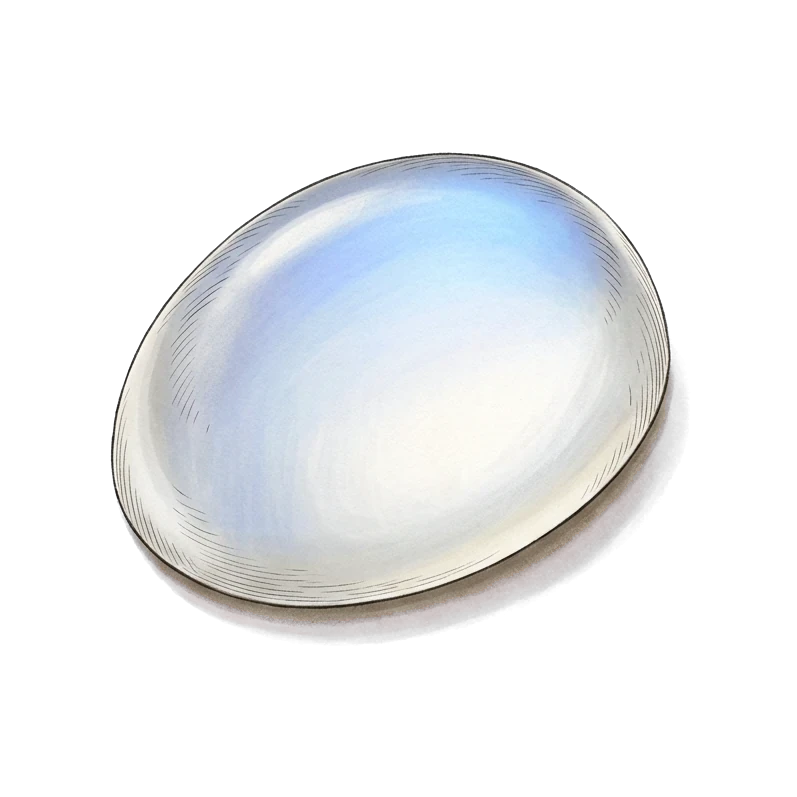
What does moonstone mean?
Love and good luck. Legends say moonstone brings good fortune, and it has long been tied to love, passion and fertility.
Most of its lore, though, comes back to the moon. Its glow looks like a full moon shining through thin, high clouds, and Hindu mythology says the stone is made of solidified moonbeams. The Romans and Greeks linked it with their lunar gods.
In India, Kunz wrote in 1913, it was a sacred stone, never put up for sale except on a yellow cloth, since yellow was an especially sacred color.
A stone for lovers
Moonstone ranked high as a gift between lovers. It was believed to awaken “the tender passion” and to let a couple read the fortune, good or bad, that lay ahead, as long as one of them held the stone in their mouth while the moon was full.
Moonstone symbolism in jewelry
Its modern image owes a lot to designers. René Lalique and Louis Comfort Tiffany set the pale stone in their custom Art Nouveau pieces, and Arts and Crafts artisans worked it into handmade silver. It came back with the “flower child” look of the 1960s and with New Age designers in the 1990s.
Moonstone color: the sheen and the stone
Moonstone has two colors to judge: its body color and its sheen. Stones range from semitransparent to opaque and from colorless to white, with a blue, silver or white sheen. The body can also be green, yellow to brown, or gray to almost black.
The ideal hasn’t changed in centuries: a colorless, nearly transparent stone with no visible inclusions and a vivid blue sheen. The sheen should sit centered on top and show from a wide range of angles, and if you can only see it from one narrow angle, the stone is worth less.
-

Blue-sheen moonstone Orthoclase
Colorless and nearly transparent with a vivid blue sheen: the finest kind.
#E6ECF2
-

Rainbow moonstone Labradorite
A light stone with a multicolored sheen, found in Madagascar. Technically a labradorite.
#D5DEE8
-
Peach moonstone
Orange to yellow body color, popular today.
#F0D5C0
-

Gray moonstone
Body colors run from gray to nearly black.
#7A7A80
-

Green moonstone
“Parrot green” moonstone, found in southern India in 1997.
#8DB06A
-

Cat’s-eye moonstone
Shows a cat’s-eye band along with its sheen. A few show a four-rayed star.
#D9D4C7
Rainbow moonstone vs. moonstone
Strictly speaking, rainbow moonstone isn’t moonstone. Classic moonstone is orthoclase with a single blue, silver or white sheen. Rainbow moonstone is a labradorite, another feldspar, found in Madagascar with a multicolored sheen over a light body color.
The name has stuck anyway. As GIA puts it, to be called moonstone, a stone’s actual mineral matters less than the beauty of its sheen, and a third feldspar, sanidine, can be called moonstone too.
Why moonstone glows
Moonstone is a variety of orthoclase feldspar. As it forms, orthoclase and albite separate into thin, stacked layers, and light scattering between them produces the glow, called adularescence.
The layers are about half a micron thick, close to the size of a wavelength of light. Turn the stone and the light seems to roll across its surface.
Is moonstone durable enough for everyday wear?
| Hardness | 6–6.5 on the Mohs scale |
|---|---|
| Everyday ring? | Occasional wear Too soft or fragile for a daily ring. Best in earrings, pendants and rings for special days. |
| Family | Feldspar |
| Main sources | India, Sri Lanka, Brazil, Madagascar, Myanmar, Tanzania |
Not for a ring worn every day. Moonstone is only moderately hard, at 6 to 6.5, and has poor toughness, and high heat can crack it. Many stones also carry tiny tension cracks that gemologists call centipedes, after their many-legged look.
Where moonstone is found
The most important sources are India and Sri Lanka. Moonstone also comes from Brazil, Madagascar, Myanmar and Tanzania, and in the US from New Mexico, North Carolina and Virginia.
Feldspars make up more than half of the earth’s rocky crust, so moonstone comes from one of the most common minerals there is. Large fine stones are very rare all the same.
Florida made moonstone its official state gem in 1970, to honor the Apollo 11 moon landing and the spaceflights launched from Kennedy Space Center. The stone isn’t found naturally in Florida, or on the moon.
Famous moonstones
Moonstone’s fame rests on jewels and stories more than on record-breaking stones.
-
A Frankish disk brooch
Late 600s
A gold brooch set with moonstone (adularia), garnets and glass, now at the Metropolitan Museum of Art.
-
Mizauld’s moonstone
Reign of Edward VI
A traveler’s “selenite or moonstone,” said to show a white spot that waxed and waned with the moon. Its owner dedicated it to the young king.
Moonstone names that mislead
Rainbow moonstone is the best-known case, but the trade has stretched the name to cover a dyed stone too, and sold moonstone under another gem’s name.
| Sold as | What it is |
|---|---|
| Rainbow moonstone | Labradorite (another feldspar) |
| Blue moonstone | Dyed blue chalcedony |
| Ceylon opal | Moonstone |
How to buy moonstone
Buyers look at three things: the body color, the color of the sheen and where the sheen sits.
- Clarity: the stone should be close to transparent, since inclusions can get in the way of the sheen.
- Cut: most moonstone is cut as a smooth, domed cabochon, which shows the sheen best. It should be evenly shaped and not too flat, because a flat one barely shows any sheen. Faceted moonstone is becoming more common, and carvings like the “man in the moon” play on the name.
- Size: moonstone comes in all sizes, but fine material is getting scarcer in large stones, which makes a large fine one fairly valuable.
| Type | What to know |
|---|---|
| Natural | Mined. Ask the seller whether it has been treated. |
| Imitation | Glass sold as “opalite” and colored chalcedony can pass for moonstone. |
| Type | Price |
|---|---|
| Classic moonstone | $1.30–$15 |
| Rainbow moonstone | $5–$60 |
| Cat’s-eye moonstone | $3–$50 |
Prices vary with size, color, clarity and seller. They’re a guide to what shops ask, not a valuation or an investment view.
How to clean moonstone
Cleaning moonstone
- Warm soapy water, soft brush
- Safe
- Ultrasonic cleaner
- Never
- Steam cleaner
- Never
It can crack in high heat.
Warm, soapy water with a soft brush is the best way to clean it. Skip ultrasonic and steam cleaners, since heat can crack the stone.