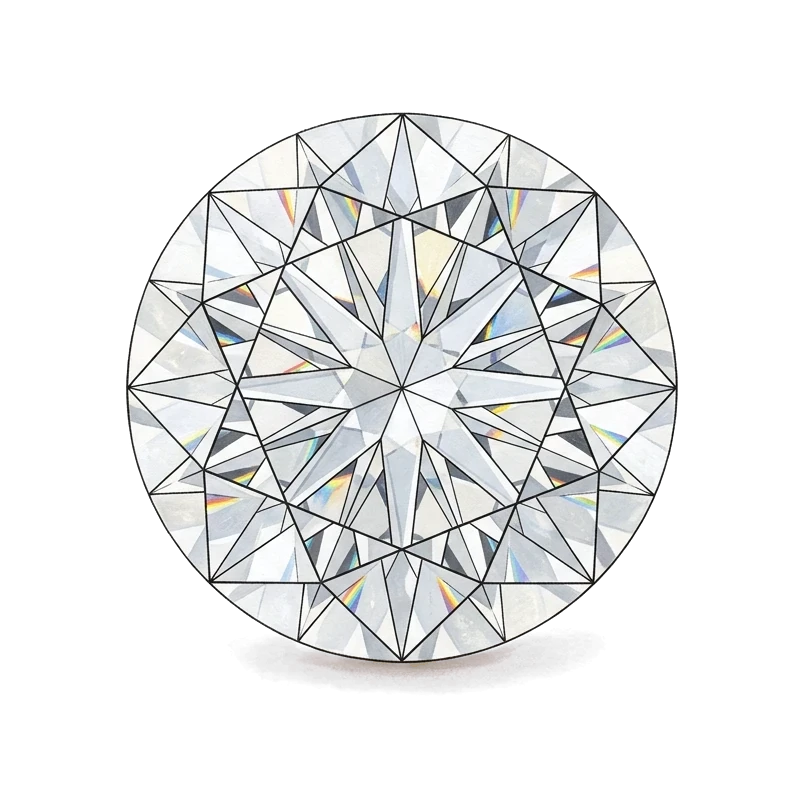
What does the April birthstone mean?
The word diamond comes from the Greek adamas, “invincible” or “unbreakable.” The April verse Kunz recorded calls it an “emblem of innocence,” and today it stands for strength, clarity and lasting love.
India was the first source. Diamonds were traded there as early as the 4th century BC, and by the 1400s they were in fashion among Europe’s elite. The first recorded diamond engagement ring was given in 1477, by Archduke Maximilian of Austria to Mary of Burgundy.
Brazil took over in the 1700s, and the finds near Kimberley, South Africa, in the late 1860s started the modern diamond market. The older lore, from charms against night ghosts to a “gem of reconciliation” between husband and wife, is in our guide to diamond meaning and symbolism.
April birthstone color: colorless, and every other color
Most diamonds sold are colorless or close to it, graded from D (colorless) down the alphabet as a yellow or brown tint appears. Strong natural colors are rare: the deep blue Hope diamond, traced to India’s Golconda area, is the best-known example.
-
 Colorless
-
 Yellow
-
 Pink
-
 Blue
Is a diamond good for everyday wear?
| Hardness | 10 on the Mohs scale |
|---|---|
| Everyday ring? | Great for everyday Hard and tough enough for a ring worn every day. |
| Family | Diamond |
| Main sources | Russia, Botswana, Canada, DR Congo, South Africa, Australia |
| Treatments | Some are fracture-filled or color-treated. A grading report says so. |
| Lab-grown | Yes. It costs a fraction of the price of a mined diamond of the same size and grade. |
| Anniversary | 60th and 75th wedding anniversary |
Diamond is the hardest natural material, which is why it suits a ring worn every day. Hard isn’t unbreakable, though: diamonds can chip, especially where two stones touch in a setting, so have a jeweler check it now and then.
Lab-grown vs. natural diamonds: how to buy and what they cost
Diamonds are graded on the 4Cs: color, clarity, cut and carat weight. A grading report from an independent lab confirms all four, says whether the stone is natural or lab-grown, and discloses treatments such as fracture filling.
| Type | What to know |
|---|---|
| Natural | Mined. Some are fracture-filled or color-treated. A grading report says so. |
| Lab-grown | Real diamond, made in a lab. It costs a fraction of the price of a mined diamond of the same size and grade. |
| Imitation | Cubic zirconia, moissanite and glass look like diamond but are different materials. |
| Type | Price |
|---|---|
| Natural, 1 carat | $3,200–$4,700 |
| Lab-grown, 1 carat | $450–$700 |
| Natural, 2 carats | $18,600–$20,000 |
| Lab-grown, 2 carats | $1,000–$1,200 |
Each range runs from the lowest to the highest median asking price at the sellers and price trackers cited, rounded. Lab-grown prices fell by about a quarter in the year to October 2026.
Prices vary with size, color, clarity and seller. They’re a guide to what shops ask, not a valuation or an investment view.
The gap between natural and lab-grown widens with size: at two carats, a lab-grown stone costs less than a tenth of a natural one of the same grade.
How to clean and care for a diamond
Cleaning diamond
- Warm soapy water, soft brush
- Safe
- Ultrasonic cleaner
- Use with caution
- Steam cleaner
- Use with caution
GIA leaves ultrasonic and steam cleaning to a jeweler, who checks for loose stones first. Never use an ultrasonic on a fracture-filled stone.
At home, soak diamond jewelry in warm water with mild soap and scrub gently with a soft toothbrush. Avoid chlorine bleach and abrasives like toothpaste, which can damage the metal of the setting. Ultrasonic and steam cleaning are best left to a jeweler, who can check for loose stones first.
April birthstone gift ideas
The diamond birthstone is also the classic engagement stone, so it suits gifts that mark a milestone.
-
Diamond stud earrings
The classic April gift. Lab-grown studs give the same sparkle at a much lower price.
-
A fancy-color accent
A small yellow or pink diamond makes an April gift that doesn’t look like an engagement ring.
-
A diamond pendant
A single stone on a fine chain is wearable every day and suits any age.
-
A milestone anniversary gift
Diamond is the traditional gem for the 60th and 75th wedding anniversaries.
Diamond colors for parties and design
Diamond white with a touch of ice blue makes a crisp April palette. The codes are below.
- Colorless Diamond #EEF2F6 rgb(238, 242, 246)
- Yellow Diamond #F2D16B rgb(242, 209, 107)
- Pink Diamond #F2B8C6 rgb(242, 184, 198)
- Blue Diamond #8FB8DE rgb(143, 184, 222)
Every month’s stones in one palette, with a free download: birthstone colors by month.