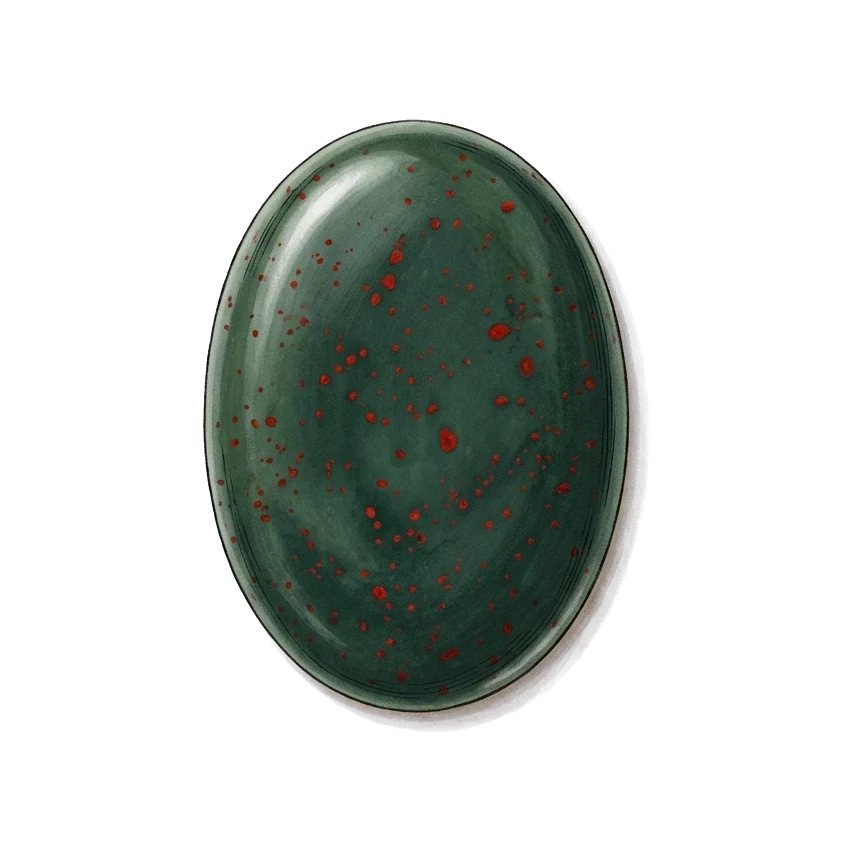
What does bloodstone mean?
Courage. Bloodstone has long stood for bravery, probably through its blood-red spots and its link to Mars, the Roman god of war who gave March its name. An American birthstone book from 1879, A Christmas Ring, already calls it March’s “tutelary gem.”
Much of the bloodstone meaning, though, comes from two older stories: one about the sun, and one about the cross.
Heliotrope, the stone that turned the sun
Its other name, heliotrope, comes from the Greek for “sun” and “turning.” Pliny the Elder wrote that, dipped in water and turned toward the sun, the stone gave back a red reflection.
Over time the story grew. The gemologist George F. Kunz, in The Curious Lore of Precious Stones (1913), describes how the red glint became a power to turn the sun itself blood-red and to raise thunder, lightning, rain and storms. The old treatise of Damigeron adds that it foretold the future through rain and “audible oracles.” Kunz suspected the conjurors simply watched the sky for a coming storm before they consulted the stone.
The Leyden papyrus, as Kunz quotes it, praises bloodstone as an amulet without equal. Whoever carried it would be given whatever they asked for, could calm the anger of kings, and would be believed whatever they said.
The martyr’s stone
In Christian legend, the red spots were the blood of Christ. Medieval Christians tied the stone to the crucifixion and to martyrdom, and some carvers set the head of Christ so the spots fall like drops of blood.
Bloodstone color: green with red spots
What is bloodstone, exactly? A dark green chalcedony, darker than chrysoprase or prase. Its red to orange spots are iron oxides such as hematite, and they’re what set it apart from plain green plasma.
-

Dark green
#2F5A43
-
Red spots
#8B1A1A
Some stones have only a few spots, or none at all, and the stone’s opacity comes from tiny needle-like crystals of actinolite or hornblende inside it.
Is bloodstone durable?
| Hardness | 6.5–7 on the Mohs scale |
|---|---|
| Everyday ring? | Everyday, with care Fine in a ring if you take it off for chores and sports. Safest in earrings and pendants. |
| Family | Chalcedony (quartz) |
| Main sources | India, Brazil, Australia, China, United States |
| Lab-grown | No lab-grown bloodstone is known. |
Bloodstone is 6.5 to 7 on the Mohs scale, and tough: it resists chipping and breaking better than most gemstones. It’s usually cut as smooth cabochons or carved, though it can be faceted.
Where bloodstone comes from
India is the largest producer. The United States has many localities, mostly in California, and other sources include Australia, Brazil and China. It forms in cracks and cavities in rock, and turns up as pebbles in riverbeds.
Famous bloodstone carvings
Bloodstone is more often carved or polished into domes than faceted, and carved pieces survive in museums, among them these.
-
Heliotrope cameos
About 1560
Cameos of the Virgin and of Christ carved in heliotrope, on display in Florence.
-
Christ’s head in bloodstone
Some carvers placed the thorn-crowned head of Christ so the red spots read as drops of blood.
-
A German snuffbox
About 1740
A snuffbox of bloodstone and gold, now at the Metropolitan Museum of Art.
Real bloodstone or not?
Not everything sold as bloodstone is the real thing. Opaque stones with a mostly red body, or opaque stones of another color with red spots, aren’t true bloodstone, and a few names for the real stone mislead too.
| Sold as | What it is |
|---|---|
| Blood jasper | Bloodstone, which isn’t usually classed as jasper |
| Oriental jasper | Bloodstone under another misleading name |
| “Bloodstone” | Sometimes hematite, a different gem (though some bloodstone contains it) |
| Chicken-blood stone | A different material, not bloodstone |
How to buy bloodstone
Bloodstone is inexpensive and comes in many sizes. Its value rests on color and spots: deep red or dark orange spots raise the price, and so does fine carving.
| Type | What to know |
|---|---|
| Natural | Mined. Ask the seller whether it has been treated. |
| Lab-grown | No lab-grown bloodstone is known. |
| Imitation | Glass can mimic its colors, like the Japanese “maple stone” with red “flowers.” |
| Type | Price |
|---|---|
| Green with red spots, 1 carat and up | $1.50–$6 |
Prices vary with size, color, clarity and seller. They’re a guide to what shops ask, not a valuation or an investment view.
How to clean bloodstone
Cleaning bloodstone
- Warm soapy water, soft brush
- Safe
- Ultrasonic cleaner
- Not recommended
- Steam cleaner
- Not recommended
GIA advises warm soapy water and keeping it away from harsh chemicals and high heat.
Some references treat bloodstone as tough enough for mechanical cleaning. We follow GIA’s more cautious advice: warm soapy water, a soft brush and a soft cloth, and no harsh chemicals or high heat.