What color is aquamarine?
Blue with a touch of green, in a narrow range: blue, slightly greenish blue, greenish blue and green-blue. The most valued aquamarine color is a dark blue to slightly greenish blue of moderate strength, and the purer and more intense the blue, the higher the price.
Most aquamarine is light in tone. A cut stone usually needs to weigh more than about 5 carats before its color looks deep, although some mines in Nigeria, Madagascar and Mozambique produce intense color in smaller sizes.
-

Light greenish blue
Greenish blue and light in tone: the most familiar look.
#A9D9D6
-

Green-blue
Closer to the natural, unheated color, which some buyers prefer.
#5FB3B3
-

Pure blue
The look that heating gives most stones on the market.
#86B9E0
-

Dark blue
The most valued color: dark blue to slightly greenish blue, moderately strong.
#3E86BE
-

Santa Maria
A trade name for the finest blue.
#2F78C4
Not the stone: the web color “aquamarine” The CSS color of that name is #7FFFD4. It’s much greener and brighter than the gem.
The color also changes with the viewing angle: nearly colorless one way, a stronger blue the other. Cutters orient the stone so its top facet runs parallel to the length of the crystal, which shows the blue and keeps the most weight.
What is Santa Maria aquamarine?
Santa Maria is a trade name for top blue aquamarine. It comes from the Santa Maria de Itabira mine in Minas Gerais, Brazil, which produced a lot of fine color and is now mined out. Today the trade uses it for a color, not a place.
Santa Maria color has reached the market two ways since the 1970s: Brazilian stones resold out of estates and private hands, and newer finds in Mozambique, Madagascar and Nigeria. The name has also been stretched, applied to stones that don’t reach its quality. In 2022 the Asian Institute of Gemological Sciences set a color standard for it: blue, of medium saturation, with no brown or yellow tints.
The gem and the web color
Color pickers and design apps call a bright mint green “aquamarine.” That’s the CSS color of that name, shown under the swatches above, and it looks little like the gem.
What does aquamarine mean?
The name joins the Latin words for water and sea. Sailors believed the gem calmed the waves and kept them safe at sea, and that belief is still the heart of the aquamarine meaning.
It’s an old idea. The gemologist George F. Kunz, in The Curious Lore of Precious Stones (1913), describes a Greek list of seven amulets for seafarers, probably written in the third or fourth century. One holds a beryl “transparent, brilliant, and of a sea-green hue,” evidently aquamarine, which banished fear.
Medieval writers gave beryl, the mineral aquamarine belongs to, a longer list. Around 1220, Arnoldus Saxo wrote that it helped against foes in battle or in lawsuits and made its wearer unconquerable yet amiable. A German translation of another medieval book says beryl rekindles the love of married people.
Aquamarine in the Bible
The Bible has no word for aquamarine, but it does name beryl. In the King James Version, beryl is the first stone of the fourth row on the high priest’s breastplate (Exodus 28) and the eighth foundation stone of the New Jerusalem (Revelation 21).
Which Hebrew stone that really was is far less certain. The King James “beryl” is the tarshish, a name Kunz traced to Tartessus in Spain, and he thought the stone itself was yellow jasper in Moses’ day and topaz in the Second Temple.
Aquamarine turns up one stone later. The shoham is “beryl” in the Greek Septuagint but “onyx” in English Bibles, and Kunz concluded that the high priest of the Second Temple wore aquamarines as his shoham stones. In the 800s, Archbishop Rabanus Maurus read the beryl of Revelation as “the perfect operation of prophecy.”
Is aquamarine durable?
| Hardness | 7.5–8 on the Mohs scale |
|---|---|
| Everyday ring? | Great for everyday Hard and tough enough for a ring worn every day. |
| Family | Beryl |
| Main sources | Brazil, Pakistan, Nigeria, Madagascar, Mozambique, United States (Colorado) |
| Treatments | Most is heated for a purer blue. Unheated blue stones can cost more. |
| Lab-grown | Yes. It has been grown in labs since at least 1990, and a gem lab can tell it from mined aquamarine. |
| Anniversary | 19th wedding anniversary |
Aquamarine is 7.5 to 8 on the Mohs scale, and most cut stones are eye-clean, so it’s an easy gem to live with. Stones with visible inclusions are usually cut as cabochons, beads or carvings, and parallel inclusions can give a cat’s-eye effect.
Where aquamarine comes from
Minas Gerais, Brazil, has been an important source for two centuries, mainly in the east of the state near Teófilo Otoni. In Pakistan, miners climb to between 9,800 and more than 13,000 feet in the Karakoram to reach it. Other sources include several African countries, China, Myanmar, Russia and Ukraine, and in the US, Colorado and California.
Aquamarine crystals can be enormous, and some weigh up to 100 pounds.
Famous aquamarines
-
The Dom Pedro aquamarine
A 10,363-carat obelisk about 14 inches tall, cut by Bernd Munsteiner using the fantasy-cut technique and believed to be the largest faceted aquamarine in the world. It is at the Smithsonian.
-
The Roosevelt aquamarine
Given in 1936
A 1,298-carat step-cut stone from the government of Brazil to Eleanor Roosevelt, now at the Franklin D. Roosevelt Presidential Library in Hyde Park, New York.
Names to watch for
Two trade names borrow aquamarine’s. A “Brazilian aquamarine” is blue-green topaz, and a “Siamese aquamarine” is blue zircon.
| Sold as | What it is |
|---|---|
| Brazilian aquamarine | Blue-green topaz |
| Siamese aquamarine | Blue zircon |
How to buy aquamarine
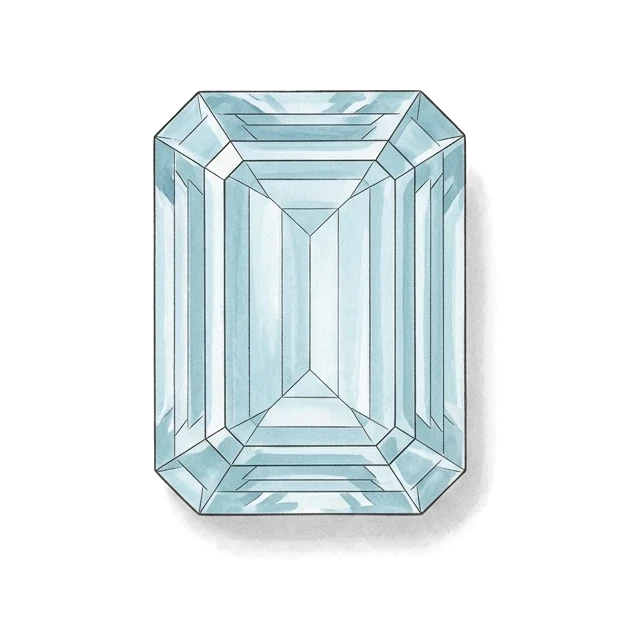
Judge the color first. Because it’s light, the cut matters a lot too: a well-cut aquamarine shows its brilliance. Emerald cuts and round or oval brilliants are the usual choices.
Large cut stones are hard to use in jewelry and sell mainly as center stones, and above 25 carats the price per carat tends to drop.
| Type | What to know |
|---|---|
| Natural | Mined. Most is heated for a purer blue. Unheated blue stones can cost more. |
| Lab-grown | Real aquamarine, made in a lab. It has been grown in labs since at least 1990, and a gem lab can tell it from mined aquamarine. |
| Type | Price |
|---|---|
| 1–5 carats | $20–$500 |
| Over 5 carats | $70–$1,000 |
Prices vary with size, color, clarity and seller. They’re a guide to what shops ask, not a valuation or an investment view.
How to clean aquamarine
Cleaning aquamarine
- Warm soapy water, soft brush
- Safe
- Ultrasonic cleaner
- Usually safe
- Steam cleaner
- Usually safe
Only for stones without fractures or liquid inclusions.
A toothbrush, warm water and mild dish soap do the job. Ultrasonic and steam cleaners are usually safe, as long as the stone has no fractures or liquid inclusions.