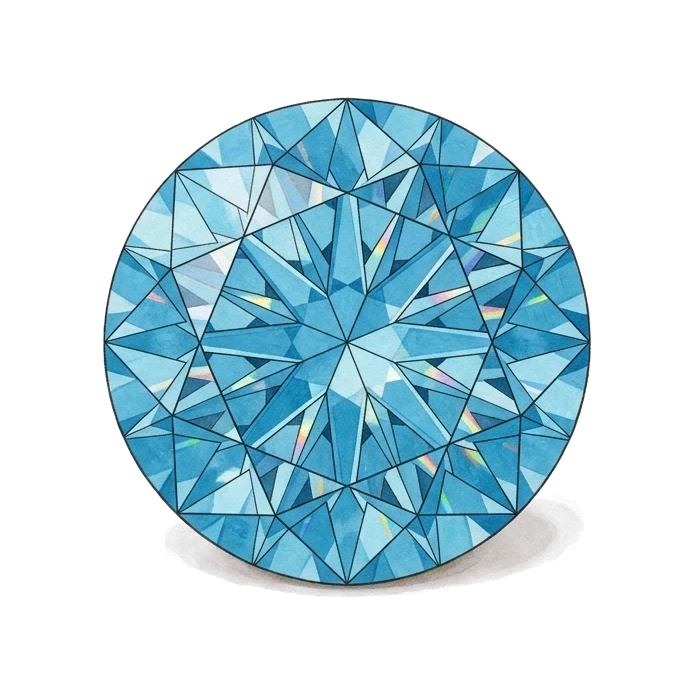
What does zircon mean?
Wisdom, riches and honor. In the Middle Ages, zircon was thought to bring all three, along with sound sleep and protection from evil spirits. Our charts shorten it to wisdom and prosperity.
Even the name is a matter of debate. Many scholars trace it to the Arabic zarkun, “cinnabar” or “vermilion,” and others to the Persian zargun, “gold colored.” Given how many colors zircon comes in, GIA finds either one believable, while the International Gem Society and the V&A give only the golden one.
Older writers called zircon jacinth or hyacinth, though those names sometimes meant other stones too. Jacinth was believed to:
- Protect travelers. It was especially recommended as an amulet for anyone setting out on a long journey, against wounds and injuries on the road. It was also said to promise a warm welcome at any inn, to add to its owner’s riches and to make him prudent in his affairs.
- Turn away lightning. It was confidently reported that in places where many people were struck, no one wearing a jacinth was ever harmed, and even a wax seal pressed with a jacinth engraving was thought to keep lightning away.
- Bring on sleep. The 16th-century scholar Cardano wore a fairly large jacinth and found that it “seemed to dispose somewhat to sleep, but not much.” He put the weak effect down to his stone, which was golden rather than the best bright red.
Zircon in India: one of the nine gems
In Hindu tradition, zircon alternates with hessonite garnet as one of the nine gems of the navaratna. Worn together, the nine were believed to protect the wearer and bring wealth and wisdom. Its Sanskrit name in the list of nine is gomeda.
Another Sanskrit name, râhuratna, made it the jewel of Râhu, the dragon blamed for eclipses of the Sun and Moon. Because it was sacred to so malevolent a power, it was believed to ward off misfortune: nothing worked better against lesser evil spirits than a great one. In the nine-gem ring, the jacinth sat to the southwest, Râhu’s place.
Hindu poets also described the Kalpa Tree, an offering to the gods, as a mass of jewels: coral for its young leaves, rubies for its fruit, and zircons for all the rest of its foliage.
Hyacinth, jacinth and jargoon: zircon’s old names
In the trade, reddish brown zircon goes by hyacinth or jacinth, and light yellow to colorless zircon by jargoon. The words were never exact. Hyacinth was once used for hessonite too, a reddish orange garnet.
The colors had their own lore. The lapidary of Alfonso X put the red jargoon under the influence of Mars, the yellow under Jupiter and the white jargoon under Venus.
The King James Bible names jacinth twice in Revelation, among the colors of the riders’ breastplates and as the eleventh foundation stone of the New Jerusalem. Whether that stone was zircon is anyone’s guess. George Kunz found that the old hyacinthus was used for both sapphire and jacinth, and the bishop Andreas of Caesarea described Revelation’s jacinth as “of a celestial hue.”
From Victorian blue to “imitation”
Victorian England loved blue zircon, and fine stones turn up in English estate jewelry from the 1880s. Untreated zircon often has a cloudy, smoky look, and in Victorian times that smokiness made it a popular stone for mourning jewelry.
George Kunz, Tiffany’s famous gem buyer, championed zircon and once suggested calling it “starlite” for its fire. The name never caught on.
What hurt zircon’s reputation was its use as a stand-in for diamond in the early 1900s. Better imitations replaced it long ago, but to many people its name still means “imitation.”
What is zircon? The oldest mineral on Earth
Zircon is a mineral, zirconium silicate (ZrSiO4). Crystals big and clear enough to cut are rare. Most are only a few millimeters long, too small for jewelry, and go into abrasives and ceramics instead.
It is also a clock. Radioactive trace elements inside it tick off time, which makes zircon a geological record of the early Earth. Zircon from Australia is the oldest mineral on Earth, at 4.4 billion years.
In 2001, the geologist Simon Wilde and his colleagues reported a grain from the Jack Hills of Western Australia dated to 4,404 million years, give or take 8 million. That was about 130 million years older than any earlier find. Its chemistry pointed to rock that had been in contact with liquid water, which made it the earliest evidence of continents and oceans.
A 2014 study led by John Valley of the University of Wisconsin–Madison went down to single atoms. Using atom-probe tomography to measure individual lead atoms, it confirmed that Jack Hills zircons crystallized 4.4 billion years ago, so Earth’s crust had formed at least that early, only 160 million years after the solar system.
High, intermediate and low zircon
The uranium that makes zircon a clock also damages it. Over long stretches of geological time, radiation from these impurities can break down a zircon’s crystal structure, and its optical and physical properties fall with it.
Gemologists sort zircon by how much damage it has taken. High zircon has a full crystal structure, intermediate zircon some damage, and low zircon so much that in extreme cases it is nearly amorphous, with no orderly structure at all. Green stones are the ones most often low.
Virtually all zircon used in jewelry is the high type. High heat can partly repair the damage, rebuilding a stone’s crystal structure.
Zircon vs cubic zirconia
Zircon and cubic zirconia share part of a name and little else. Zircon is zirconium silicate with traces of iron, uranium, thorium and hafnium, and it forms tetragonal crystals. Cubic zirconia is zirconium oxide, with cubic crystals.
CZ isn’t a mineral at all: there is evidence that it may have formed naturally after a meteorite impact over 4 billion years ago, but all the CZ in jewelry is made in labs. It is made by heating powdered ingredients until they melt, then letting them cool into a solid.
| Feature | Zircon | Cubic zirconia |
|---|---|---|
| What it is | Natural mineral | Lab-made |
| Hardness (Mohs) | 6 to 7.5 | About 8.5 |
| Fire | Close to diamond’s | Slightly more than diamond’s |
| Look | Doubly refractive, so facets look doubled and can blur | Broad flashes that some find artificial |
| Weak points | Brittle, so take care in a ring | Scratches more easily than diamond, and colorless CZ may yellow |
| Ultrasonic cleaning | Not recommended | Safe |
Every row comes from GIA’s guide to diamond simulants. GIA’s guide to imitations gives CZ the same hardness and fire, and also warns that CZ yellows over time. The International Gem Society’s simulant chart agrees that CZ disperses light more than diamond, and puts its hardness between 8 and 8½.
Zircon’s high luster, refraction and dispersion give it strong brilliance and rainbow flashes of fire, close enough to diamond’s to explain centuries of confusion between the two. Both zircon and CZ have been used widely as diamond lookalikes, colorless zircon for centuries and CZ more recently.
How to tell zircon from diamond
Look for doubled facets. Zircon’s double refraction is strong enough that you see twice as many facets, and twice as much fire, and under magnification the back facets look doubled. Diamond has none, which makes doubling the most obvious way to separate the two.
Cutters orient the table to the stone’s optic axis to keep the doubling down, or the inside can look fuzzy. Check the edges as well: zircon is brittle, and a closer look usually shows damage to the surface and facet edges.
Weight is another clue. Zircon is heavier than most gems of the same size.
Zircon colors
Zircon comes in yellow, green, red, reddish brown, blue and colorless, and in warm earth tones like cinnamon and sherry. Collectors value the range, but buyers mostly want one color: blue.
-
Blue
The color most buyers want: dealers report that at least 80 percent of zircon sold is blue. It ranges from very slightly to very strongly greenish blue, and it is almost always the result of heating.
#3BA7C9
-
Colorless
Brilliant and fiery, and long used in place of diamond. It is usually heated, and the trade calls it Matara zircon, after a city in Sri Lanka.
#EEF2F6
-
Golden yellow
Often made by heating brown zircon. Heating blue zircon again in air can also turn it golden.
#D9A23A
-
Orange
One of zircon’s warm earth tones. New South Wales, Australia, is known for fine orange zircon.
#E07B2A
-
Red
With blue and green, one of the most valuable colors, prized by collectors. Red stones are usually smaller than blue or yellow ones.
#B5302E
-
Green
A collectors’ color, and with blue and bright red one of the most valuable. Green zircons are often the low type, their crystal structure worn down by natural radiation.
#5E9A3C
-
Reddish brown
A common natural color, called hyacinth or jacinth in the old trade. Most heated blue and colorless zircon starts out brown or reddish brown.
#8E4A2B
-
Pink to purple
Australia’s Harts Range produces pink and purple zircon. Purple stones, like red ones, are usually small.
#B5739D
Zircon’s most popular colors usually start out brown: heated with or without oxygen, reddish brown stones turn blue, colorless or golden.
Blue zircon: heated, and sensitive to UV
Blue zircon is made by heating brown zircon to 900 to 1,000 °C without oxygen, and the trade assumes every blue zircon has been heated. Its typical greenish blue has been called “zircon blue.”
Ratanakiri province, in northeastern Cambodia, is famous for an especially rich blue. That blue isn’t natural either: it comes from heating brown to reddish brown stones for several hours. Heated blue zircon can be heated again in air to turn it golden.
Blue zircon sells well even though top-grade topaz offers blue for much less.
Treated zircon and what sellers must disclose
Colorless zircon is heated as routinely as blue, and the heating can’t be detected in the stone. Some orange, yellow and red zircon is heated as well. Fracture filling is possible but rarely done.
Not every heated color is fully stable. Some heated stones drift back toward their original color, usually light brown, after long exposure to bright light. Heated green and yellow tend to hold up better against sunlight and UV than heated blue.
A color that can drift back isn’t fully permanent, and the US Federal Trade Commission’s Jewelry Guides say a seller must disclose a treatment that isn’t. GIA adds that without disclosure, a buyer could think a stone was naturally finer, and so worth more, than it is.
Is zircon good for everyday wear?
| Hardness | 6–7.5 on the Mohs scale |
|---|---|
| Everyday ring? | Everyday, with care Fine in a ring if you take it off for chores and sports. Safest in earrings and pendants. |
| Family | Zircon |
| Main sources | Sri Lanka, Australia, Myanmar, Vietnam, Cambodia |
| Treatments | Blue and colorless zircon are almost always heated brown zircon, and some golden, orange and red zircon is heated too. A few heated stones drift back toward brown after long, bright light. |
| Lab-grown | Zircon has been grown in labs for research, but lab-grown zircon has no known use in jewelry. “Synthetic zircon” sold online may be cubic zirconia. |
Zircon is 6 to 7.5 on the Mohs scale, with fair to good toughness. It can be worn in any kind of jewelry with care, away from rough wear and hard knocks, and stored so it doesn’t rub against other pieces.
Its weak point is its edges. Zircon is very brittle, so facet edges chip and wear, and as a ring stone it needs a protective setting. Pendants, brooches and earrings are safer.
Where zircon is found
Most gem zircon comes from Southeast Asia, often as water-worn pebbles in gravel deposits. It often turns up near sapphire, and Sri Lanka, Australia, Myanmar, Vietnam and Cambodia have both.
- Sri Lanka: zircon in every color, including rare cat’s-eyes, from its gem gravels. Elahera, in the center of the island, is one of its most productive gem areas.
- Cambodia: the main source of the brown rough that heats to blue and colorless.
- Myanmar: yellowish and greenish zircon from the same gravels as ruby.
- Australia: yellow-brown, orangy brown, pink and purple zircon from Zircon Hill, in the Harts Range near Alice Springs.
- Thailand: one of the most important commercial sources.
Famous zircons
Two of these zircons are in London and two in Washington, D.C. The fifth is a single grain from Western Australia.
-
The Hellenistic zircon bust
Carved in the 1st century BC
A bust of a woman carved from zircon in Hellenistic Greece, reset in the early 1600s as a gold pendant hung with pearls, with the Virgin of the Assumption engraved on the reverse. It is at the V&A in London.
-
Giuliano’s zircon cross
Made about 1880
A gold cross brooch by the London jeweler Carlo Giuliano, enameled in blue, black and white. Three of its arms hold kite-shaped zircons and the fourth a purple spinel, around a white sapphire. It is at the V&A.
-
The Roebling blue zircon
A 103.2-carat step-cut zircon in a medium dark, slightly greenish blue, from Thailand. It belongs to the Washington A. Roebling Collection at the Smithsonian.
-
The George Pendant
Given in 2005
A large green zircon from the Ratnapura mines of Sri Lanka, never treated, cut as a cabochon by George Crevoshay and framed by four green tourmalines in an 18-karat gold pendant designed by Paula Crevoshay. It was the first zircon jewel in the Smithsonian’s National Gem Collection.
-
The Jack Hills zircon
Confirmed in 2014
A grain too small to see with the naked eye, from the Jack Hills of Western Australia. At 4.4 billion years, it is the oldest known material of any kind formed on Earth.
Zircon names to watch for
Most of zircon’s misleading names borrow a more famous gem’s. Colorless zircon was passed off as “Ceylon” or “Matura” diamond, a trick our diamond guide covers too, and blue zircon as “Siamese aquamarine.” Selling a zircon as a diamond is unethical, IGS warns.
| Sold as | What it is |
|---|---|
| Ceylon diamond | Colorless zircon |
| Matura diamond | Colorless heated zircon |
| Siamese aquamarine | Blue zircon |
| Oriental hyacinth | Pink sapphire, not zircon |
| Hyacinth or jacinth | Reddish brown zircon, but the name was also used for hessonite garnet |
| Synthetic zircon | May be cubic zirconia: lab-grown zircon has no known use in jewelry |
How to buy zircon
With a zircon gemstone, start with color. Blue usually costs more than any other zircon color, because more buyers want it. Then look at:
- Cut. Zircon is brittle and a challenge to cut, and cutters usually give it a brilliant cut, most often round or oval, to show off its luster and fire. The “zircon cut” adds eight extra facets to the pavilion, but the extra labor means it is seldom seen today.
- Size. Supply is limited, and sizes depend on color. Blue and green stones usually run from 1 carat up to 10, yellows and oranges up to about 5 carats, and reds and purples smaller still.
- Clarity. Most faceted zircon has no inclusions you can see, and stones that show them are worth less.
| Type | What to know |
|---|---|
| Natural | Mined. Blue and colorless zircon are almost always heated brown zircon, and some golden, orange and red zircon is heated too. A few heated stones drift back toward brown after long, bright light. |
| Lab-grown | Zircon has been grown in labs for research, but lab-grown zircon has no known use in jewelry. “Synthetic zircon” sold online may be cubic zirconia. |
| Imitation | Cubic zirconia is a different, lab-made material that imitates diamond. Don’t confuse the two. |
| Type | Price |
|---|---|
| Blue, 1–2 carats | $15–$50 |
| Blue, 2–5 carats | $35–$180 |
| Other colors, 1–2 carats | $15–$100 |
Prices vary with size, color, clarity and seller. They’re a guide to what shops ask, not a valuation or an investment view.
How to clean zircon
Cleaning zircon
- Warm soapy water, soft brush
- Safe
- Ultrasonic cleaner
- Not recommended
- Steam cleaner
- Not recommended
Heat can change its color, and UV lamps, such as tanning beds and nail lamps, can turn blue zircon brown. Its facet edges wear, so keep it from rough wear.
Clean zircon with warm, soapy water. Skip mechanical cleaners such as ultrasonics: zircon is too brittle for them. Heat can change the color of some zircon, but chemicals don’t harm it.