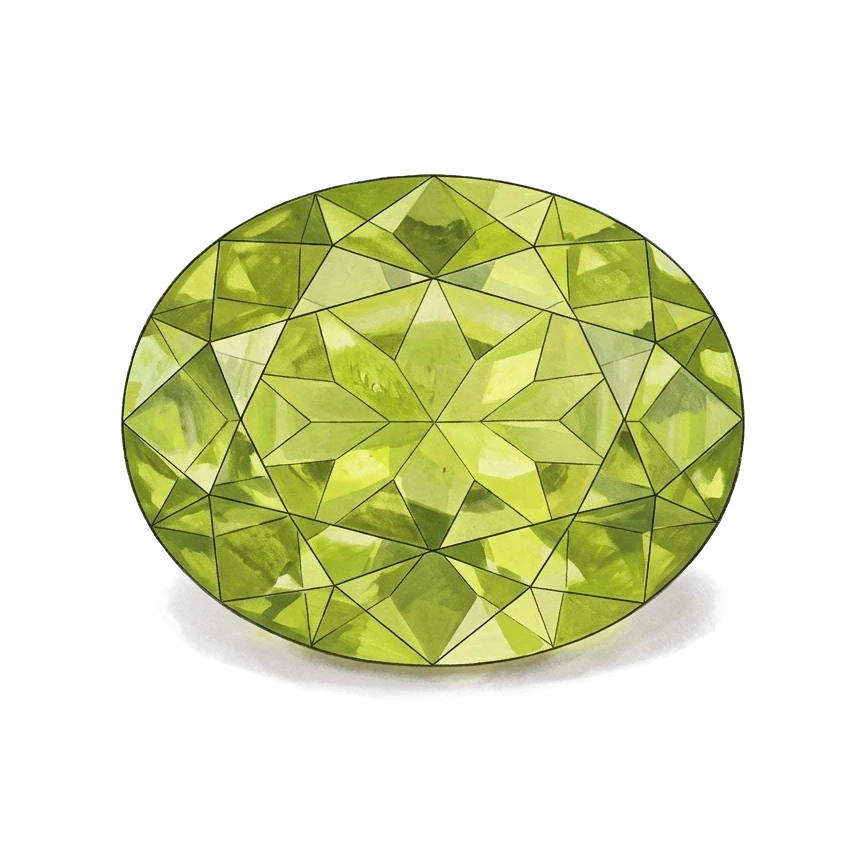
Peridot color: why it’s always green
Most colored gems owe their color to a trace of something that doesn’t belong in the crystal. Peridot is different: iron is part of its own recipe, so its yellowish green is built in. It is the gem variety of olivine, a silicate of magnesium and iron, and the iron is what makes it green.
That’s also why the peridot color range is so narrow. It runs from brownish green through yellowish green to pure green, and yellowish green is what you’ll see in most jewelry.
The best color is a grass green with no hint of yellow or brown. Pure green stones are rare, and peridot’s color tends to be at its finest in stones of 10 carats and more.
-

Grass green
The finest hue: green with no hint of yellow or brown. Pure green stones are rare.
#4E9A2E
-

Yellowish green
The color most peridot has, and the one seen most in jewelry.
#9DC21F
-

Greenish yellow
The yellow end of the range, furthest from the prized pure green.
#BFC72A
-

Brownish green
Lower-quality peridot is brownish. The finest stones show no brown at all.
#7D7A2C
-

Zabargad, Egypt
The Red Sea island mined in antiquity. Its crystals are still among the finest in the world.
#7FAE1E
-

Kyaukpon, Myanmar
Near Mogok. The best stones have deep color and superb transparency.
#5E9E22
-

Sapat Valley, Pakistan
Mined high in the Himalaya and on the market since 1994. Larger and cleaner than Arizona’s, and usually more even in color than Myanmar’s.
#6FAA1C
-

San Carlos, Arizona
Nodules from old lava flows, worked by Apache families. Mostly smaller commercial sizes.
#A5BF2A
-

Pallasitic peridot
Peridot from stony-iron meteorites. Cut stones usually weigh under half a carat.
#A9A830
The best colors mostly come out of Myanmar and Pakistan, while a brownish tint marks a lower grade. The hex codes above are our standard swatches for the peridot colors, not lab measurements, so use them as a starting point for a palette.
Peridot vs emerald
The two have been mixed up since ancient times. Some historians think Cleopatra’s famous emeralds may have been peridots, and medieval Europe went on confusing the two. Today the difference is plain: peridot is olivine, a warmer, more yellowish green, while emerald is a green beryl, colored by chromium, vanadium and iron.
What does peridot mean?
Most peridot meaning has to do with light. The ancient Egyptians called it the “gem of the sun.” Kunz thought that link with the sun probably explains why it was believed to put evil spirits to flight, the way sunlight drives off the dark.
The lore was specific about how to wear it. Peridot symbolism in the old stone books went like this:
- Set in gold, it was believed to dispel the “terrors of the night.”
- Strung on a donkey’s hair and tied to the left arm, it was a guard against evil spirits.
- Against magic, it was credited with the power to dissolve enchantments.
The Red Sea island that supplied it had its own legend. The Greek historian Diodorus wrote that the stone couldn’t be seen in the glare of day but shone in the dark. The guards marked each glowing spot at night and dug the stone out in the morning.
For centuries peridot was a September stone. Under its old name, chrysolite, it was September’s gem in the older lists Kunz printed, and he complained when the 1912 US list moved it to August as sardonyx’s alternate.
Peridot in the Bible
The word “peridot” isn’t in the King James Version. The stone may be there under another name, though, because ancient writers used “topaz” for what we call peridot.
- The high priest’s breastplate: its second stone is the Hebrew piṭdah, “a topaz” in the King James text. Kunz had little doubt it was the ancients’ topazius, a greenish stone that usually meant our peridot. But the Hebrew word may come from a Sanskrit word for yellow, and he thought the oldest breastplate may have held a green serpentine, with peridot only in a later one.
- Revelation 21: the seventh foundation stone of the New Jerusalem is “chrysolyte” and the ninth “a topaz.” In ancient usage the two names had roughly swapped places, so which of them was our peridot is uncertain.
Is peridot good for everyday wear?
| Hardness | 6.5–7 on the Mohs scale |
|---|---|
| Everyday ring? | Occasional wear Too soft or fragile for a daily ring. Best in earrings, pendants and rings for special days. |
| Family | Olivine |
| Main sources | China, Myanmar, Pakistan, Tanzania, Vietnam, United States (Arizona) |
| Anniversary | 16th wedding anniversary |
Peridot is softer than many gems, at 6.5 to 7 on the Mohs scale, and can’t take hard wear. That’s why GIA doesn’t recommend it for a ring worn every day.
Pendants and earrings keep it out of harm’s way. Some acids can damage it too, even acidic sweat over a long time, and a harder gem in the same jewelry box can scratch it.
Where peridot is found
The peridot stone forms deep in the earth’s upper mantle, in a rock called peridotite, and reaches the surface in lava or when the mantle is pushed up as the crust splits. Miners find it in two ways. Most of it comes as rounded nodules from old lava flows, in the United States, China and Vietnam. Large crystals, grown in veins and pockets of rock, are a rare find, from Finland, Pakistan, Myanmar and Zabargad.
- Zabargad, Egypt. The oldest recorded source, a small island in the Red Sea once called Topazos. Pliny, quoting older writers, dated the first stones from the island to the time of Queen Berenice, around 300 BC. Later the island was forgotten and found again more than once.
- Arizona. The main US source, on the San Carlos Apache reservation, where the mines have been worked by the same Apache families for decades. In the early 1990s Arizona supplied most of the world’s peridot.
- Pakistan. In 1994 a deposit at about 4,500 meters (15,000 feet) in the western Himalaya began sending large, fine peridot to market, far cleaner and bigger than Arizona’s.
- Myanmar. Loose crystals sometimes turn up in crevices on the northern slope of Kyaukpon, a mountainous area near the gem town of Mogok, with deep color and superb transparency at their best.
Hawaii even has a green beach. On the Big Island, waves wash olivine out of an old volcanic cone and leave it behind as green sand.
Some peridot isn’t from Earth at all. It turns up in pallasite meteorites, about 4.5 billion years old, and its mineral, olivine, was found in the comet dust that NASA’s Stardust probe brought back to Earth in 2006.
Famous peridots
The most famous peridots were long famous as something else. The green gems in the Treasury of the Three Magi at Cologne, some nearly two inches long, most likely reached Europe through loot or trade in the time of the Crusades, and were called emeralds.
-
The Smithsonian’s Zabargad peridot
A 311.8-carat cushion cut from Zabargad, long described as the largest cut peridot known. It came to the Smithsonian with the Washington A. Roebling Collection.
-
The Shrine of the Three Kings
For centuries the green gems on this shrine in Cologne Cathedral were believed to be emeralds. They are peridots.
-
The Natural History Museum peridot
A 146.10-carat cut peridot in the museum’s collection in London.
-
The Van Cleef & Arpels peridot suite
2004
A necklace, bracelet, ring and earrings in platinum and diamonds, cut from 40,000 carats of Pakistani rough. The necklace alone holds 31 peridots totaling 228.22 carats.
-
A 2.32-carat peridot from space
2022
The largest meteorite peridot a client had sent to GIA’s laboratory. Most cut ones weigh under half a carat.
Peridot names to watch for
Chrysolite, peridot’s old name, has also been borrowed for trade names of other stones entirely.
| Sold as | What it is |
|---|---|
| Chrysolite | An old name for peridot, at times also used for other stones |
| Bohemian chrysolite | Moldavite (natural glass) |
| Cape chrysolite | Green prehnite |
| Saxon chrysolite | Greenish yellow topaz |
| Siberian chrysolite | Demantoid (garnet) |
How to buy peridot
Start with color: look for a green with as little yellow or brown as you can afford. Then check clarity and size:
- Clarity: better stones look clean to the eye, with only tiny black spots, minute crystals, under a loupe. Black spots you can see without one lower the value, as do other easily seen inclusions, such as the flat, reflective disks called “lily pads.”
- Size: peridot is inexpensive in small sizes, and prices rise for stones over about 10×8 millimeters.
- Cut: every standard shape is made, plus checkerboard cuts, cabochons, beads and carvings.
| Type | What to know |
|---|---|
| Natural | Mined. Ask the seller whether it has been treated. |
| Imitation | Glass, including a dense, high-refractive-index barium glass reported in GIA’s journal Gems & Gemology as sold as peridot. |
| Type | Price |
|---|---|
| 0.5–1 carat | $10–$50 |
| 1–2 carats | $50–$300 |
| 2–3 carats | $300–$500 |
Prices vary with size, color, clarity and seller. They’re a guide to what shops ask, not a valuation or an investment view.
How to clean peridot
Cleaning peridot
- Warm soapy water, soft brush
- Safe
- Ultrasonic cleaner
- Never
- Steam cleaner
- Never
Some acids, even acidic sweat over time, can damage it.
Peridot can crack under sudden heat, so keep it away from steam and ultrasonic cleaners. Use a soft brush, mild dish soap and warm water instead, and store it apart from harder gems.