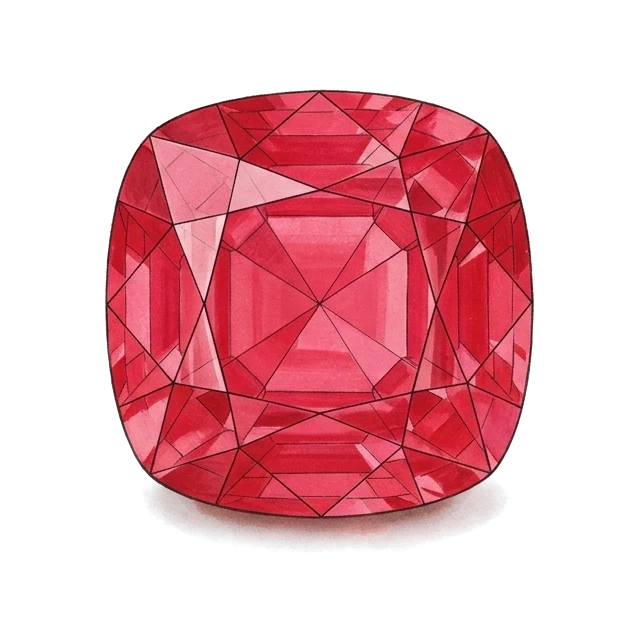
What does spinel mean?
Spinel is both a mineral, magnesium aluminum oxide, and the gem cut from it. The name is usually traced to the Latin spina, “thorn,” for the shape of its crystals, though the derivation isn’t certain. The crystals typically grow as octahedrons: two pyramids set back to back.
Most spinel symbolism comes from its red. Old lore grouped red spinel with ruby, garnet and carnelian, and red stones were believed to calm the wearer and drive away anger and discord.
GIA gives the same tradition: red gems were thought to ease anger and promote harmony. So the meaning we give spinel is harmony and calm.
A stone for emperors
The Mughal emperors held spinel in the same esteem as ruby and emerald, and chose it to carry their names. Their spinels were engraved with imperial names and dates and strung into necklaces, and some of the inscriptions call the stone la’l-i jalali, “glorious spinel.” A Flemish diamond dealer who saw Emperor Jahangir in 1619 wrote that he looked “like an idol,” with spinels, emeralds and pearls on his arms.
Spinel is the newest of August’s three birthstones. The American Gem Trade Association and Jewelers of America added it to the list in 2016, and it’s the traditional gift for a 22nd wedding anniversary.
Spinel vs ruby: the great impostor
For a thousand years or more, the red spinels of Central Asia were called “balas rubies.” The name comes from Balakhsh, an old form of Badakhshan, the mountain region where they were mined. Badakhshan straddles today’s Afghanistan and Tajikistan.
Marco Polo described its balas mines in the late 1200s. Only the king could have them dug, he wrote, so that the stones would keep their value. The deposit at Kuh-i-Lal, in Tajikistan’s Pamir Mountains, has been worked on and off for centuries, and many of the great red spinels in the world’s crown jewels came from there.
Medieval Arab and Indian scholars did tell balas from true ruby, but most people treated it as a kind of ruby all the same. They look alike because both get their red from chromium.
They are still different minerals. Ruby is corundum, and spinel adds magnesium to its aluminum oxide. The story of the stone it was mistaken for is in our guide to ruby meaning.
The question was settled in 1783, when the French mineralogist Jean-Baptiste Louis Romé de l’Isle measured the angles between crystal faces and showed that spinel and ruby were different minerals. GIA counts the work of telling them apart as the birth of gemology.
Spinel colors: red, pink, cobalt blue and more
Spinel comes in a wider range than most people expect: orange, intense “stoplight” red, vibrant pink and every shade of purple, blue and violet, through to bluish green. Each color has its own cause:
- Red and pink: chromium. The more chromium, the stronger the red.
- Orange and purple: a mix of iron and chromium.
- Violet to blue: iron, while the most vibrant blues owe their color to cobalt.
-
Red spinel
The most valued color. Pure to slightly purplish red, from chromium: the more chromium, the stronger the red.
#B8122F
-

“Jedi” spinel
Gemologist Vincent Pardieu’s nickname for glowing, neon pink to red stones with no dark tone, from Namya and Man Sin in Myanmar.
#F2295F
-

Mahenge spinel
Pinkish and orangy red, from Tanzania. Known since the late 1980s, the deposit became famous for a 2007 find of crystals of up to 54 kilograms.
#EE5A7E
-

Cobalt blue spinel
Traces of cobalt give the most vivid blues. Fine cobalt blue ranks second only to red.
#1E4FC2
-

Orange spinel
Colored by iron and chromium together. Vivid orange is valued with hot pink.
#EE6F2D
-

Lavender and violet spinel
Less in demand than the rarer colors, so pale lavender is one of the more affordable spinels.
#9A86C4
-

Gray spinel
Gray stones grew more popular in the trade in the late 2010s.
#8C8F99
-


Color-change spinel
Grayish blue or violet by day, an amethyst-like purple under a lamp. Rare and usually small.
Daylight #6F72A8
Lamplight #8D5C9E
Red is the most desirable, followed by fine cobalt blue, then vibrant hot pink and vivid orange. Violet, purple and lavender stones are less in demand. The finest reds are pure to slightly purplish red, neither light nor very dark.
Dark tone is the usual flaw in an otherwise fine spinel. The gemologist Vincent Pardieu and the dealers he worked with called it the “dark side,” so the glowing hot pink stones untouched by it became “Jedi” spinels. A few spinels show a star, and some change color, from grayish blue or violet in daylight to purple under a lamp.
Is spinel good for everyday wear?
| Hardness | 8 on the Mohs scale |
|---|---|
| Everyday ring? | Great for everyday Hard and tough enough for a ring worn every day. |
| Family | Spinel |
| Main sources | Myanmar, Sri Lanka, Vietnam, Tanzania, Tajikistan, Pakistan |
| Treatments | Rarely treated. Some stones are heated, which is stable, and fracture filling is rare. |
| Lab-grown | Yes. Made for more than a century and long used to imitate other gems, so it is far more common in jewelry than natural spinel. |
| Anniversary | 22nd wedding anniversary |
Spinel rates 8 on the Mohs scale and has good toughness, so it’s durable enough for every kind of jewelry. It’s stable in light and with chemicals. High heat is the one thing to keep it away from, since it can fade some colors.
Where spinel is found
Today’s main sources are Tajikistan, Myanmar, Sri Lanka, Vietnam, Tanzania and Pakistan.
- Myanmar: the Mogok Stone Tract, known for hot pink and red spinel. Its stones are so naturally lustrous that locals call them “spirit polished.”
- Sri Lanka: mined across the southern half of the island for blue, pink and purple spinel, above all in the river gravels of the Ratnapura District.
- Vietnam: the Luc Yen region has produced red, purple, pink and violet spinel since the 1980s, and vivid blues turned up there in the 2000s.
- Tanzania: red spinel has been found near Mahenge since the late 1980s, and a 2007 find of giant crystals, up to 54 kilograms, made the deposit famous for its pinkish and orangy reds.
Famous spinels
Of all the “rubies” that turned out to be spinel, the Black Prince’s Ruby is one of the most famous. It was probably mined in the mountains of Afghanistan, and tradition says it passed through the hands of Moorish and Spanish kings before Peter of Castile gave it to Edward, the Black Prince, in 1367.
The Royal Collection Trust notes that it’s hard to prove this is the same stone, though a large spinel does appear in the descriptions of England’s historic state crowns. It has been reset each time the crown was remade. Along the way it has survived fires, an attempted theft and the bombing raids of World War II.
The Timur Ruby, a red spinel of over 350 carats, carries several Persian inscriptions that testify to its age.
-
The Black Prince’s Ruby
Traditionally 1367
About 170 carats, set in Britain’s Imperial State Crown above the Cullinan II diamond. Tradition says it was Edward the Black Prince’s payment for a battle won.
-
The Timur Ruby
A red spinel that belonged to several Mughal emperors, Shah Jahan among them, and came from Lahore in 1849. It is now the centerpiece of a necklace in Britain’s Royal Collection.
-
The spinel of the Great Imperial Crown
1762
A 398.72-carat spinel on the crown made for the coronation of Catherine II of Russia, now in the Diamond Fund in Moscow.
-
The Carew Spinel
A 133.5-carat spinel engraved with the titles of three Mughal emperors, Jahangir, Shah Jahan and Aurangzeb, now at the V&A in London.
Spinel names to watch for
Calling a spinel a “ruby spinel,” or even a “ruby red” spinel, suggests it’s a kind of ruby, and gemologists advise against both. “Balas ruby” belongs to history, not to a sales tag. In the other direction, garnets have been sold under spinel’s name. The names to know:
| Sold as | What it is |
|---|---|
| Balas ruby | Red spinel (a historical name, not a trade name today) |
| Ruby spinel or spinel ruby | Spinel, never a ruby |
| Arizona spinel | Red or green garnet |
| Candy spinel | Almandine garnet |
How to buy spinel
What sets the value:
- Color: red leads, then cobalt blue, hot pink and orange. In blue, look for an intense violet blue to pure blue, neither too dark nor too light. Most blue spinel has low saturation and looks grayish.
- Clarity: stones with no inclusions visible to the eye are worth more, and the more visible the inclusions, the lower the value.
- Cut and size: ovals and cushions are the usual shapes. Fine rough is so scarce that it’s cut to save weight rather than to standard sizes, and fine red, pink and blue stones become hard to find above five carats.
Spinel is rarely treated, though some stones are heated, and cobalt diffusion has been used to strengthen the blue in others. Heating is stable, and fracture filling is rare. For a fine blue, ask for a lab report.
Early in the 20th century, researchers trying to grow blue sapphire made blue spinel by accident, and lab-grown spinel has stood in for other gems ever since. It’s common in class rings and birthstone jewelry, and most colorless spinel in jewelry is probably lab-grown.
| Type | What to know |
|---|---|
| Natural | Mined. Rarely treated. Some stones are heated, which is stable, and fracture filling is rare. |
| Lab-grown | Real spinel, made in a lab. Made for more than a century and long used to imitate other gems, so it is far more common in jewelry than natural spinel. |
Red costs the most, then fine cobalt blue, then vivid hot pink and orange. Prices climb steeply above 5 carats.
Demand for fine spinel now well exceeds supply, which has narrowed its price gap with ruby and sapphire. Even so, pink spinel often sells for less than pink sapphire.
How to clean spinel
Cleaning spinel
- Warm soapy water, soft brush
- Safe
- Ultrasonic cleaner
- Usually safe
- Steam cleaner
- Usually safe
Fractures can be a problem, and high heat can fade some colors.
Warm, soapy water is always safe. Ultrasonic and steam cleaners are usually fine too, unless the stone has fractures. A fracture-filled spinel should only be cleaned with warm soapy water or a damp cloth.