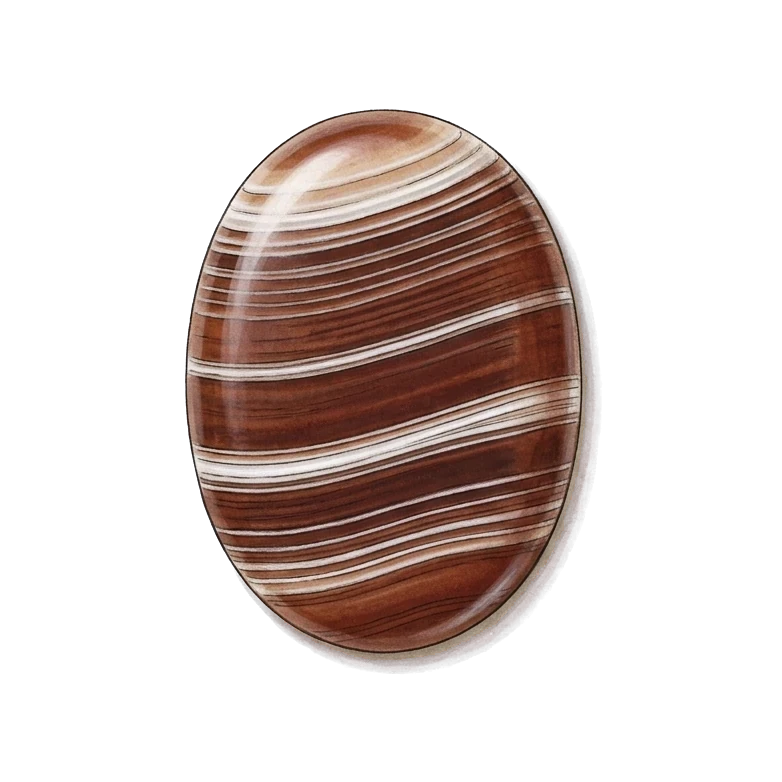
What does sardonyx mean?
Mostly courage. Roman soldiers wore sardonyx rings carved with Mars, the god of war, for protection in battle. The stone was believed to pass some of that bravery on to whoever wore it.
The sardonyx meaning given today is courage, happiness and clear communication, and a steadying influence on marriages and partnerships.
Rome took to the stone early. Pliny passed on the story that the first Roman to wear a sardonyx was Scipio Africanus the Elder, said it was held in high esteem in Rome from then on, and noted that the emperor Claudius wore it often.
By the Middle Ages its reputation had turned gentler. Marbodus, bishop of Rennes around 1100, thought sardonyx best suited to a humble, modest person and said it had no mystic powers at all.
A red stone against a dark one
The old lore makes more sense once you know what people thought of its two halves.
Onyx had a bad name. It was said to cool the ardors of love and to stir up discord between lovers, perhaps, Kunz suggests, because its black and white layers sit so close and still contrast so sharply.
Its Arabic name, jaz’, was linked to sadness, and a lapidary once credited to Aristotle warned that whoever wore onyx in a ring would suffer fearful dreams and endless worries. Marbodus added lawsuits and quarrels to the list.
Sard was the opposite. It was believed to guard against sorcery and to drive away the bad dreams that onyx brought on.
Marbodus wrote that a sard worn on the finger would undo the onyx’s malign influence, and that this was about the only power it had. Sardonyx carries both layers, the trouble and its remedy, in one stone.
Sardonyx in the Bible
The King James Bible names sardonyx only once. In Revelation, it’s the fifth of the twelve stones in the foundations of the New Jerusalem’s wall: “The fifth, sardonyx; the sixth, sardius.”
Exodus never uses the word. The high priest’s breastplate has an onyx in its fourth row, and two onyx stones on his shoulders carried the names of the children of Israel.
The Jewish historian Josephus, writing in the first century AD, called those shoulder stones sardonyxes and wrote that the one on the right shoulder shone whenever God was present at the sacrifices. In his Antiquities he also gave the name sardonyx to the first stone of the breastplate. GIA notes the belief that sardonyx was one of the breastplate stones.
Medieval readers gave each foundation stone a meaning. For Rabanus Maurus, Archbishop of Mainz in the 800s, sardonyx stood for “the humility of the saints in spite of their virtues.” Andreas, bishop of Caesarea, likened its color to a fingernail and took it for the apostle James, and another writer saw in the “nail-colored Sardonyx” the strength of spiritual life.
What is sardonyx? Sard and onyx in one stone
Sardonyx is two kinds of chalcedony, a quartz with crystals too small to see, grown together in layers. Its sard layers run from brownish red through brown to dark orange, and they alternate with onyx, usually white or black.
The name says as much: it comes from the Greek sardónyx, sard plus onyx, and ónyx itself meant “nail” or “claw.” Pliny compared the stone’s white and red to a fingernail and the flesh beneath it.
-
Red and white sardonyx Sard and onyx
The classic look: brownish red sard banded with white onyx.
#8B4A2B
-
Orange and white sardonyx Sard and onyx
Sard runs to dark orange, so some stones band orange with white.
#B8642F
-
Sardonyx with black onyx Sard and onyx
The sard alternates with black layers instead of white.
#3A2B25
-
Sard Chalcedony
The red layer: brownish red to brown to dark orange.
#9A4A22
-

Onyx Chalcedony
The contrasting layer, typically white (the black kind is in the stone above).
#EDE6DC
Sardonyx vs. onyx and carnelian
Onyx is a chalcedony with straight, parallel bands of alternating colors. Sardonyx is the version in which some of those bands are sard, so it reads warm and reddish where onyx is black and white.
Carnelian is a near relative, and in ancient texts the name sardius meant carnelian. Carnelian was also August’s stone on most of the older lists Kunz gathered. On the list American jewelers adopted in 1912, sardonyx was August’s main birthstone, with peridot only its alternate.
Another chalcedony on the birthstone list is March’s bloodstone, green with red spots instead of bands.
Why sardonyx suits cameos and seals
Sardonyx has a history of more than 4,000 years, and for millennia its bands have made it a favorite of gem carvers. The layers suit two very different ways of carving it.
- Intaglio: the design is cut down into the stone. Until about the fifth century BC, gems were carved only this way, a practice that grew out of seal stones, and lettering on an intaglio is cut in mirror image so it reads correctly in the impression. Sardonyx made good Roman seals and signet rings because hot wax didn’t stick to it. Pliny said it was nearly the only engraved gem that didn’t pull the wax away with it.
- Cameo: the stone is cut away around the design, leaving it raised. The finest cameos play a pale layer against a dark one for contrast, and stones with more bands let carvers bring in more colors.
Roman wearers used cameos to show off their taste and wealth, and to declare loyalty to their gods or to political powers. Ancient cameos have held up better than their settings, which were often melted down.
Is sardonyx good for everyday wear?
| Hardness | 6.5–7 on the Mohs scale |
|---|---|
| Everyday ring? | Everyday, with care Fine in a ring if you take it off for chores and sports. Safest in earrings and pendants. |
| Family | Chalcedony (quartz) |
| Main sources | India, Brazil, Germany, Madagascar, Uruguay, United States |
| Treatments | Often dyed, like other chalcedony. High heat during jewelry repair can change a dyed color. |
At 6.5 to 7 on the Mohs scale, sardonyx needs some care, above all in a ring. It’s best in earrings and necklaces unless it has a protective setting, and it suits rings and bracelets worn now and then.
Where sardonyx is found
India is known for sardonyx with good contrast between its layers. It’s also found in Brazil, Germany, the former Czechoslovakia, Madagascar, Uruguay and the United States, among other places.
Famous sardonyx cameos
The great sardonyx pieces aren’t loose gems but carvings, and two of the most famous were cut in ancient Rome.
-
The Great Cameo of France
About AD 23
A five-layer sardonyx carved in Rome, 31 by 26.5 centimeters, the largest cameo left from antiquity. Stolen in 1804, it was found in Amsterdam without its mount, which had been melted down.
-
The Met’s Augustus cameo
About AD 41–54
A Roman sardonyx portrait of Augustus as a triumphant demigod, wearing the aegis, made under the emperor Claudius.
-
The “Essex Ring”
A gold ring with a sardonyx cameo of Elizabeth I, said to be the one she gave the Earl of Essex to return if he were ever in trouble. It’s now at Westminster Abbey.
Sardonyx names to watch for
The names to watch belong to onyx, sardonyx’s other half. In the stone trade, “onyx” is also used for banded calcite rocks that aren’t chalcedony at all.
| Sold as | What it is |
|---|---|
| Onyx marble | Travertine, a banded calcite rock, not chalcedony |
| Mexican onyx | Banded travertine (calcite or aragonite), not chalcedony |
How to buy sardonyx
In a fine sardonyx stone, the reddish sard and white onyx contrast strongly. It can be translucent or opaque, and it rarely has flaws or fractures. Because you look at its surface rather than into it, its value rests mostly on the surface and on a clean, even pattern.
- Cut: cabochon is the most common cut, and sardonyx is also carved into cameos, intaglios and inlays that show off its layers.
- Carving: finely banded and intricately carved pieces cost the most.
- Dye: like other chalcedony, sardonyx is commonly dyed.
| Type | What to know |
|---|---|
| Natural | Mined. Often dyed, like other chalcedony. High heat during jewelry repair can change a dyed color. |
| Imitation | Fakes go back to Rome, where Pliny described black, white and red stones glued together to pass as sardonyx. |
Widely available and moderately priced in sizes up to 10 carats.
How to clean sardonyx
Cleaning sardonyx
- Warm soapy water, soft brush
- Safe
- Ultrasonic cleaner
- Use with caution
- Steam cleaner
- Use with caution
Warm soapy water and a soft-bristled brush are the safest way to clean it. Use ultrasonic and steam cleaners with caution, and keep dyed sardonyx away from high heat, such as during jewelry repairs, which might change its color.