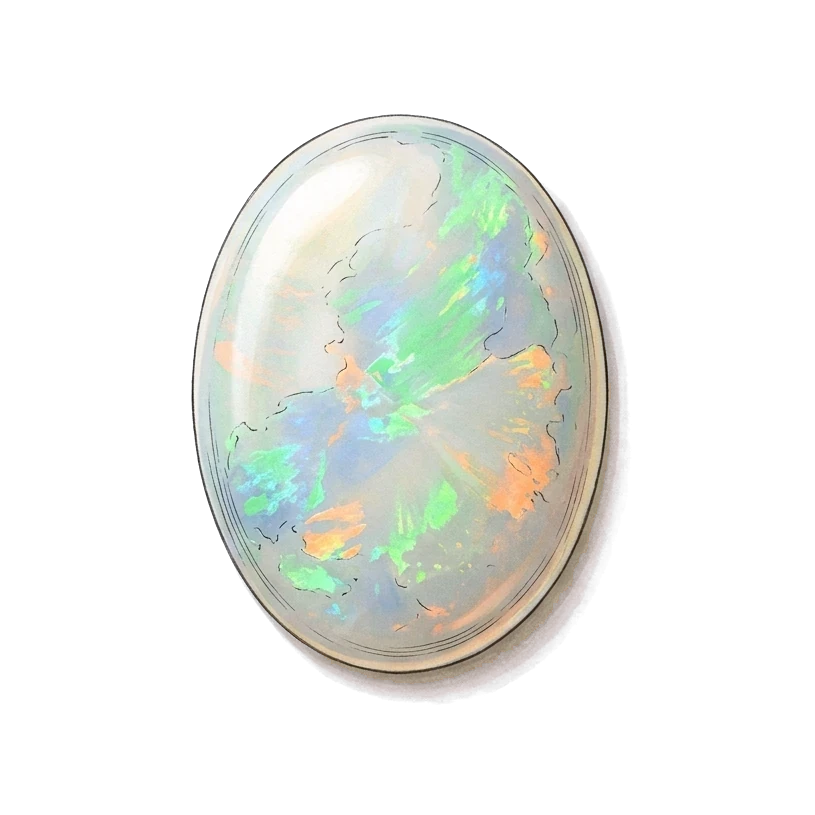
What does opal mean?
Opal’s meaning starts with its colors. Writing around AD 75, Pliny saw in a single stone the fire of the carbuncle, the purple of amethyst and the sea-green of emerald, all shining together. Because it held the colors of other gems, the Romans thought it among the most precious and powerful of all.
In Rome it stood for love and hope, and its Latin name, opalus, was a byword for “precious stone.” Europeans long saw it as a symbol of hope, purity and truth. Those three words are still the opal stone meaning GIA gives for October’s birthstone.
Opal was believed to:
- Guard the eyes, and hide a thief. Medieval writers called it ophthalmius, the “eye stone.” It was said to keep its wearer’s sight clear while clouding the eyes of everyone nearby, which made it, in one Elizabethan translation, “the most sure patron of theeves.”
- Keep blond hair golden. Fair-haired women valued opal necklaces above everything, believing their hair would keep its color for as long as they wore them.
- Guard a ruler’s honor. Albertus Magnus described the orphanus, a stone in the crown of the Holy Roman Emperor that is believed to have been a splendid opal. It was called “the orphan” because no other like it had ever been seen, and it was said to guard the regal honor.
In Indigenous Australian stories, a rainbow made opal’s colors when it touched the earth, and Indigenous people know opal as the “fire of the desert.” Not all opal symbolism was flattering. Shakespeare used it for a changeable mind: in Twelfth Night, the clown tells the Duke, “thy mind is very opal.”
Opal is also the gem for the 14th wedding anniversary.
Opal in ancient Rome: the opal of Nonius
In Pliny’s own ranking, opal came second in value only to smaragdus, the Roman emerald. He also told of the senator Nonius, whom Mark Antony proscribed for the sake of an opal ring. Nonius fled, taking nothing of all his wealth but that ring, valued at two million sesterces.
Whether Pliny’s opalus was our opal isn’t certain. The gem expert George Kunz pointed out that opal isn’t found where Pliny said it came from, and that Pliny praised glass imitations of it, when no stone is harder to imitate. Yet Pliny describes a fine opal so well, Kunz admitted, that it’s hard to say what else he could have meant.
Is opal bad luck? Where the myth comes from
No. The bad-luck story is the newest part of opal’s lore. GIA traces it to Walter Scott’s novel Anne of Geierstein, published in 1829.
In the novel, the Lady Hermione always wears a dazzling opal in her hair. It sparkles when she’s happy and flashes red when she’s angry, and when a few drops of holy water fall on it, its fire goes out. She faints, and by the next day nothing is left of her but a small heap of ashes.
Kunz found nothing in the book to show that Scott meant opal to be unlucky. Hermione’s gem was enchanted because she was, and Kunz thought Scott chose opal only for its play of color and its sensitivity to moisture. He put much of the superstition down to a careless reading.
Before the 19th century, opal had no such shadow. The 16th-century scholar Cardano bought one for 15 gold crowns and said it gave him as much pleasure as a diamond that had cost him 500. Kunz found none of the “silly fancies” about opal in Cardano’s day: the 19th century developed them.
Kunz also offered a down-to-earth explanation. Opal is brittle, and cutters and setters, who answered to the owner for any stone they broke, came to regard opals as unlucky. Many widespread superstitions, he thought, have no better foundation.
Another theory ties the bad luck to the evil eye, through a supposed link between the name “opal” and the Greek ophthalmos, “eye.” Kunz called that altogether incorrect, since the medieval eye stone was thought to protect sight, not harm it. And while opal was thought unlucky, black opal was regarded as an exceptionally lucky stone.
Opal colors: body color and play-of-color
Opal is hydrated silica, silica with up to 20% water held in its structure.
It comes in two broad classes. Precious opal shows play-of-color, the flashing rainbow that makes opal famous, and common opal doesn’t. Australian miners call common opal potch.
Play-of-color comes from opal’s structure. Precious opal is made of sub-microscopic silica spheres stacked in a grid, like Ping-Pong balls in a box, and light passing between them diffracts, or bends, and breaks up into spectral colors. Scientists at Australia’s CSIRO showed in 1965 that the gaps between the spheres diffract the light.
The size of the spheres sets the color. Spheres about 0.1 micron across give violet, spheres about 0.2 micron give red, and sizes in between give the rest of the rainbow.
Every opal also has a background color, or bodycolor, caused by tiny impurities held in its silica spheres. The trade sorts opals into types by that background, and the flashes play across it.
Bright flashes matter more than any one hue, and a stone whose flashes span the whole spectrum is very rare. Traditionally, red is the most prized flash color, then orange, then green, though taste and fashion shift.
-

White or light opal
Play-of-color on a white or light gray body. More common than black opal, and mined at White Cliffs, Coober Pedy, Andamooka and Mintabie.
#EEF1F4
-

Black opal
Play-of-color on a black or dark body, which makes the flashes stand out. The rarest type, and Lightning Ridge’s specialty.
#22262E
-
Boulder opal
Thin layers of opal cut together with the host rock they formed in. Mined only in Queensland.
#6B4A2F
-

Crystal and water opal
Clear, transparent to semitransparent opal. Crystal opal can show excellent play-of-color, while water opal shows faint flashes or none.
#DCE7EC
-

Fire opal
A body that is usually yellow, orange or red, with or without play-of-color. The trade also calls it Mexican opal.
#E66B2B
-

Wollo opal, Ethiopia
Found in 2008 near Wegel Tena. Mostly white, and hydrophane: it turns transparent when soaked in water.
#EFE7DA
-
Matrix opal
Precious opal spread through a porous host rock. Andamooka’s is often sugar-treated to darken it like black opal.
#4A3F3A
-
Common opal (potch)
Opal with no play-of-color. Australian miners call it potch.
#D8D0C2
The hex codes above are our standard swatches for each type’s body color, not lab measurements. No swatch can hold play-of-color, which changes with the viewing angle and the light.
Types of opal: white, black, boulder, crystal and fire opal
Experts sort gem opal into many categories, and GIA names five main types. White opal is more common than black. Black opal is the rarest, and many buyers favor it because play-of-color stands out against its dark body.
Australia’s prized black opal comes from Lightning Ridge, a small, dry town in New South Wales where the summer heat often drives miners to live underground. Its flashes can be red, green, blue, violet, magenta or yellow against the dark background.
Boulder opal forms in thin layers within its host rock, and cutters leave the rock attached as part of the finished gem. It comes from only one place in the world, Queensland.
Crystal opal is transparent to semitransparent, with a clear background that can show excellent play-of-color. Water opal is just as clear, but its flashes are faint, if it has any.
Fire opal breaks the rule that opal is all about play-of-color. Its body is usually yellow, orange or red, it may or may not flash, and the trade also calls it Mexican opal. The Mexican state of Querétaro mines it in yellow, orange and reddish orange to red, some with good play-of-color.
Matrix opal is precious opal spread through a porous host rock. At Andamooka, in South Australia, it has been darkened since the mid-1950s with a sugar and acid treatment that leaves carbon in the pores, so the play-of-color stands out the way it does in black opal.
Ethiopian opal and hydrophane
Ethiopia has brought big changes to the opal trade in recent years. In 2008, a deposit was found near the village of Wegel Tena, in Wollo Province, in volcanic rock. Most of its opal is white, with some brown, fire and colorless crystal opal.
Wollo’s opaque to translucent opal is hydrophane: soaked in water, it turns transparent. Because it absorbs liquids so readily, treaters dye it, most notably purple, and smoke-treat it to give it a dark body.
The white stones have proved remarkably durable, while fire and crystal opal from the same deposit break easily. Another mine, in Ethiopia’s Shewa Province, yields black opal as well as orange, white and crystal opal.
Is opal good for everyday wear?
| Hardness | 5–6.5 on the Mohs scale |
|---|---|
| Everyday ring? | Occasional wear Too soft or fragile for a daily ring. Best in earrings, pendants and rings for special days. |
| Family | Opal (hydrated silica) |
| Main sources | Australia, Ethiopia, Mexico, Brazil, United States |
| Treatments | Some opal is impregnated with oil, wax or plastic, or darkened by sugar or smoke treatment. Doublets and triplets are thin slices of opal glued to a backing. |
| Lab-grown | Yes. The Gilson company has made it since the 1970s, after it found a way to settle and press tiny silica spheres into the stacked grid that makes play-of-color. |
| Anniversary | 14th wedding anniversary |
Opal is 5 to 6.5 on the Mohs scale, and its toughness is very poor to fair. It suits jewelry, but it scratches and chips more easily than many gems, so GIA suggests a protective setting, with metal or other gems around the opal, for anyone who is hard on their jewelry. Treat an opal ring like silk, as GIA puts it: beautiful, but in need of a little more care.
Opal can also dry out. Heat, very dry air, bright light or direct sun can dry it out and cause crazing, a fine network of cracks like a spider’s web, which is why opals shouldn’t sit in a shop window. High heat or sudden temperature changes can fracture opal too, and hydrofluoric acid and caustic alkaline solutions attack it.
Some deposits craze more than others. The Smithsonian notes that Virgin Valley opal, from Nevada, is seldom used in jewelry because it tends to craze. Australia’s government says its opal is valued for its stability, while opal from volcanic rock elsewhere tends to hold more water and to crack or craze.
For a ring worn every day, October’s other birthstone, tourmaline, is the sturdier pick: GIA calls it generally suitable for everyday wear.
Where opal is found
Australia supplies about 90% of the world’s opal, and its mines have produced it commercially since the 1890s. Its opal fields are bigger than those in the rest of the world combined.
Each field has its specialty. Lightning Ridge, in New South Wales, is famed for black opal, White Cliffs in the same state and Coober Pedy, Andamooka and Mintabie in South Australia for white opal, and Queensland for boulder opal. South Australia’s three big fields produce eight out of ten of the world’s opals.
Opal is Australia’s national gemstone, proclaimed by the Governor-General, Bill Hayden, on 23 July 1993. South Australia had already adopted it as its state gemstone emblem on 15 August 1985.
Ethiopia, Mexico and Brazil are important sources too, and smaller deposits are found in Central Europe, Honduras, Indonesia, Madagascar, Peru, Turkey and the United States. Medieval Europe’s opal came from Hungary, where more than 300 men were said to be working the mines of Cernowitz early in the 15th century.
Famous opals
Great opals get names. Admirers have called them Pandora, Light of the World and Empress, and Australia’s best-known stones include the Aurora Australis and the Pride of Australia, also called the Red Emperor. Shaped like the country, the Pride of Australia had toured at least five World’s Fairs by 1954.
The Fire of Australia was hand-mined at Coober Pedy by Walter Bartram in 1946 and stayed in the Bartram family for decades. It’s just under 5,000 carats, a size found in only a few places on Earth, South Australia among them. With federal funding, the South Australian Museum bought it to keep it on public display, and it is now a prize piece of the museum’s Minerals gallery.
-
The Fire of Australia
Found in 1946
Mined at Coober Pedy and called the world’s finest uncut opal. It weighs 998 grams, about the size of two cricket balls.
-
The Aurora Australis
Found in 1938
A black opal from Lightning Ridge, considered the most valuable black opal in the world.
-
The Halley’s Comet Opal
Found in 1986
Dug at Lightning Ridge about the time Halley’s Comet appeared in Australian skies.
-
The Andamooka Opal
Given in 1954
A 203-carat opal from Andamooka, set with diamonds in a necklace and given to Queen Elizabeth II on her first visit to Australia.
-
The Roebling Opal
Given in 1926
A 2,585-carat piece of black opal rough from Virgin Valley, Nevada, with blue and green flashes. Opal there formed in voids left by rotted tree limbs.
-
The Desert Beauty
Donated in 1987
A 290-carat cabochon cut from an opalized shell found at Coober Pedy, now in the Australian Museum.
Opal names to watch for
Opal’s trade names can hide a lab-grown stone, a treatment or an imitation. Ceylon opal isn’t opal at all: it’s moonstone with an opal-like shimmer.
| Sold as | What it is |
|---|---|
| Ceylon opal | Moonstone with an opal-like shimmer |
| Andamooka rainbow matrix opal | Matrix opal darkened with sugar and acid |
| Gilson opal | Lab-grown opal, made since 1972 |
| Slocum stone | Glass with metal foil inside: an imitation |
| Opalite | A plastic imitation of opal, sold under that name since 1988 |
How to buy an opal
Play-of-color comes first. GIA weighs an opal’s color (its body and its play-of-color), its pattern and its clarity, and bright play-of-color is prized over faint. The most valuable opals show play-of-color from every angle. Then look at:
- Pattern. The flashes come in named patterns: pinfire (small, close-set points), harlequin (broad, angular patches), flame (red streaks across the stone) and peacock (mostly blue and green). Large, close patches are usually preferred over scattered dots, and dead spots with no color lower the value.
- Clarity. What counts depends on the type: crystal opal should be transparent, black opal opaque. A cloudy or milky body lowers the value and can signal a less stable stone, and crazed opal sells for less.
- Cut. A fine opal is symmetrical, with a well-rounded dome. Flat cabochons break more easily and very high ones are hard to set, and exceptional rough is often cut into irregular shapes to keep as much play-of-color as possible.
- Origin. An opal’s value rests on its quality, not on where it was mined. Fine opal comes from Lightning Ridge and from many other places.
For an important stone, get a lab report. GIA doesn’t grade opal, but its identification report says whether a stone is natural or lab-grown and names any treatments it can detect.
Doublets, triplets and treated opal
Thin slices of opal are often glued to a backing. A doublet is a layer of opal cemented to obsidian, dyed black chalcedony, black glass, common opal or plastic, and a triplet adds a domed cap of colorless quartz or glass on top. They sell for a fraction of the price of boulder opal, but they are partly precious opal and still have value as gems.
Darkening opal is an old trick. Before natural black opal turned up in New South Wales around 1900, black opals were faked by dipping light stones in ink, or by letting burnt oil into cracks made by heating them. Today’s treatments include sugar and smoke treatment and impregnation with oil, wax or plastic, so ask what you’re buying.
Lab-grown opal arrived in 1972, when Pierre Gilson began making a true synthetic opal. The Gilson process precipitates microscopic silica spheres, lets them settle in acidic water for more than a year, then presses them without disturbing the stacked grid that makes play-of-color. To the unpracticed eye, the result can look like valuable natural white or black opal.
Imitations are far older. Pliny warned that no gem was faked in glass more exactly than opal, and gave a test: held up to the sun, a fake shows one color throughout, while a real opal casts shifting colors onto the fingers. Modern fakes include John Slocum’s glass with metal foil inside, from the early 1970s, and plastic with true play-of-color, offered in 1988 as “Opalite.”
A loose plastic fake gives itself away by its heft, but set in jewelry, it takes a gemologist’s tests to tell.
| Type | What to know |
|---|---|
| Natural | Mined. Some opal is impregnated with oil, wax or plastic, or darkened by sugar or smoke treatment. Doublets and triplets are thin slices of opal glued to a backing. |
| Lab-grown | Real opal, made in a lab. The Gilson company has made it since the 1970s, after it found a way to settle and press tiny silica spheres into the stacked grid that makes play-of-color. |
| Imitation | Glass, such as the foil-filled Slocum stone of the early 1970s, and plastic, some of it sold as “Opalite.” |
| Type | Price |
|---|---|
| Fire opal | $15–$100 |
| Ethiopian | $20–$200 |
| Australian | $20–$1,000 |
| Doublet | $10–$100 |
Prices vary with size, color, clarity and seller. They’re a guide to what shops ask, not a valuation or an investment view.
How to clean opal
Cleaning opal
- Warm soapy water, soft brush
- Safe
- Ultrasonic cleaner
- Not recommended
- Steam cleaner
- Not recommended
Warm soapy water is the only safe method. Keep it from high heat and sudden temperature changes, and don’t soak doublets or triplets.
Warm, soapy water is the only safe way to clean opal, since other methods might damage the stone or any filler in it. Don’t leave doublets or triplets in water, because long soaking can weaken their glue, and store opal on its own so harder gems can’t scratch it.
Some owners keep their opals in water. GIA finds no evidence that this stops them drying out, but says it can’t hurt and might be a good idea in a very dry climate, and jewelers often put a glass of water in their opal cases for the same reason.