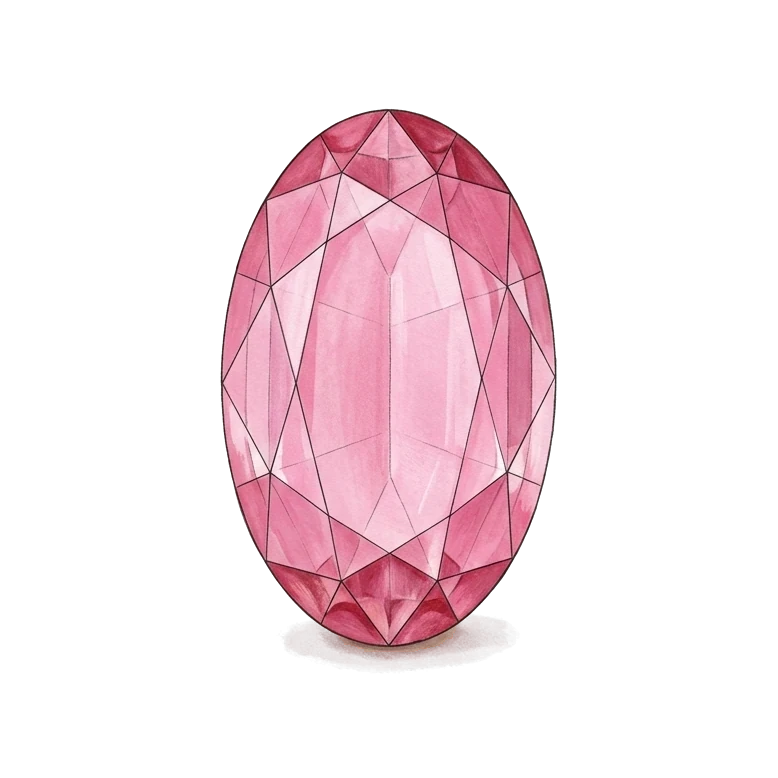
What does tourmaline mean?
Even the name lumps several gems together. It comes from toramalli, a Sinhalese word for “mixed gems,” which Dutch merchants used for the many-colored, water-worn pebbles that miners dug from the gem gravels of Ceylon, now Sri Lanka. GIA also translates it as “stone with mixed colors,” since one crystal often holds several.
For most of history, nobody knew they were looking at one gem. Until modern mineralogy, people named tourmaline after whatever stone its color suggested: ruby, sapphire, emerald.
In 1554, Francisco Spinoza’s expedition discovered a “Brazilian emerald,” the first recorded green tourmaline crystal. Scientists recognized tourmaline as a mineral species of its own only in the 1800s.
Its colors may also explain its traditional meaning. GIA suggests that’s why ancient mystics believed tourmaline could inspire artistic expression: it has a palette for every mood. Tourmaline is also the gem of the eighth wedding anniversary.
Pink, black and green tourmaline meaning
Crystal lore also credits each color with powers of its own.
- Pink tourmaline meaning: love, compassion and gentleness. Pink is also the shade the 1952 update to the US birthstone list named for October.
- Black tourmaline meaning: protection for the wearer.
- Green tourmaline meaning: courage and strength.
These are beliefs, not properties of the stone. What tourmaline does when it’s heated, though, is physics.
The electric stone
Tourmaline is pyroelectric: it becomes electrically charged when it’s heated. It’s piezoelectric too, so squeezing it builds a charge as well. GIA notes a practical side effect: warmed under the lights of a display case, tourmaline picks up extra dust.
The effect may have been noticed 24 centuries ago. Theophrastus described a stone he called lyngourion that attracted straws and bits of wood, and he believed it formed from the urine of a wild animal, which Pliny the Elder later named as the lynx. A historian of physics, writing in Physics Today, judges it most probably tourmaline. Kunz read Theophrastus’s stone as jacinth, or possibly sapphire.
Europe met the effect again through Dutch gem cutters who tested tourmaline in a fire. In a book of 1707, Johann Georg Schmidt passed on a physician’s account: in 1703 the Dutch had brought from Ceylon a stone called tourmaline that attracted the ashes of warm or burning coals, “as the magnet does iron,” and then pushed them away again. Linnaeus was the first to link the effect to electricity, and he named the mineral lapis electricus, “electric stone.”
Tourmaline in Imperial China
In China, red tourmaline once signaled rank. On Kunz’s list of the stones Chinese mandarins wore to show their rank, “red or pink tourmaline, ruby (and rubellite)” come first.
At the turn of the 20th century, tourmaline’s biggest market was China. Much of the pink and red tourmaline from San Diego County, California, was shipped there because the Empress Dowager Tz’u Hsi (Cixi) was especially fond of the color, and craftsmen carved it into snuff bottles and other pieces for jewelry. The California miners depended on that trade so much that when the Chinese government collapsed in 1912, the US tourmaline trade collapsed with it.
Tourmaline colors: one of the widest ranges of any gem
Tourmaline has one of the widest color ranges of any gem species, in shades of virtually every hue. Traces of iron, and possibly titanium, are generally thought to make the greens and blues, and manganese the reds and pinks. Some pink and yellow stones may owe their color to radiation, natural or from a lab.
That’s because tourmaline isn’t one mineral but a group of closely related species that share a crystal structure and differ in chemistry. The major ones are elbaite, liddicoatite, dravite, uvite and schorl. Most gem tourmalines are elbaites, which grow in granite pegmatites, where one pocket can hold crystals of several colors.
-

Rubellite Elbaite
Pink, red, purplish red, orangy red or brownish red tourmaline. Some in the trade say the name shouldn’t cover pink stones.
#C21E56
-

Indicolite Elbaite
Dark violetish blue, blue or greenish blue tourmaline colored by iron, not copper.
#1F5A8C
-

Verdelite Elbaite
The trade name for green tourmaline colored without chromium or vanadium.
#3E8E5E
-

Chrome tourmaline Dravite and uvite
An intense green that can rival tsavorite, and now and then emerald. Despite the name, it is colored mostly by vanadium.
#0E7A3E
-

Paraíba tourmaline Elbaite or liddicoatite
Neon blue to green, colored by copper. First found in Paraíba, Brazil, in the late 1980s, and since the early 2000s in Nigeria and Mozambique too.
#19C3CF
-

Watermelon tourmaline
Pink in the center and green outside, so crystals are usually cut in slices to show both.
#E0607E
-

Parti-colored tourmaline
Two or more colors in one stone, often green and pink. The zones form when the trace elements change as the crystal grows.
#9DB04A
-

Cat’s-eye tourmaline
Most often green, blue or pink. Tube-like inclusions give it a softer eye than cat’s-eye chrysoberyl.
#5F8F55
-

Achroite Elbaite
Colorless tourmaline, valued for its rarity.
#E9EEEC
-
Schorl
Typically black and rich in iron. Rarely cut as a gem, though it has been used in mourning jewelry.
#1E1E22
Rubellite and pink tourmaline
Rubellite is the trade name for pink, red, purplish red, orangy red or brownish red tourmaline, though some in the trade argue it shouldn’t cover pink. It’s one of tourmaline’s most sought-after colors, and at its best its hue and depth approach those of ruby and pink sapphire.
That closeness fooled royal courts. One of the “rubies” in the Russian crown jewels, the Caesar’s Ruby pendant, is rubellite. The trade name “Siberian ruby” still means red tourmaline: see the other ruby names to watch for.
Paraíba tourmaline
Paraíba tourmaline’s neon blues and greens reached the market from Brazil’s Paraíba state in the late 1980s. Copper causes its color, and copper isn’t a coloring agent in any other tourmaline. Some stones hold so much that tiny flecks of native copper show inside.
The name now describes the stone, not the place. The definition agreed by the gem labs’ Laboratory Manual Harmonisation Committee, which GIA uses, covers blue, bluish green to greenish blue and green tourmaline colored mainly by copper and manganese, “of whatever geographical origin.”
Similar stones have come from Nigeria and Mozambique since the early 2000s, and telling them from Brazil’s takes quantitative chemical analysis in a lab. GIA’s birthstone page calls them Paraíba-type tourmalines.
Brazilian stones are typically valued more highly than African ones. Paraíba tourmaline is rarely seen bigger than one carat, and with this gem, color matters more than size.
Watermelon tourmaline and bicolor stones
Color zones form when the trace elements change in amount or makeup while a crystal grows. Watermelon tourmaline is pink in the center and green outside, so crystals are usually cut in slices to show both. Other crystals change color along their length, pink at one end and green at the other, and gemologists call all of these parti-colored.
Pink and green is one of the most common pairings, but many others are possible. Liddicoatite can show striking, complex zoning, and it’s named after Richard T. Liddicoat, a former president of GIA.
Green, blue and chrome tourmaline
Chrome tourmaline is an intense green, but it’s colored mostly by vanadium, the element behind many Brazilian and African emeralds. It can be a lower-priced alternative to tsavorite garnet or emerald, and while both are rare above two carats, chrome tourmaline up to five carats isn’t hard to find.
Most green tourmalines are strongly pleochroic, showing a different color depending on the direction you look through them. The most valuable show attractive colors both ways, such as green one way and blue the other. Blue tourmaline colored by iron is called indicolite, and its blues fall short of Paraíba’s copper blue.
Some tourmalines show a cat’s eye. Their eye is softer than that of cat’s-eye chrysoberyl, because it comes from larger, tube-like inclusions.
Is tourmaline good for everyday wear?
| Hardness | 7–7.5 on the Mohs scale |
|---|---|
| Everyday ring? | Great for everyday Hard and tough enough for a ring worn every day. |
| Family | Tourmaline group |
| Main sources | Brazil, Afghanistan, Pakistan, Nigeria, Mozambique, United States (California, Maine) |
| Treatments | Heating and irradiation are the main treatments, and both are often undetectable. Irradiated color can fade with heat or bright light, and some stones have fractures filled with oil or resin. |
| Lab-grown | No synthetic gem tourmaline is sold. It has been grown only in research labs. |
| Anniversary | 8th wedding anniversary |
At 7 to 7.5 on the Mohs scale, tourmaline is generally fine for everyday wear. Its toughness is rated fair.
Heat is the risk to watch. High heat can change a tourmaline’s color, and a sudden change in temperature can crack it.
Where tourmaline is found
Brazil is tourmaline’s most common source, and most of Brazil’s has come from pegmatites in the state of Minas Gerais. Afghanistan, Pakistan, Kenya, Madagascar and Mozambique mine it too. Madagascar and Afghanistan have produced fine red tourmaline.
In the United States, Maine’s first major find came in 1820 at Mount Mica, in Paris: as Augustus Hamlin told the story in 1895, two boys found it while exploring the countryside. Tourmaline is now Maine’s state mineral, and the Mount Mica quarry still turns up gem tourmaline from time to time. Maine has watermelon tourmaline too, green outside and pink at the core.
California’s first commercial tourmaline mine opened in 1898 at the Himalaya pegmatite, in the Mesa Grande district, famed for fine rubellite. After the China trade ended, the Himalaya mine stopped producing gems in large volumes, though mines such as the Stewart Lithia mine at Pala still yield some.
Famous tourmalines
One of the most famous tourmalines spent centuries under another name. Caesar’s Ruby got its name from Boetius de Boot, whose 1609 book on gems called the Holy Roman Emperor Rudolf II’s great red gem Caesaris rubinus, “the Emperor’s Ruby.”
Swedish troops later took it from Prague Castle in the Thirty Years’ War, and an Amsterdam pawn record of 1655 listed it as a “rubin balais,” an early hint that it wasn’t a ruby. Others are museum treasures, from an ancient carved portrait to the pride of Maine’s mines.
-
Caesar’s Ruby
Given to Catherine the Great in 1777
A 255.75-carat red stone cut in a raspberry shape, once thought one of Europe’s largest rubies. In 1922 the mineralogist Aleksandr Fersman found it was rubellite. It is still shown under its old name in Moscow’s Diamond Fund.
-
The Alexander the Great intaglio
Identified in 2019
A red-yellow tourmaline, 2.4 cm wide, carved with Alexander’s profile and thought to date from his reign. Gem-A’s tests made it the earliest known use of tourmaline as an ornament. It is in Oxford’s Ashmolean Museum.
-
The Hamlin Necklace
Bequeathed in 1934
Eighteen removable pendants of Mount Mica tourmaline and beryl, with a 34.25-carat center stone, made by the mine’s owner, Augustus Hamlin. Harvard’s Mineralogical and Geological Museum calls it arguably the best known piece in its gem collection.
-
The Jolly Green Giant
Found in 1972
A 10-inch crystal from the Dunton Mine in Newry, Maine, where large pockets opened that year yielded hundreds of pounds of red and green tourmaline. It is now in the National Museum of Natural History in Washington, D.C.
-
The Smithsonian’s carved tourmaline
A 376.85-carat tourmaline carved by O. Hansen, who used the stone’s own colors as part of the design.
Tourmaline names to watch for
Some sellers give tourmaline the name of a pricier gem. A blue stone called a “Brazilian sapphire” or “Ural sapphire” is tourmaline, and so is a “Siberian ruby.” Ask the seller what the stone really is, and get a lab report for a valuable one.
| Sold as | What it is |
|---|---|
| Siberian ruby | Red tourmaline (rubellite) |
| Brazilian sapphire | Blue tourmaline |
| Ural sapphire | Blue tourmaline |
| Brazilian emerald | Green tourmaline |
| Ceylonese peridot | Green tourmaline |
How to buy tourmaline
Color matters most. The most valuable tourmalines are highly saturated with no dark, blackish areas, though softer “earth” colors have become popular. Then look at:
- Clarity, by color. Pink and red tourmalines often have inclusions you can see, and buyers accept them if the color is strong. Green tourmalines are expected to look clean, so distracting inclusions can lower their value.
- Cut. Tourmaline crystals are often long, so many cut stones are narrow, non-standard sizes. Many cutters also orient a stone to lighten dark rough or darken pale rough.
- Size. Price per carat rises considerably for large stones, generally once they pass five carats.
- Origin, for Paraíba. A famous mine doesn’t guarantee quality, but fine stones with a lab report confirming Paraíba origin command a premium.
Heating and irradiation are tourmaline’s two most important treatments. Some blue and green stones are heated at low temperatures to lighten or improve their color, while pink stones can be irradiated to deepen theirs. Both treatments are often undetectable, and heating can burst fluid inclusions, leaving fractures that may be filled with oil or resin.
There’s no lab-grown tourmaline to choose instead. Gems & Gemology, GIA’s journal, states that no synthetic gem tourmaline exists, and the synthetics made so far were grown only for research.
| Type | What to know |
|---|---|
| Natural | Mined. Heating and irradiation are the main treatments, and both are often undetectable. Irradiated color can fade with heat or bright light, and some stones have fractures filled with oil or resin. |
| Lab-grown | No synthetic gem tourmaline is sold. It has been grown only in research labs. |
| Imitation | Glass has been cut to look like Paraíba tourmaline crystals, though GIA calls this unusual. |
| Type | Price |
|---|---|
| Green, 1 carat | $15–$80 |
| Pink, 1 carat | $60–$150 |
| Rubellite (red), 1 carat | $100–$400 |
| Blue, 1 carat | $200–$1,000 |
Prices vary with size, color, clarity and seller. They’re a guide to what shops ask, not a valuation or an investment view.
How to clean tourmaline
Cleaning tourmaline
- Warm soapy water, soft brush
- Safe
- Ultrasonic cleaner
- Not recommended
- Steam cleaner
- Not recommended
High heat can change its color, and sudden temperature changes can crack it.
Clean tourmaline with warm, soapy water and a soft brush. Ultrasonic and steam cleaners aren’t recommended. Light and chemicals generally won’t hurt it, but heat can, and color produced by irradiation can fade with heat or bright light.