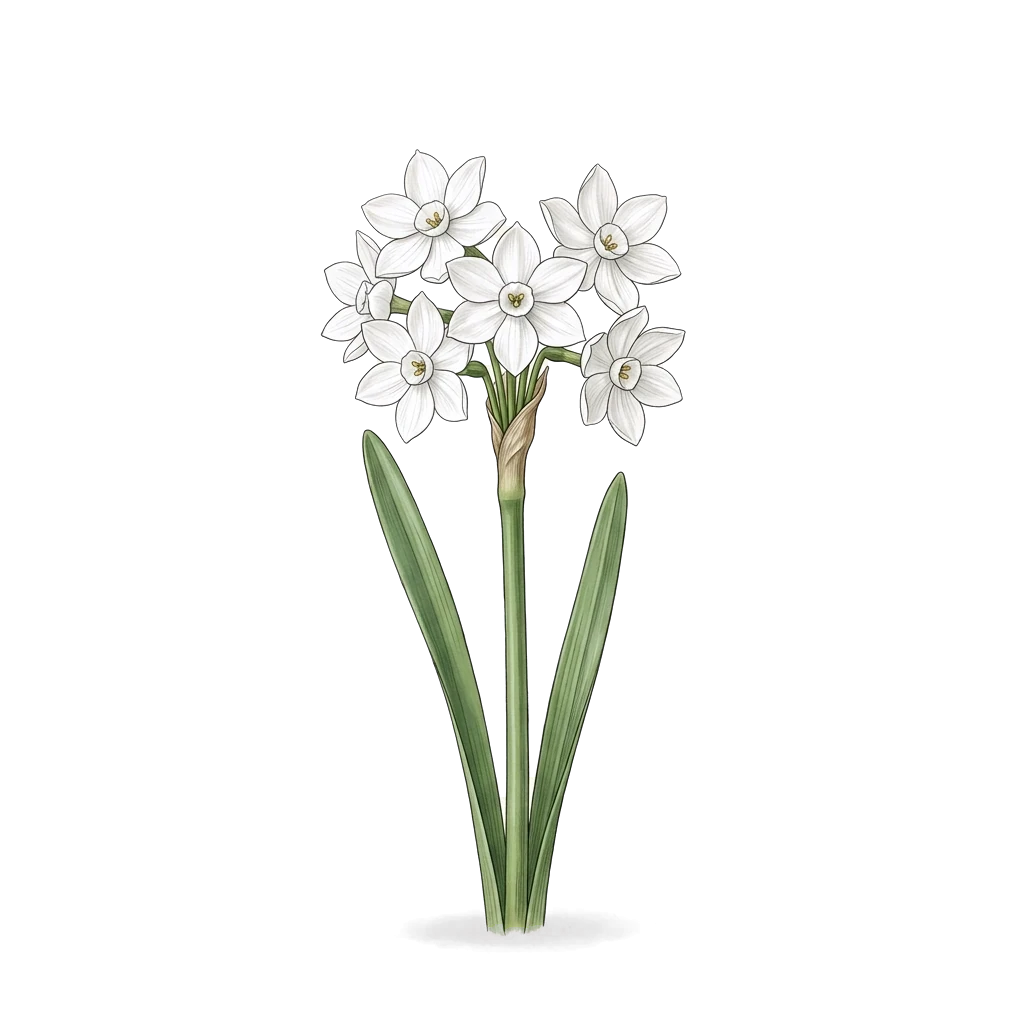
What is a narcissus flower?
Narcissus is the botanical name of the daffodils, the whole genus. In everyday English, “a narcissus” is a daffodil, especially one with small flowers and a short, cup-shaped center. The narcissus on birth flower lists is the paperwhite, Narcissus tazetta, the one people grow in bowls of pebbles in winter.
A paperwhite stem carries anywhere from 3 to 20 fragrant flowers, each with white petals around a small yellow cup. That bunch of flowers on one stem is what sets the tazetta daffodils apart: they make up Division 8 of the classification daffodil societies follow, defined by usually three to twenty flowers on a stout stem, broad leaves and spreading, fragrant flowers. For the trumpet daffodils of spring and the poems written about them, see our daffodil meaning page.
The wild plant grows from the Canary Islands and the Mediterranean east to China and Japan. Outdoors it survives the winter only in mild climates: NC State Extension rates it hardy in USDA zones 7 to 10, and Illinois Extension only to zone 8. Farther north the paperwhite narcissus is not winter-hardy outdoors, which is why most people grow it indoors in a bowl.
Narcissus meaning
The narcissus stands for rebirth and hope. In a dark month, a bowl of white paperwhites coming out of brown bulbs is a fair picture of both.
The Victorian reading is another matter. Kate Greenaway’s Language of Flowers (1884) gives the narcissus a single word, “egotism,” the failing of the Greek youth the genus is named for.
The narcissus myth: Echo’s side of the story
Ovid tells the narcissus myth in the third book of the Metamorphoses, and his version is as much about the nymph Echo as about Narcissus. Narcissus was sixteen, and young men and girls alike wanted him, but none of them touched him.
Echo can only give back the last words she hears, so Ovid builds their meeting out of her repetitions. Separated from his hunting companions, Narcissus calls “Ecquis adest?” (“Is anyone here?”) and she answers “Adest!” (“Here!”). When he calls “Huc coeamus!” (“Let us meet here!”), she returns “Coeamus” more gladly than she ever answered anything (the word can also mean “let us come together”) and runs out of the trees to throw her arms around him, and he runs from her.
Echo hid in the woods and wasted with grief until only her voice and her bones were left, and the bones, people say, took the shape of stone. From then on she hides in the woods, seen on no mountain but heard by everyone.
Narcissus’s own end comes at a spring, where he falls for his reflection and at last understands it: “Iste ego sum,” “I am he.” As he dies, Echo repeats his last “farewell,” and Ovid adds that even in the underworld he went on gazing at himself in the waters of the Styx.
Narcissus flower colors
- White
- Yellow center
A paperwhite has white petals around a small yellow cup, and some kinds, such as ‘Ziva’ and ‘Galilee’, are white all through. The golden one, ‘Grand Soleil d’Or’, has yellow petals around an orange cup.
The water fairy flower of the Chinese New Year
In southern China the narcissus is a flower of the New Year. In 1942 the botanist Franklin Metcalf described the New Year flower markets of Canton, where streets were lined with flowering branches for the last days of the old year. At the top of his list was the narcissus, which he called the Chinese New Year lily, the water fairy flower or the Chinese sacred lily, and “probably the most common flower” of the festival.
He wrote that people loved it for the snow-white petals and rich fragrance, and that the green leaves and white flowers bursting from shaggy brown bulbs stood for the beginning of a new year. Growers sliced the bulbs so the flowers came up in tight, curving masses shaped like objects, timed to be at their best as the New Year began, and that craft was confined to about ten hamlets near Changchow (Zhangzhou), in southern Fukien (Fujian).
The Chinese name is shuǐxiān. Lan Su Chinese Garden in Portland translates it as “water immortal”: the xiān is a Daoist immortal, and the water is there because the bulb flowers with nothing but water and sunlight. The garden’s curator writes that the bulbs first reached China in the Song dynasty, brought by Arab traders through what is now Fujian, and that a carved “crab-claw” bulb takes about three hours of work.
The Metropolitan Museum of Art owns a mid-13th-century handscroll of the flower, Narcissus, by the Southern Song painter Zhao Mengjian, in ink on paper and more than 12 feet long.
Types of paperwhite narcissus
The paperwhites belong with the tazetta daffodils. Illinois Extension counts two species sold under the name, Narcissus tazetta and the white-cupped N. papyraceus, though Clemson treats the second as another name for the first. The bulbs sold for forcing are mostly named cultivars, so choose by scent as much as by color.
-
Tazetta daffodils
Division 8 of the RHS classification, where the paperwhites belong. Usually three to twenty fragrant flowers on a stout stem, with broad leaves and spreading petals
-
'Ziva'
Narcissus 'Ziva'
Pure white flowers with a strong, musky fragrance, which some people find objectionable
-
'Inbal'
Narcissus 'Inbal'
White flowers with a mild, pleasant fragrance, one of the paperwhites suggested for anyone put off by the scent of Ziva
-
'Galilee'
Narcissus 'Galilee'
Pure white flowers with a moderate musky fragrance
-
'Bethlehem'
Narcissus 'Bethlehem'
Creamy white petals around a yellow cup, with a mild musky fragrance
-
'Grand Soleil d'Or'
Narcissus 'Grand Soleil d'Or'
Yellow petals and an orange cup, with a sweet, fruity fragrance. It takes one to two weeks longer to force than other paperwhites and flowers less heavily
-
Chinese sacred lily
White petals, a yellow cup and a citrus-like fragrance. In southern China it is the flower of the New Year, and like the other paperwhites it can be forced without chilling
How to force paperwhites indoors
Growing narcissus (paperwhite)
Facts for paperwhite (Narcissus tazetta), grown outdoors
- Type
- Bulb
- Blooms
- Spring
- Sun
- Full sun to part shade
- USDA zones
- 7–10
- Native to
- The Mediterranean east to China and Japan
Paperwhites need no cold treatment before forcing, unlike hardy bulbs. This is how to force paperwhites in a bowl:
- Take a bowl with no drainage hole, at least 2 to 3 inches deep, and fill it with pebbles, pea gravel or coarse sand to about an inch below the rim.
- Set the bulbs on top and push gravel around them to cover the bottom quarter of each bulb.
- Add water until it just touches the bottom of the bulbs, and keep it at that level. More water than that rots them.
- Leave the bowl somewhere cool (45° to 50°F) and dark for two or three weeks while the roots grow, then move it to a sunny window at 60° to 70°F once the shoots are about 3 inches tall.
They flower four to six weeks after planting. Plant a new bowl about every two weeks from mid-October and you can have flowers from Thanksgiving until late March. Once buds open, moving the bowl out of direct sun makes the flowers last longer.
When they’re done, throw the bulbs away: forced paperwhites can’t be forced again and aren’t winter-hardy outdoors. Where they are hardy (zones 7 to 10, by NC State’s rating), fresh bulbs can go straight into the garden in full sun or part shade and well-drained soil rich in organic matter.
Pickled paperwhites: Cornell’s alcohol trick
Forced paperwhites can grow 18 to 20 inches tall, and their stalks often flop. Erin Finan, a Cornell horticulture student working with Bill Miller of the university’s Flower Bulb Research Program, put an old gardeners’ tip to the test: water them with a little alcohol.
Start the bulbs in plain water. When the roots have formed and the green shoot is 1 to 2 inches long, pour off the water and replace it with a solution of 4 to 6% alcohol: one part 80-proof gin or a similar spirit to seven parts water, or one part 70% rubbing alcohol to 10 or 11 parts water. The plants end up a third to half shorter, with flowers just as big that last just as long.
Don’t use beer or wine, since their sugars cause problems, and don’t go stronger: at much more than 10% alcohol, growth problems start. The researchers think it works by stressing the plant for water, making it harder to take up.
Are paperwhites poisonous to cats and dogs?
Narcissus (paperwhite)
- Pets
- Toxic to dogs, cats and horses
- People
- Listed as poisonous (low severity) The bulbs are the most poisonous part.
In the US, if a pet may have eaten part of a plant, call your vet or the ASPCA Animal Poison Control Center at (888) 426-4435. If a person has, call Poison Control at 1-800-222-1222.
The ASPCA’s paperwhite entry covers the whole genus, under the names daffodil, jonquil and narcissus too, and says the bulbs are the most poisonous part.
Narcissus bouquet ideas
Paperwhites make their best gift still growing: a bowl of bulbs just showing buds opens in the recipient’s home rather than yours. If you do cut them for a narcissus bouquet, treat them like any daffodil and stand the stems alone for a few hours first, since their sap shortens the life of other flowers in the same water.
-
A New Year bowl
Chinese sacred lilies in pebbles and water, with a few branches of flowering peach beside them, as in the Canton flower markets.
-
White with holly
Cut paperwhites and a few sprigs of berried holly, the two December flowers in one jar. Give the narcissus stems their own water first.
-
Gold and white, softly scented
‘Grand Soleil d’Or’ with white ‘Inbal’: a brighter bowl than plain white, and gentler on the nose than a bowl of ‘Ziva’.
-
A staggered set
Three small pots planted two weeks apart, so the gift keeps flowering into the new year, one pot after another.
For the holly side of that December pairing, see our holly meaning page.
Narcissus tattoo ideas
A paperwhite isn’t one flower but a bunch of them, usually three to twenty small heads with spreading petals on a single stem. That cluster, and the bulb it rises from, set it apart from a big spring daffodil.
-
Flower and reflection
A stem of paperwhites above a water line, mirrored underneath: Narcissus at the spring, told without a figure.
-
Echo’s answer
A small narcissus with one word beneath it, "adest" (here), the reply Echo gave when Narcissus asked if anyone was there.
-
Brush and ink
Black ink only, in loose strokes for long leaves and white flowers, after Zhao Mengjian’s 13th-century narcissus handscroll at the Met.
-
Bulb, roots and bloom
The whole plant as it grows in a glass: pebbles, white roots, a papery bulb and the flower cluster on top. It suits a long, narrow space like the forearm.