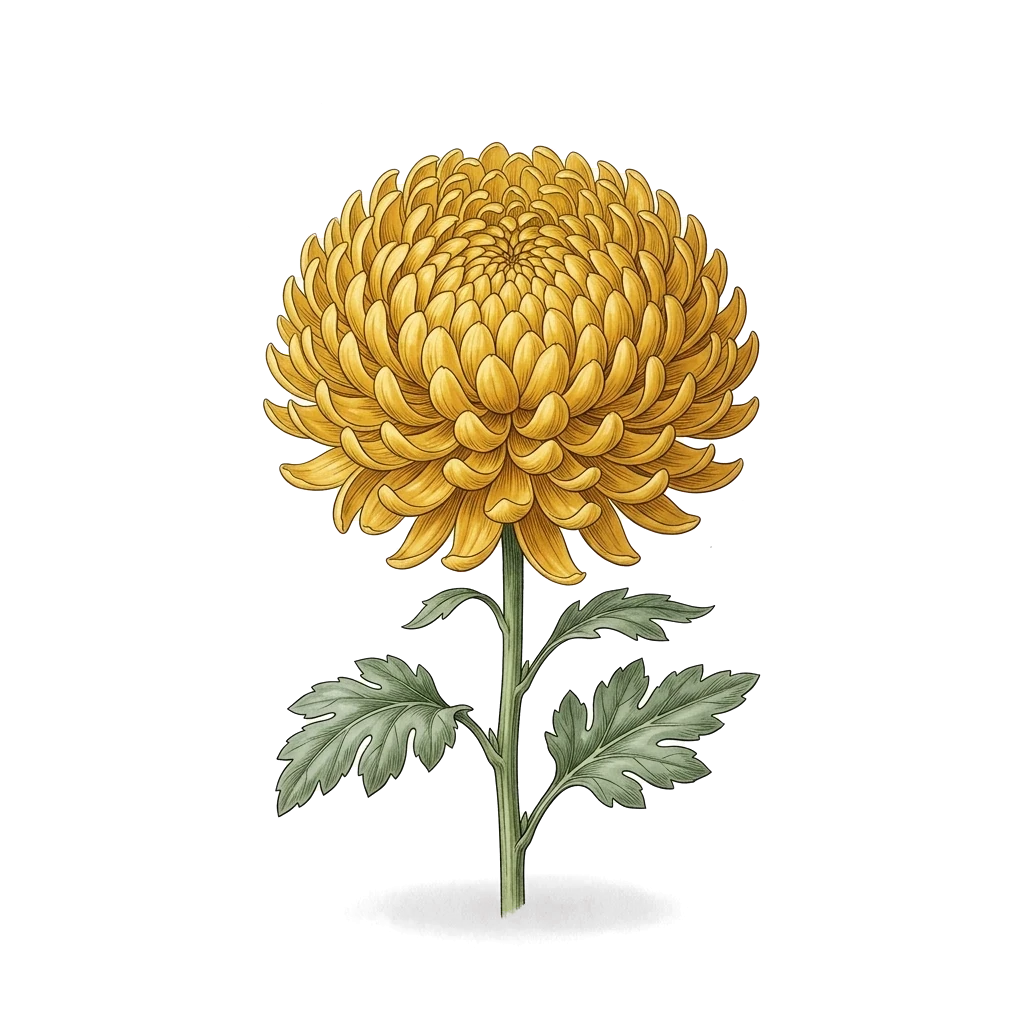
What does a chrysanthemum symbolize?
The Old Farmer’s Almanac gives the chrysanthemum three words: loyalty, friendship and joy. The name is older than any of them. It comes through Latin from the Greek khrūsanthemon, “gold flower.”
Kate Greenaway’s 1884 Language of Flowers reads the flower color by color: red says “I love,” white “Truth” and yellow “Slighted love.” Her other entry, the Chinese chrysanthemum, stands for “Cheerfulness under adversity.”
Beyond the flower books, the mum flower meaning changes with the map. In China it belongs to a poet, in Japan to the imperial family, and in France to the dead.
Chrysanthemum colors and their meanings
| Color | Meaning today | Victorian (1884) |
|---|---|---|
| Yellow | A wounded heart, neglected love 1884: Slighted love | |
| Red | True love 1884: I love | |
| White | Innocence and honesty 1884: Truth | |
| Purple | — | |
| Orange | — |
Red chrysanthemum meaning
Red is where the old book and today’s charts agree most plainly. The Almanac reads a red mum as true love, and Greenaway’s red chrysanthemum says “I love.”
White chrysanthemum meaning
White stands for innocence and honesty on the Almanac’s list. In 1884 it meant one word, “Truth.”
Yellow chrysanthemum meaning
Yellow gets the sad message: a wounded heart or neglected love today, “slighted love” in Greenaway. That is a little unfair to the oldest color of all. The Almanac says the first chrysanthemums were golden, and the ones Tao Yuanming wrote about were yellow.
Chrysanthemum symbolism in China: Tao Yuanming’s eastern hedge
Chrysanthemums have been grown in China since at least the 5th century BC. Their poet came much later. Tao Yuanming (365–427) retired from his post as governor of Pengze at 41 to live quietly in the country, and two of his poems, “Returning Home” and “Drinking Wine,” describe his detachment from society and his fondness for yellow chrysanthemums.
Arthur Waley’s 1918 translation gives the famous lines: “I pluck chrysanthemums under the eastern hedge, / Then gaze long at the distant summer hills.” The poet picking his flowers at the hedge east of his house became a painting theme of its own, and in Japan artists painted Tao from the Muromachi period to the Edo period.
The chrysanthemum also kept company with the scholar’s other plants. East Asian poets and painters gave plants such as the plum, orchid, chrysanthemum and bamboo auspicious meaning, literary resonance and scholarly virtue, and in the Korean tradition the four are the “Four Gentlemen,” each said to embody the noble qualities of the ideal Confucian gentleman-scholar.
The chrysanthemum in Japan
In Japan, chrysanthemums have been cultivated since the 8th century AD. The imperial household has shown them off since 1878, when the Imperial Household Ministry held its first chrysanthemum viewing for the imperial family at the Akasaka Palace. From 1880, foreign envoys were invited too.
The show moved to Shinjuku Gyoen, then an imperial garden, in 1929. It stopped from 1937 to 1948, and since 1949 the garden, now a national one, has carried the tradition on every year. Today the exhibition runs from November 1 to 15.
The imperial crest and the Supreme Order
The chrysanthemum appears on the emperor’s official seal and crest. At Shinjuku Gyoen, a large single-flowered kind with around 16 petals, Ichimonji, is also called the Imperial Crest chrysanthemum because its shape resembles the imperial family’s crest.
Japan’s most prestigious award carries the flower too. The Grand Cordon of the Supreme Order of the Chrysanthemum was established in 1876 and the Collar in 1888, and the badge shows a rising sun wreathed with chrysanthemums and chrysanthemum leaves.
Higo chrysanthemums and the samurai
Higo chrysanthemums are said to come from Higo province, now Kumamoto Prefecture, in the Edo period (1603–1868). There the domain’s lord, Hosokawa Shigekata, encouraged his samurai to grow them as a discipline of spirit and refinement. Their single flowers mix flat and tubular petals, with clear gaps between them.
Why chrysanthemums are a flower of mourning in France
In parts of Europe, the chrysanthemum is a flower of sorrow, death and mourning. The City of Paris dates that role in France to November 11, 1919, when President Raymond Poincaré called for every war memorial in the country to be decorated with flowers. The chrysanthemum, in full bloom at that time of year, was the one chosen.
Flowering the cemeteries grew into a custom tied to November 2, the Day of the Dead. In 2023, chrysanthemums made up 60 percent of the plants French households bought for All Saints’ Day, according to a study the City of Paris cites.
The flower had reached France long before. In 1789 the sea captain Pierre Blancard became the first to bring chrysanthemum cuttings to France from China.
Chrysanthemums in America
Philadelphia saw them early. Chrysanthemums were shown at a Pennsylvania Horticultural Society meeting as early as 1828, and at the society’s 1841 annual meeting Robert Kilvington exhibited the first known hybrid grown in the United States.
From the 1880s through the 1920s, chrysanthemum shows lasting several days were held each fall in major American and Canadian cities. Visitors were fascinated by the “wonderfully bizarre” Japanese forms of the time.
Types of chrysanthemums
The garden mum is Chrysanthemum × morifolium, a complex hybrid of five Chinese species with hundreds of cultivars. Its name means “mulberry leaf,” after the shape of the leaves.
The National Chrysanthemum Society sorts the blooms into 13 classes by the shape of their florets, from the huge incurves to the spiders and the thistle-like Ise blooms of Japan. Eight of the classes:
-
Irregular incurve
Class 1. Broad ray florets curl inward in an uneven way to make a very large bloom, the biggest over 8 inches across. Its lower florets may swirl or form a skirt
-
Reflex
Class 2. Florets overlap and curve back in a large, rounded bloom that can top 8 inches, with the short center florets hiding the disk
-
Regular incurve
Class 3. Short florets curve smoothly inward into a ball, ideally as deep as it is wide
-
Decorative
Class 4. Flatter blooms, upper florets curving in and lower ones out, with no center showing. Many mums grown for cutting and for landscaping are in this class
-
Pompon
Class 6. Small, firm balls of short florets, from buttons under an inch to blooms of about 4 inches
-
Single and semi-double
Class 7. One to five rows of strap-shaped florets around a daisy-like center
-
Spoon
Class 9. Narrow tubular florets that open into a flat spoon at the tip, radiating like spokes from a visible center
-
Spider
Class 11. Long, tubular florets, fine or bold, ending in coils or hooks and pointing every which way
Size matters to the society as much as shape. The biggest blooms in classes 1 and 2, over 8 inches, are always grown as disbuds and need a long, cool, frost-free season or a greenhouse to reach full size, while many garden cultivars carry small blooms and normally aren’t disbudded.
How to grow chrysanthemums
Growing chrysanthemum
- Type
- Perennial
- Blooms
- Fall
- Sun
- Full sun
- USDA zones
- 5–9
- Native to
- Asia
Cut the plants back three times in spring and summer, the last time around mid-August. That keeps them bushy and compact and stops them flowering in spring. In the South they overwinter outdoors easily, but in colder places they may need to be dug up and kept in a greenhouse over winter.
Mums time their flowers by day length: buds start to form once days are 12 hours or shorter, so a plant under a street light or security light can be slow to bud. The society sorts cultivars into early, mid and late season, from those that generally flower by September 30 to those that open from October 23 into December.
Are mums poisonous to cats and dogs?
Chrysanthemum
- Pets
- Toxic to dogs, cats and horses
- People
- Listed as poisonous (low severity) Stomach upset if eaten, and touching the leaves can cause mild rashes in some people.
In the US, if a pet may have eaten part of a plant, call your vet or the ASPCA Animal Poison Control Center at (888) 426-4435. If a person has, call Poison Control at 1-800-222-1222.
The ASPCA lists the signs as vomiting, diarrhea, hypersalivation, incoordination and dermatitis. Its separate “daisy” entry is the same plant, filed under Chrysanthemum species with chrysanthemum and mum as its other names.
Chrysanthemum bouquet ideas
Cut chrysanthemums when the flowers are nearly or fully open, strip any leaves that would sit in the water and change the water every couple of days. They last 7 to 10 days in a vase.
-
Spiders in a tall vase
A few spider mums in a narrow vase let the long, hooked florets fall where they like. They look best with room around them.
-
Yellow, from the eastern hedge
A loose bunch of small yellow mums for someone retiring to a quieter life, the way Tao Yuanming did.
-
Pompons down the table
Button pompons fit in jam jars and egg cups, so a row of them can run the length of a fall dinner table.
-
Red and white
Red for "I love," white for "Truth": in Greenaway’s book, a mixed bunch says both.
Chrysanthemum tattoo ideas
A chrysanthemum tattoo depends on its florets, and the society’s classes are a ready-made guide: they curl in, curve back, open into spoons or end in hooks.
-
An incurve globe
A regular incurve is a near-perfect ball of short, inward-curving florets. Shade it as a solid sphere rather than a flat flower.
-
A spider mum
Long tubular florets with a coil or hook at each tip give a fine-line piece plenty of movement, even at a small size.
-
Sixteen petals
A flat single flower with about 16 petals, like the Ichimonji grown at Shinjuku Gyoen, recalls the shape of the imperial crest.
-
Under the eastern hedge
A few yellow flowers at a fence with far-off hills behind, after Tao Yuanming’s poem, with or without his line.