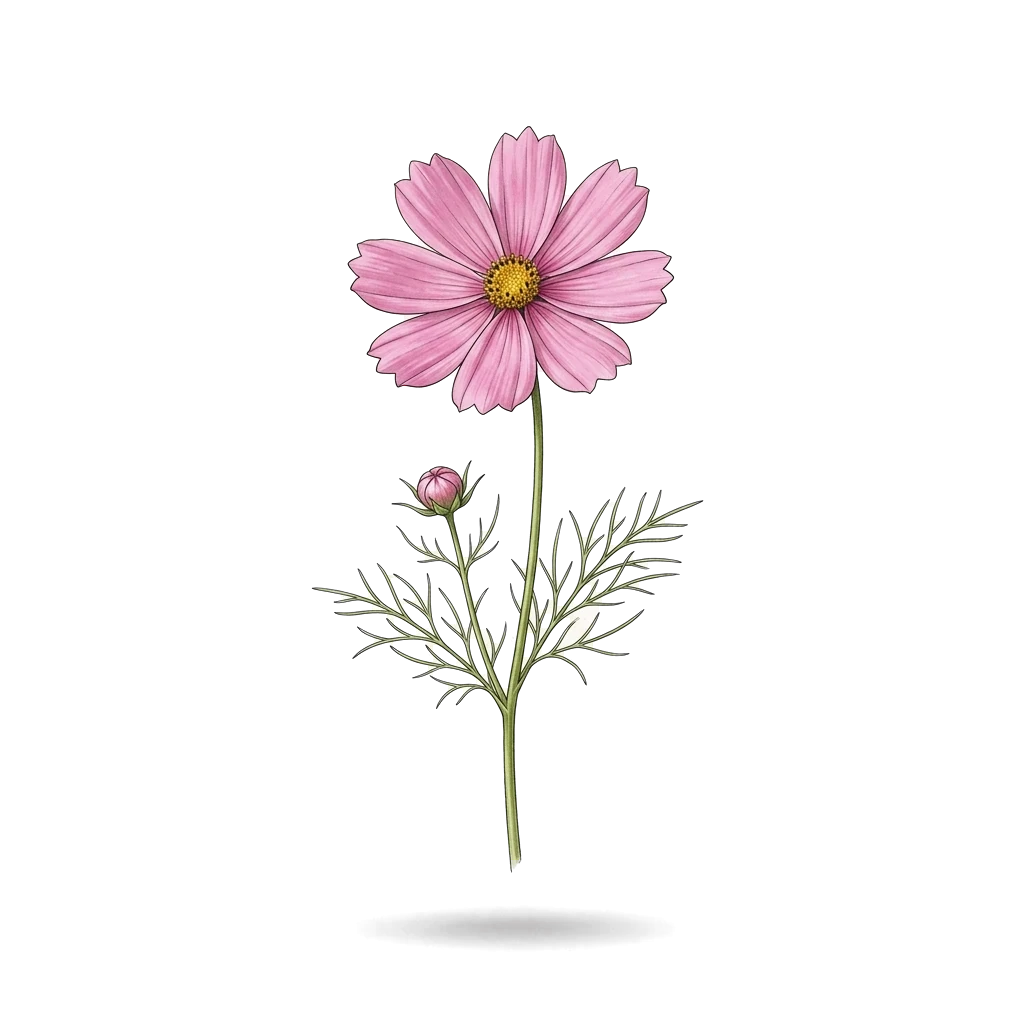
What is a cosmos flower?
A cosmos is one of a group of mostly Mexican plants in the daisy family, with flower heads in many colors and leaves divided like feathers. The genus has about 35 species. Two of them fill gardens as annuals: the garden cosmos, Cosmos bipinnatus, and the sulphur cosmos, Cosmos sulphureus.
Botanically, each bloom is a flower head. A ring of colored ray florets surrounds a center of tiny disc florets, as in a daisy. Bipinnatus describes the leaves, which are bipinnate, deeply cut and lacy, and the cosmos plant also goes by Mexican aster, cut-leaf cosmos and tall cosmos.
Cosmos flower meaning
The cosmos stands for harmony and joy. The harmony is in the name: the Greek kosmos means order, and in English the word also means the universe seen as an orderly, harmonious whole. Kate Greenaway’s 1884 Language of Flowers leaves the cosmos out, so it has no Victorian meaning to inherit.
Who named the cosmos?
The name entered botany on February 16, 1791, when Antonio José Cavanilles published the genus Cosmos in the first volume of his Icones et descriptiones plantarum, with the garden cosmos as its type. Plate 14 of that book, drawn by Cavanilles and engraved by Miguel Gamborino, shows Cosmos bipinnatus with its parts labeled a to f, and the RHS Lindley Collections hold a copy.
Cosmos colors and what they mean
| Color | Meaning today |
|---|---|
| Pink | A mother's love |
| Magenta | — |
| White | Faithfulness and devotion |
| Red | Love and passion |
Each part of the color range belongs to a different plant. Pinks, lavenders, whites and maroons are garden cosmos, golds and oranges are sulphur cosmos, and the darkest of all, a maroon-crimson that smells of chocolate, is the chocolate cosmos.
Types of cosmos
-
Garden cosmos
Cosmos bipinnatus
The common cosmos, also called Mexican aster: an annual 2 to 4 feet tall with lacy, deeply cut leaves and flowers in pink, lavender, white or maroon
-
Sulphur cosmos
Cosmos sulphureus
Also called Klondike, orange or yellow cosmos: a fast annual with golden-yellow or orange flowers 1 to 3 inches across. It reseeds easily and can become weedy
-
Chocolate cosmos
Cosmos atrosanguineus
A tuberous perennial from Mexico with bowl-shaped, maroon-crimson flowers that smell of chocolate. In cold areas its tubers are lifted before the first frosts
-
Sensation Series
Cosmos bipinnatus
Garden cosmos with large flowers in pink, red and white
-
Sonata Series
Cosmos bipinnatus
Large pink, white or red flowers on short plants, 1 to 2 feet tall
-
Seashells Mix
Cosmos bipinnatus
Tube-shaped petals in red, pink and white, on plants about 3 feet tall
-
Picotee and Candy Stripe
Cosmos bipinnatus
White flowers edged in reddish pink (Picotee) or striped (Candy Stripe)
The two annuals behave differently in the garden. Garden cosmos grows taller, with finer, stringlike leaves and flowers from lavender and violet to rose, red and white. Sulphur cosmos, also called orange cosmos, usually stays between 1 and 3 feet, blooms orange, red or yellow and handles heat better.
Chocolate cosmos, kept alive in gardens
Chocolate cosmos was discovered in Mexico in the 1860s and has been in cultivation since then. It is believed to be extinct in the wild, where it has not been found again.
Until recently, all the plants in cultivation were thought to be a single clone that could not fertilize itself, so it set no seed. The RHS reports plants being reintroduced from micropropagated material at the Royal Botanic Gardens, Kew, and a fertile selection, ‘Pinot Noir,’ coming into cultivation from New Zealand.
It is a tuberous perennial, not an annual, and the RHS rates it hardy only in coastal and relatively mild parts of the UK. In cold areas, lift the tubers before the first frosts and keep them frost-free over winter.
How to grow cosmos
Growing cosmos
- Type
- Annual
- Blooms
- Spring to fall
- Sun
- Full sun to part shade
- Native to
- Mexico and the southwestern US
Sow cosmos straight into the garden once all danger of frost has passed, about 1/8 inch deep. The seed germinates best at 70 to 75°F. Plants usually start to bloom two to three months after planting.
Poor soil suits it. Cosmos prefers well-drained ground of average to poor fertility, and rich soil gives weak, floppy plants that bloom late and sparsely, which is why UF/IFAS advises against fertilizing it. Tall kinds may need staking where the wind is strong.
Cosmos is sensitive to day length and blooms best in late summer, as the days shorten. Deadheading keeps it flowering and may reduce self-sowing, and that matters: it seeds so heavily that it is sometimes called a weed.
Are cosmos poisonous to cats and dogs?
Cosmos
- Pets
- Not in the ASPCA’s plant list
- People
- Not listed as poisonous
In the US, if a pet may have eaten part of a plant, call your vet or the ASPCA Animal Poison Control Center at (888) 426-4435. If a person has, call Poison Control at 1-800-222-1222.
No cosmos appears in the ASPCA’s plant list, under a common name or a botanical one.
Cosmos bouquet ideas
For a vase, cut stems whose flowers are in full bloom. NC State lists the Versailles series of garden cosmos for cutting, with large blooms in red, white and pink. For an October birthday, the month’s other flower brings weight to a loose cosmos bunch: tuck in a few marigolds, with their old and new meanings.
-
Chocolate and cream
Maroon chocolate cosmos among white garden cosmos, for someone who would rather smell chocolate than eat it.
-
One Seashells stem
A single stem of tube-petaled Seashells cosmos in a bud vase, where the rolled petals get a proper look.
-
Picotee meadow
Pink-edged Picotee cosmos with grasses and a little white lace flower, loose enough to look just picked.
-
Orange and gold
Sulphur cosmos with orange marigolds, two flowers from Mexico in the colors of a late garden.
Cosmos tattoo ideas
Draw the leaves as well as the flower. Cut into fine, lacy segments, they tell a cosmos apart from a daisy at a glance.
-
A stem in the wind
One flat flower and a wisp of lacy leaf on a long, bending stem, kept light in fine line along the forearm or ribs.
-
The 1791 plate
Copy the engraving of the first named cosmos, with its small lettered details, for a black-and-grey botanical piece.
-
Nearly black
A chocolate cosmos in deep maroon ink, for the garden flower once thought to survive as a single clone.
-
Ray and disc
A flower head seen straight on, the ring of ray florets around the disc, as a small round motif behind the ear or on a collarbone.