What do marigolds symbolize?
The marigold stands for warmth and creativity. The older marigold meaning in English is grief: Kate Greenaway’s 1884 Language of Flowers gives the plain marigold that single word, and a marigold paired with cypress stands for despair. In Mexico the flower belongs to the dead in a warmer way, as the cempasúchil whose scent is said to lead souls to the family altar on the Day of the Dead.
Marigold symbolism is tangled partly because two different plants answer to the name. The word is Middle English, marygolde, joining Mary, with whom the flower was linked in various traditions, to golde, and it first named the calendula. Today “marigold” means first of all Tagetes, a genus of the Americas, and only after that calendula and look-alikes such as the marsh marigold.
Is calendula a marigold?
It is the original marigold, though not a Tagetes. The two are different genera of the daisy family, with different homes and histories.
| Feature | Tagetes (African, French, signet) | Calendula (pot marigold) |
|---|---|---|
| Native to | The Americas, from the southwestern US to southern South America | The Mediterranean |
| In Britain | Grown since the late 16th century | Named in Middle English, as marygolde |
| Other names | Aztec, American or big marigold; cempasúchil | Garden or common marigold, Mary bud, ruddles |
| Leaves | Strong-smelling when crushed | Aromatic and lance-shaped |
Greenaway kept them apart as well. She gives the French marigold “jealousy,” the African marigold “vulgar minds” and the garden marigold, one of the calendula’s common names, “uneasiness.”
Marigold colors and what they mean
- Orange
- Yellow
- Red-brown
Marigolds come in yellow, orange and red, in bicolors, and, among African marigolds, in a pale, whitish shade. The colors have no Victorian meanings of their own: Greenaway’s go by kind of marigold, never by color.
The Day of the Dead marigold
The Day of the Dead, as Mexico’s Indigenous communities keep it, falls each year between the end of October and the beginning of November, and UNESCO inscribed it on its list of humanity’s intangible heritage in 2008. Families welcome their dead home by laying flower petals, candles and offerings along the path from the cemetery to the house.
The flower on those paths is the cempasúchil, native to Mexico. Mexican tradition says the souls find their way to the ofrendas, the home altars, by the scent of its petals, and the flowers fill the cemeteries too. Mexico’s agriculture ministry tells it this way: the orange and yellow petals mark the road, and their scent calls the souls, because the flowers are thought to hold the warmth of the sun.
Botanically the cempasúchil is Tagetes erecta, the plant commonly called the African marigold. Mexican growers planted 2,198 hectares of it in 2021, and on average about 90 percent of a year’s crop comes to market in October.
“Twenty flowers”: the marigold’s Nahuatl name
Cempasúchil comes from the Nahuatl cempohualxochitl, “twenty flowers” or “several flowers.” A Nahuatl dictionary glosses it in Spanish as the “flor que llaman de muertos,” the flower they call the flower of the dead.
The Florentine Codex, made in Mexico City in 1577, draws it as a single blossom on a stem between two curved, saw-toothed leaves. It was a name for people too. A register drawn up at Huejotzingo, Puebla, in 1560 records a woman named Ágata Cempohualxochitl, her name written with a marigold glyph.
Mary’s gold: the marigold in Europe
The Shakespeare Birthplace Trust takes Shakespeare’s marigold to be the calendula, the plant the word had meant since Middle English. In The Winter’s Tale, Perdita hands out “The marigold, that goes to bed wi’ th’ sun / And with him rises weeping,” a flower she ties to the setting and rising sun and to the dew on its petals in the morning. He names marigolds six times, and in Pericles they hang with purple violets “as a carpet” upon a tomb.
Walter Crane drew Perdita’s line in 1906 for Flowers from Shakespeare’s Garden: a figure in a cap and dress trimmed with marigold petals, holding a coat covered in marigolds, with the sun behind. The plate is in the RHS Lindley Collections.
The New World marigolds came later. In 1542 the botanist Leonhart Fuchs used the name Tagetes indica for a colorful plant just brought into German gardens, and the French and African marigolds reached Britain in the late 16th century. Their names were guesses: the genus is native to neither Europe nor Africa.
A late-16th-century English herbalist called them “most venomous and full of poison,” yet by the end of the next century they grew in gardens all over Europe. The genus name honors Tages, an Etruscan deity.
Marigolds in India
The Cleveland Museum of Art holds a painting of a flowering marigold made in about 1765 at Murshidabad or Lucknow, in gum tempera and gold on paper. The museum notes that Portuguese trade in the 1500s and 1600s brought marigolds to India, along with potatoes and tomatoes. Their color made them a favorite for garlands, and they are still much used in devotional offerings throughout India.
Types of marigolds
-
African marigold
Tagetes erecta
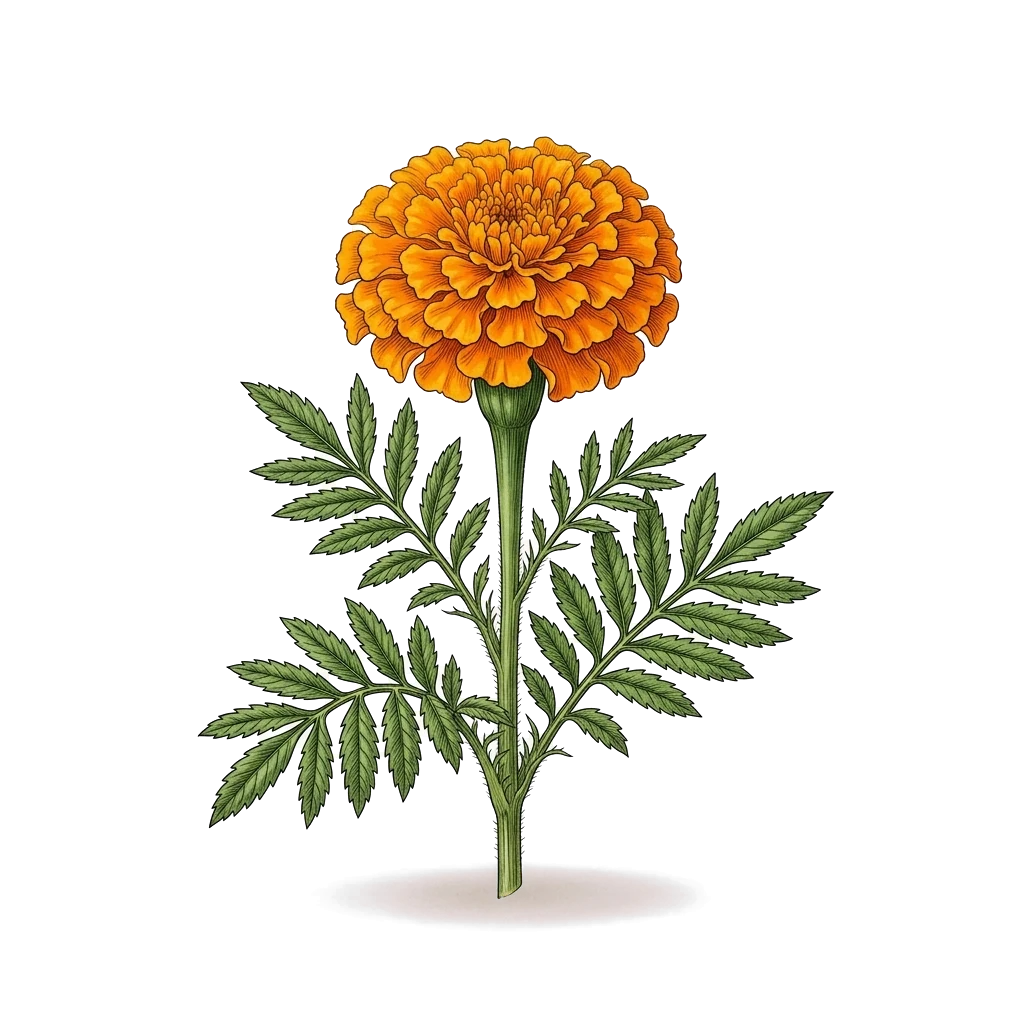
Also called Aztec, American or big marigold, and native to Mexico and Central America, not Africa. Plants 1 to 4 feet tall carry huge, mostly double flowerheads 2 to 4 inches across
-
French marigold
Tagetes patula
A compact annual from Mexico and Guatemala, 6 to 12 inches tall, with single, semi-double, double or crested flowers in yellow, orange, red and bicolors
-
Triploid hybrids
Tagetes erecta × Tagetes patula
Crosses that give the African marigold’s big flowers, 2 to 3 inches across, on the French marigold’s compact plants. They seem unaffected by summer heat and generally bloom all summer
-
Signet marigold
Tagetes tenuifolia
Also called striped Mexican marigold. A half-hardy annual; the cultivar Golden Gem has deep yellow-orange flowers with a slightly darker center
-
Pot marigold
Calendula officinalis
Not a Tagetes but a Mediterranean annual of another genus, also called garden marigold and Mary bud, with gold, orange or red flowerheads 3 to 4 inches across
-
Marsh marigold
Caltha palustris
A buttercup, not related to true marigolds: a native perennial of wet ground from Newfoundland to Alaska, with shiny deep yellow sepals in spring
Only the first four are Tagetes. The pot marigold is the calendula of the table above, and the marsh marigold is a buttercup of wet ground, not related to true marigolds at all. Among the Tagetes, the names mislead: the African marigold comes from Mexico and Central America, so read the Latin on a seed packet.
How to grow marigolds
Growing marigold
- Type
- Annual or perennial
- Blooms
- Summer
- Sun
- Full sun
- USDA zones
- 2–11
- Native to
- Mexico, Central and South America
African and French marigolds grow easily in average, evenly moist, well-drained soil in full sun, and like a little afternoon shade where summers are hot. Start seed indoors six to eight weeks before the last frost, or sow French marigolds straight into the garden on the last frost date. Pinch young plants to make them bushy, and deadhead spent flowers promptly.
Plant tall African marigolds deep: strip a few lower leaves and set the stem below the remaining leaf scars, so it needs less support. Give them shelter, too, since the heavy heads can snap their stems in strong wind or heavy rain.
French marigolds may flower much less in the heat of summer and pick up again as it cools. Deer seldom bother either kind.
Are marigolds poisonous to cats and dogs?
Marigold
- Pets
- Not in the ASPCA’s plant list The ASPCA’s “marigold” entries are the pot marigold (Calendula), a different plant.
- People
- Listed as poisonous (low severity) Sap on broken skin can blister in sunlight.
In the US, if a pet may have eaten part of a plant, call your vet or the ASPCA Animal Poison Control Center at (888) 426-4435. If a person has, call Poison Control at 1-800-222-1222.
Search the ASPCA’s plant list for “marigold” and you reach the pot marigold, Calendula officinalis. No Tagetes is in the list under any name.
Marigold bouquet ideas
French marigolds make good cut flowers. For an October birthday, set a few beside airy cosmos, the month’s other flower, so the tight marigold heads sit among looser ones.
-
An armful of cempasúchil
Tall orange African marigolds by the bunch, as Mexican markets sell them at the end of October, for an altar, a grave or a long table.
-
Perdita’s posy
Pot marigolds with lavender, mint, savory and marjoram, the plants Perdita names in the same breath in The Winter’s Tale.
-
Rust and gold
Bicolor French marigolds with bronze foliage and a few seed heads, for a bouquet that looks like late autumn.
-
A jam jar of signets
Small signet marigolds packed tight into a short jar, for a windowsill or a desk.
Marigold tattoo ideas
Draw a marigold by its head and its leaves. African marigolds are mostly ball-shaped doubles, French ones can be single, double or crested, and both have feather-like leaves, cut in the French marigold into toothed, lance-shaped leaflets.
-
A path of petals
Loose orange petals trailing toward a candle or an open door, after the paths laid for the Day of the Dead.
-
The codex marigold
The 1577 Florentine Codex drawing in black line: one blossom on a stem, two saw-toothed leaves curving around it.
-
Bedtime with the sun
A half-closed marigold under a setting sun, for the flower Perdita says goes to bed with it.
-
Twenty flowers
One round cempasúchil head with its Nahuatl name, “cempohualxochitl,” lettered underneath in a thin script.