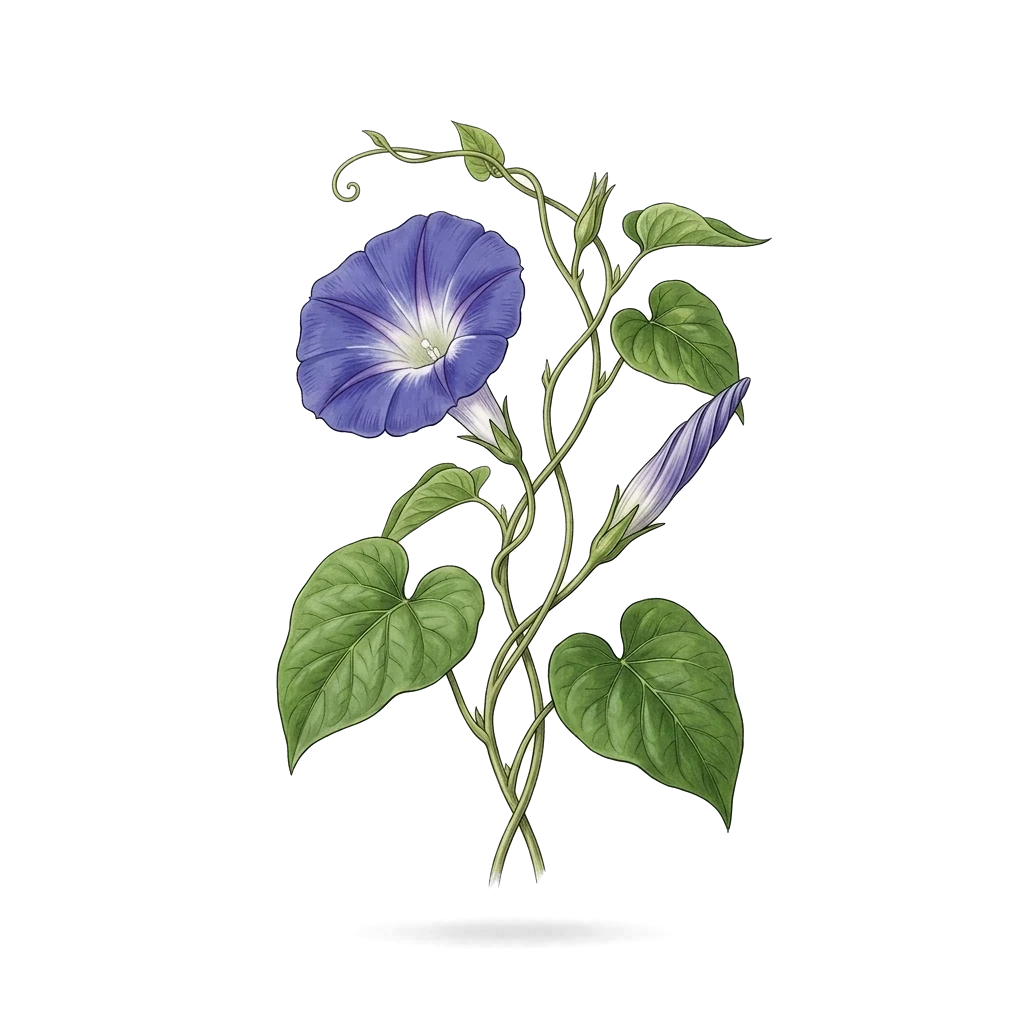
What is a morning glory flower?
A morning glory is one of the many twining vines of the genus Ipomoea and its relatives in the bindweed family, Convolvulaceae, with trumpet-shaped flowers that usually stay open for only one day. The common morning glory’s flowers open in the morning and close in the afternoon.
The family name comes from the Latin convolvulus, bindweed, from convolvere, to intertwine. Botanists once filed the common morning glory there too, as Convolvulus purpureus.
Native to Mexico and Central America, the common morning glory climbs 6 to 10 feet in a single season and has naturalized in warm temperate and subtropical regions around the world. Its flowers are deep purple with white throats, two to three inches across.
One morning per flower
Every flower gets one day. On a ‘Heavenly Blue’ vine each flower opens in the morning, then fades and drops by evening. The moonflower, a close relative, keeps the opposite hours: it opens in late afternoon and closes at dawn.
Why the Heavenly Blue morning glory turns blue
A ‘Heavenly Blue’ bud is purplish red, and the petals turn blue only as the flower opens. Researchers traced the change to the sap stored in the colored petal cells, whose pH rises from 6.6 to 7.7 as the flower opens, and that slightly alkaline sap is what makes the petals sky blue.
Morning glory meaning
The morning glory has come to mean love, both undying and unrequited, and the Old Farmer’s Almanac gives September’s two flowers “patience, love, affection” between them. Kate Greenaway’s 1884 Language of Flowers reads it less kindly. There the morning glory means “Affectation,” a showy pretense, while her plain convolvulus means “Bonds” and the major convolvulus “Extinguished hopes.”
The smaller ones are gentler. The blue minor convolvulus means “Repose. Night.” and the pink one “Worth sustained by judicious and tender affection.” Under “Indian jasmine,” she lists an Ipomoea as “Attachment.”
Whitman’s morning glory
Walt Whitman used one to wave away philosophy. In “Song of Myself” he writes: “A morning-glory at my window satisfies me more than the metaphysics of books.” The next line is “To behold the day-break!”, the hour the flower opens.
Morning glory colors and what each one means
| Color | Meaning today |
|---|---|
| Blue | Enduring love, desire, power |
| Purple | Grace, wealth, hopefulness |
| Pink | Gratitude and energy |
| Red | Passion and strength |
| White | Purity and innocence |
Blue and purple are the colors the species are known for: the azure ‘Heavenly Blue’ and the deep purple common morning glory. Garden cultivars of the common morning glory also come in white, wine red and bright red.
The Japanese morning glory
In Japan the morning glory, asagao, became a collector’s flower. The species, Ipomoea nil, came there from China and was developed into a garden plant, and in the late Edo era, between 1806 and 1860, growers picked out many mutant forms that Kyushu University still keeps. Most of those mutations, studies have found, were caused by jumping genes, transposable elements of the Tpn1 family.
The craze came in two booms, around 1810–1830 and 1847–1861, and both began in Osaka. Edo publishers answered Osaka’s illustrated morning glory books with their own, starting with Asagao sō in 1815, and in the second boom Edo gardeners traveled to Osaka to buy seed of the variant, or henka, forms.
Tokyo still holds a morning glory market. The Iriya Morning Glory Festival, from July 6 to 8 at Iriya Kishimojin temple, is the largest festival in Japan devoted to the flower. Iriya’s morning glories are said to have made their name toward the end of the Edo period, and after World War II local people revived the fair.
Types of morning glory
Gardeners grow a handful of Ipomoea species for their flowers and one for its leaves, plus a bushy cousin from the bindweed genus itself.
-
Common morning glory
Ipomoea purpurea
Native to Mexico and Central America. Purple trumpets with white throats, 2 to 3 inches across, open in the morning and close in the afternoon
-
'Heavenly Blue'
Ipomoea tricolor
The classic sky-blue morning glory, azure with a white and yellow throat. Each flower opens in the morning and fades by evening
-
Japanese morning glory
Ipomoea nil
Also filed as Pharbitis nil. Brought to Japan from China and bred there as a garden flower, with many mutant forms selected in the late Edo era
-
Moonflower
Ipomoea alba
The night bloomer: fragrant white flowers about 6 inches across open in late afternoon and close at dawn, on a vine up to 15 feet long
-
Cypress vine
Ipomoea quamoclit
Fern-like leaves and small red tubular flowers that draw hummingbirds and butterflies, on an annual vine of 10 to 20 feet
-
Spanish flag
Ipomoea lobata
Formerly Mina lobata. Upright clusters of tubular flowers open orange-red and fade to yellow and white, with every color showing at once
-
Sweet potato vine
Ipomoea batatas
The ornamental forms of the sweet potato, grown for leaves from black and purple to lime green. Its pinkish, morning glory-like flowers come sparingly
-
Dwarf morning glory
Convolvulus tricolor
A cousin in another genus: a bushy, non-vining Mediterranean annual 1 to 1.5 feet tall. Blue petals around a white throat and yellow center, each flower lasting a day
The cypress vine and the Spanish flag look nothing like the classic trumpet. Their flowers are small tubes, red in the cypress vine, which hummingbirds visit.
Is morning glory invasive?
In some places, yes. NC State notes that the common morning glory is considered invasive in some parts of the world and that the ‘Heavenly Blue’ species counts as a noxious weed in parts of the United States. Both self-seed and can turn weedy.
Arizona went further. Until January 4, 2020, most morning glory species and cultivars were Prohibited Noxious Weeds there and couldn’t be sold, even a few native ones. Under the new rules the natives came off the list, except the tall morning glory, Ipomoea purpurea, which stays a Class C noxious weed along with non-native species such as grannyvine, Ipomoea tricolor.
Arizona’s extension service puts the listing down to roots: some species have root systems extensive enough to out-compete gardens and crops. A close relative also on the list, field bindweed, Convolvulus arvensis, can root 20 feet below ground.
One morning glory is a federal noxious weed: Ipomoea aquatica, water spinach or swamp morning glory. It may be moved into or through the United States, or between states, only under a federal permit. In Florida, where it forms dense canopies, state eradication programs go after it wherever it turns up in ditches and canals.
How to grow morning glories
Growing morning glory
- Type
- Annual vine
- Blooms
- Summer to fall
- Sun
- Full sun
- Native to
- Mexico and Central America
Morning glories grow easily from seed. Seeds soaked in water for 24 hours before planting sprout quickly, and they can be started indoors or sown straight into the garden.
Give the vine full sun, a fence or trellis to twine on, and moderately fertile, moist but well-drained soil. The common morning glory then flowers from early summer into fall.
It also self-seeds and can turn weedy, so pull unwanted seedlings while they’re small: once established and twined up other stems, morning glories are hard to remove without harming the plants they climb.
Are morning glories poisonous to dogs?
Morning glory
- Pets
- Toxic to dogs, cats and horses
- People
- Listed as poisonous (low severity) Can cause vomiting, and large amounts of the seeds may cause hallucinations.
In the US, if a pet may have eaten part of a plant, call your vet or the ASPCA Animal Poison Control Center at (888) 426-4435. If a person has, call Poison Control at 1-800-222-1222.
The ASPCA lists morning glories, Ipomoea species, as toxic to dogs, cats and horses, with vomiting among the clinical signs. One cousin has an entry of its own: the sweet potato vine, Ipomoea batatas, whose ASPCA page reports no toxicity to dogs, cats or horses.
Morning glory bouquet ideas
A morning glory flower is typically open for only a day, so the vine gives more as a plant than as a cut flower. Give the plant itself, or a packet of its seed tied to a bunch of asters, the other September flower.
-
A trellis and a packet of seed
Heavenly Blue seed and a small trellis for a sunny fence or a balcony rail. Sown in spring, the vine can climb 8 to 10 feet in its one season.
-
A moonflower for night owls
The white moonflower opens in late afternoon and scents the evening. A good pick for someone who sits outside after dark.
-
Asagao in a pot
A potted Japanese morning glory for someone who loves Japan, where the flower gets a three-day festival in Tokyo every July.
-
A bouquet now, a vine next summer
Asters for the vase, with a packet of morning glory seed tucked in to sow when the weather warms.
Morning glory tattoo ideas
Three features say morning glory in ink: a trumpet-shaped flower, often deep purple with a white throat, heart-shaped leaves, and a twining stem.
-
Bud and bloom
A furled bud in purplish red beside an open sky-blue Heavenly Blue flower. The color change from one to the other is real.
-
Morning and night
A blue morning glory and a white moonflower on one vine, one open at sunrise and one at dusk.
-
A cypress vine with a hummingbird
Fine, fern-like leaves, small red star-tipped tubes and a hummingbird at one of them. It works long and thin, along a forearm.
-
Whitman’s window
One morning glory on a window frame, with "satisfies me more than the metaphysics of books" in small type underneath.