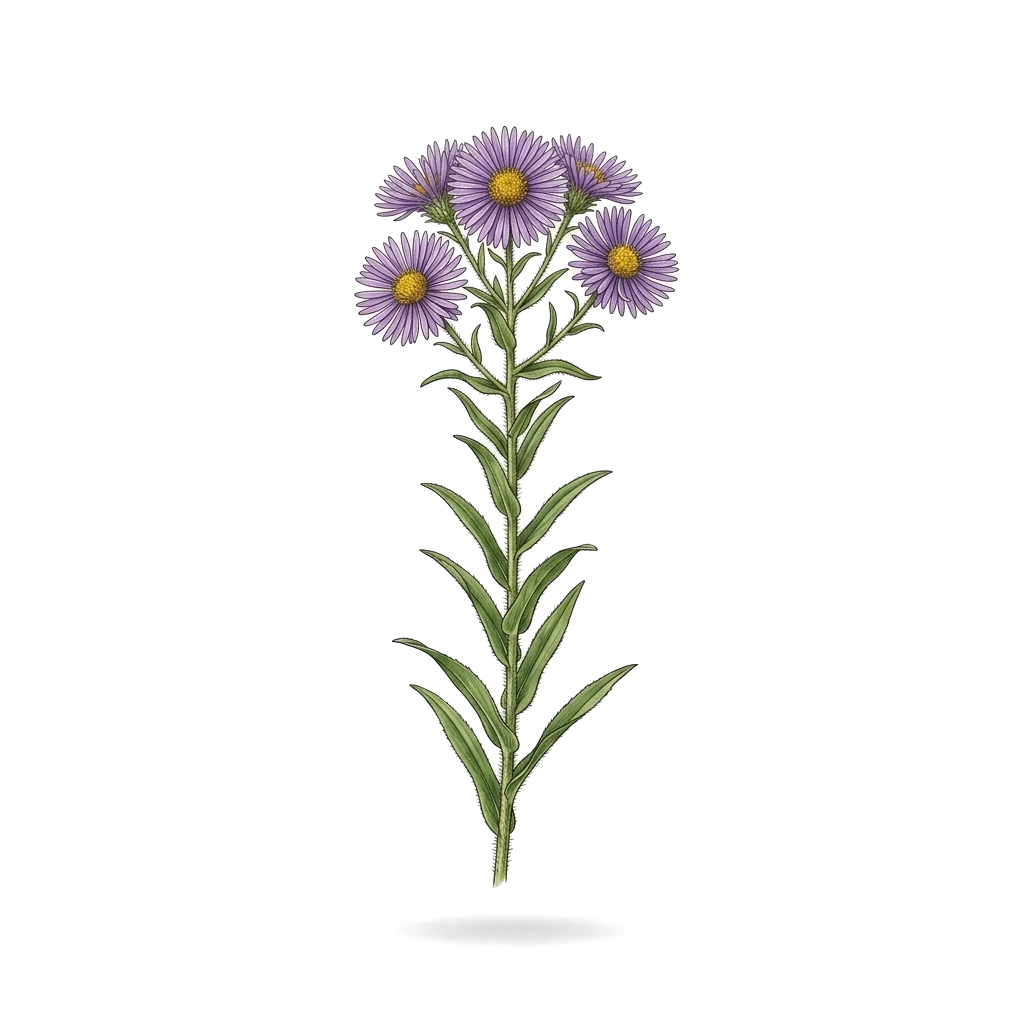
What is an aster flower?
An aster is a plant of the daisy family, and what looks like a single aster flower is really a head of many small ones: white, pink or violet rays around a disk that is usually yellow. A New England aster can carry up to 100 purple rays around nearly as many yellow disk flowers.
The name is the Latin aster, from the Greek word for star. Most asters flower in summer and autumn.
The fall-flowering kinds are also called Michaelmas daisies, a name for several leafy-stemmed asters, especially the New York aster. Michaelmas itself is September 29, the Christian feast of the archangel Michael.
Which asters are still Aster?
Fewer than you’d think. Many daisy-flowered plants once all called Aster are now split among Aster, Callistephus, Eurybia, Kalimeris and Symphyotrichum, though gardeners still call them asters. Botanists made the change in the 1990s, after molecular and morphological studies showed that the North American asters are genetically distinct from the Eurasian ones.
The groundwork was a 1994 review by the botanist Guy Nesom. He kept Aster for the Old World group built around the Italian aster, Aster amellus, and shared the New World species out among 13 genera, two of them new. Symphyotrichum took 97 species, and Eurybia 28.
Today the University of Waterloo’s Astereae Lab puts Aster at about 150 species, all native to Europe and Asia, 123 of them in China. Symphyotrichum holds most of the asters native to North America, about 90 species. The lines are still moving: the RHS treats Kalimeris as a genus of its own, while the Waterloo lab folds it back into Aster.
| What gardeners call it | Botanical name now | Native to |
|---|---|---|
| New England aster | S. novae-angliae | Eastern North America |
| New York aster, Michaelmas daisy | S. novi-belgii | Newfoundland to Georgia, near the coast |
| White wood aster | Eurybia divaricata | Eastern United States |
| Italian aster | Aster amellus | Europe and Asia |
| China aster | Callistephus chinensis | China |
The table’s names and ranges come from NC State Extension, the RHS and Info Flora.
Aster flower meaning
The usual aster meaning today is patience and love. Kate Greenaway’s 1884 Language of Flowers gives them a whole set of meanings instead, and doesn’t always agree with itself. Her China aster is “Variety” in one entry and “Variety. Afterthought.” in another, the double one “I partake your sentiments” and the single one “I will think of it.”
The Michaelmas daisy is listed twice in the same book: once as “Afterthought,” and again, under Daisy, as “Farewell.” Starwort survives as an old name for asters, as in the Italian aster’s other common name, Italian starwort. Greenaway’s American starwort is just as divided, between “Welcome to a stranger” and “Cheerfulness in old age.”
Virgil’s amellus
Amellus, the Italian aster’s species name, is also the name of a flower in Virgil. In the Georgics, he describes a meadow flower that farmers call amellus: golden at its center, with many petals around it in which “the purple of the dark violet” glimmers. The altars of the gods, he writes, are often hung with garlands of it, and shepherds gather it near the winding streams of the river Mella.
Robert Frost’s last aster
In “A Late Walk,” from Robert Frost’s A Boy’s Will, the speaker walks through a mown field and a withered garden and comes home with one flower: “the faded blue / Of the last remaining aster flower / To carry again to you.”
Aster colors and what each one means
| Color | Meaning today |
|---|---|
| Purple | Wisdom |
| Blue | — |
| Pink | Love and kindness |
| White | Innocence |
| Red | Devotion and passion |
The New England aster’s rays are purple and the white wood aster’s are white. The China aster brings in the rest: shades of white to pink, red, blue, violet, purple and yellow.
The Aster Revolution of 1918
Hungary named a revolution after the flower. The őszirózsás forradalom, the Aster Revolution, sometimes called the Chrysanthemum Revolution in English, is dated from a speech Count Mihály Károlyi gave at the Hotel Astoria in Budapest.
A photograph from that year in the Rippl-Rónai Museum shows soldiers on a truck with asters on their caps. Its caption dates the revolution’s victory to October 31, 1918.
Types of asters
The asters in gardens fall into three groups: the North American ones, now Symphyotrichum and Eurybia, the true asters of Europe and Asia, and the China aster, which has a genus to itself.
-
New England aster
Symphyotrichum novae-angliae
Native to eastern North America and once named Aster novae-angliae. Bushy clumps 3 to 6 feet tall carry flowers with up to 100 purple rays around a yellow center, from August to October
-
New York aster
Symphyotrichum novi-belgii
The Michaelmas daisy, native near the coast from Newfoundland to Georgia and Alabama. Purple to pink rays around a yellow-orange center open from late summer into early fall. Somewhat susceptible to powdery mildew
-
Aromatic aster
Symphyotrichum oblongifolium
Named for the balsam-like scent of its stems when crushed. A 3-foot mound of blue-purple daisies from late summer until the first frost
-
White wood aster
Eurybia divaricata
Formerly Aster divaricatus, a woodland aster of the eastern United States that prefers part shade. Its yellow disk centers turn red after pollination
-
Italian aster
Aster amellus
The type species of Aster, also called Italian starwort: a Eurasian plant of dry grassland and open woods, with lilac-blue rays around a yellow center from late summer into autumn
-
Frikart's aster
Aster × frikartii
A hybrid of Aster amellus and Aster thomsonii, raised in Switzerland in 1918 as a trio named for the mountains Mönch, Jungfrau and Eiger. Violet-blue flowers with orange centers
-
Tatarian aster
Aster tataricus
From Europe and Siberia, with stems 3 to 6 feet tall and lavender-blue flowers from late summer until frost. Its rhizomes spread aggressively
-
China aster
Callistephus chinensis
A separate genus: a cool-weather annual from China in white, pink, red, blue, violet, purple or yellow, from single daisies to fully double pompoms. A good cut flower
Frikart’s aster is the Italian aster’s cross with Aster thomsonii. In Ontario gardens, the University of Waterloo’s lab reports, it does very well, blooming from midsummer until late fall.
How to grow asters
Growing aster
Facts for New England aster (Symphyotrichum novae-angliae)
- Type
- Perennial
- Blooms
- Summer to fall
- Sun
- Full sun to part shade
- USDA zones
- 4–8
- Native to
- Eastern North America
Most asters do best in full sun and still flower in light shade, if less freely, and many like fertile soil that holds plenty of moisture through spring and summer. Plant them in early spring, and stake the tall kinds before midsummer.
For a shorter, bushier New England aster, the Chicago Botanic Garden pinches its plants back until the Fourth of July. The New York aster takes well to the “Chelsea chop,” which lowers its height and may save staking.
Asters are generally robust, but they can get powdery mildew, and New York aster cultivars are especially prone to it. Moisture-retentive soil makes it less likely, and most asters benefit from being lifted and divided every three to five years.
New England asters feed a lot of insects late in the year: bees, hover flies and migrating monarch butterflies all come to the flowers. The USDA calls it a good bee plant, with nectar in the autumn.
Are asters poisonous to cats and dogs?
Aster
- Pets
- Not in the ASPCA’s plant list The ASPCA’s “China aster” entry is Callistephus chinensis, a different plant.
- People
- Not listed as poisonous
In the US, if a pet may have eaten part of a plant, call your vet or the ASPCA Animal Poison Control Center at (888) 426-4435. If a person has, call Poison Control at 1-800-222-1222.
The ASPCA’s list has no entry for Symphyotrichum or for the true asters. The asters it does list are the China aster and the giant aster, a Townsendia, both different plants.
Aster bouquet ideas
For the vase, the China aster is the one to grow: NC State rates it a good cut flower for cutting and cottage gardens. The month’s other flower doesn’t travel. A morning glory closes by afternoon, so for a September birthday it belongs on the card or the wrapping paper rather than in the vase.
-
Double China asters
Full pompoms in pink, violet or white. Greenaway gave the double one "I partake your sentiments," a kind line for a friend going through something hard.
-
A Michaelmas farewell
Michaelmas daisies meant "Farewell" in one of Greenaway’s entries. A loose bunch suits a leaving party or a last day at work.
-
Single asters, loosely tied
Single China asters with yellow eyes look like a meadow picking. Greenaway’s meaning for the single one is "I will think of it."
-
The last of the garden
A few late asters with seed heads and turning leaves, the bunch Frost’s walker carries home, for someone who loves the fall.
Aster tattoo ideas
An aster drawn well is mostly rays: a ring of thin petals, sometimes a hundred of them, around a yellow disk. The white wood aster adds a detail of its own, since its yellow centers turn red after pollination.
-
A star with a hundred rays
One New England aster seen face-on, its fine purple rays radiating like the star in its name. Small and round, it fits a wrist or an ankle.
-
Red-eyed wood asters
A spray of white wood asters, some centers yellow and some turned red. The mix of colors shows the flowers aging.
-
An aster on a cap
For Hungarian roots, an aster tucked into a soldier’s field cap, as in a photograph from Budapest in October 1918.
-
Monarch on an aster
A monarch butterfly feeding on a purple aster, the meeting that happens every fall along the migration.