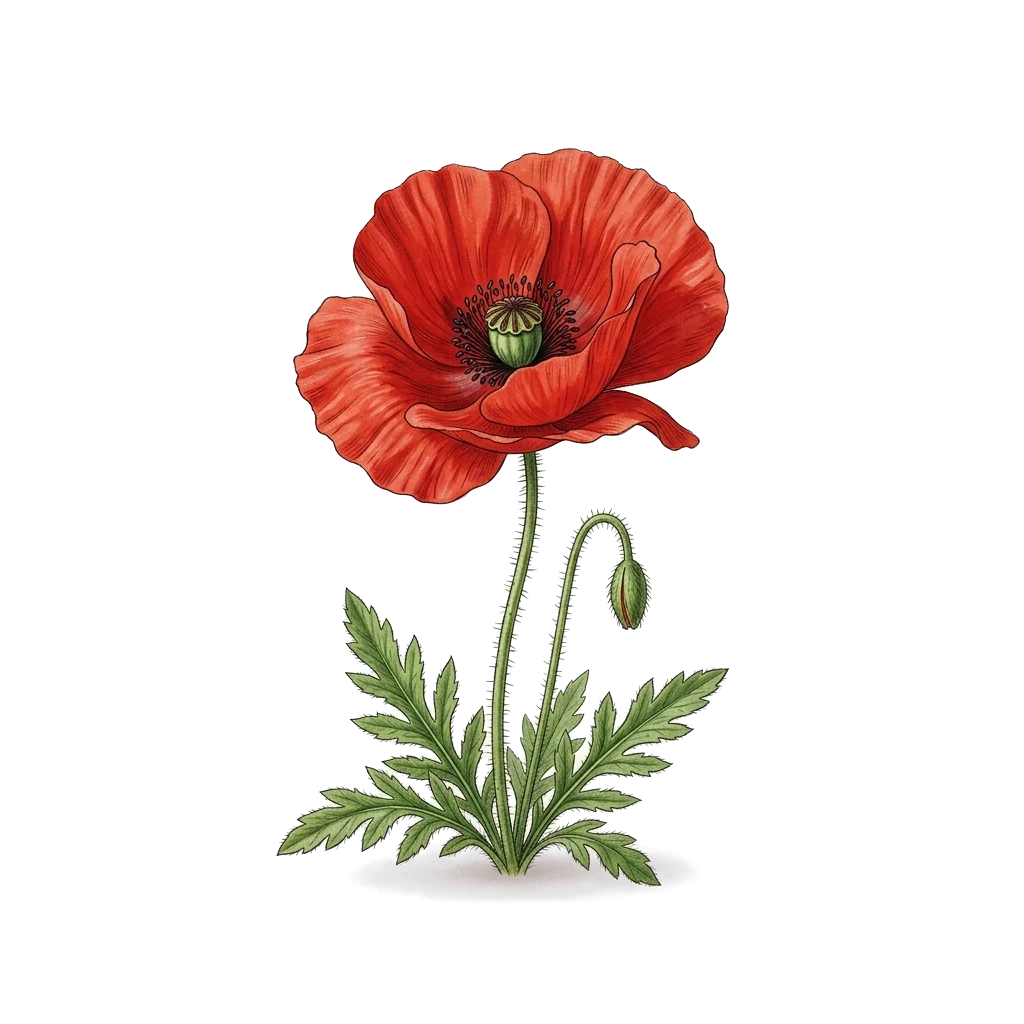
What does a poppy symbolize?
The poppy meaning most people know is remembrance and peace. That one dates from World War I. Long before it, poets and then Kate Greenaway’s Victorian flower book tied the poppy to sleep, and the war poem that changed its meaning still leans on the old one: its dead promise that they “shall not sleep, though poppies grow.”
The word itself has hardly moved. “Poppy” comes from the Old English popig, probably by way of Vulgar Latin from the Latin papaver, still the name of the genus. A true poppy has colorful flowers, usually with four delicate petals, a milky sap and a seed capsule that sheds its seeds through pores.
Kate Greenaway’s 1884 Language of Flowers has an entry each for the red, scarlet and white poppy. The white one packs three meanings into a single line: “Sleep. My bane. My antidote.”
Poppies in Greek and Roman poetry
Homer’s poppy is a simile for a dying man. In the Iliad, an arrow strikes Gorgythion, a son of Priam, and his head drops to one side “like a poppy that in a garden is laden with its fruit and the rains of spring.”
Roman poets tied it to the harvest and to sleep. Virgil tells farmers to sow flax and Cereale papaver, “the poppy of Ceres,” while the ground is still dry. Ovid plants poppies outside the cave where the god of Sleep lives: before its doors, he writes, “fertile poppies bloom.”
The deadly poppy field of Oz
L. Frank Baum gave the sleep meaning to American children in 1900. In The Wonderful Wizard of Oz, Dorothy walks into a meadow of scarlet poppies whose scent puts anyone who breathes it to sleep, and Toto and the Lion fall asleep too. Only the Scarecrow and the Tin Woodman, “not being made of flesh,” can carry her out.
Poppy colors and what each one means
- Red
- Orange
- White
- Yellow
Today’s color meanings come from the poppies people pin on to remember, and each color was taken up by an organization that says in its own words what it stands for.
Red poppy meaning
The red poppy is the Royal British Legion’s symbol of remembrance: it remembers the sacrifices of those who served their nation, shows support for today’s armed forces and stands for hope for a peaceful future. In Canada, the Royal Canadian Legion calls it a pledge never to forget those who served and sacrificed.
White poppy meaning
White poppies were first made in 1933 by members of Britain’s Co-operative Women’s Guild, many of whom had lost family and friends in World War I. None were manufactured that first year, so some of the women made their own. The Peace Pledge Union, which distributes them now, gives them three meanings: remembrance of all victims of war, soldiers and civilians alike, a challenge to war and militarism, and a commitment to peace.
Purple poppy meaning
The purple poppy remembers animals. The British charity Animal Aid launched it in 2006 to draw attention to the animal victims of war, then stopped making it in 2015 and replaced it with a purple paw badge.
Orange belongs to the California poppy, a different plant with a story of its own (below).
Poppy symbolism in war and remembrance
The poppy came to the battlefields before the poem did. In France and Belgium the shelling churned up the ground, the poppy seeds buried in it reached the light and sprouted, and soldiers picked the flowers as keepsakes or sent them home in letters. Corn poppy seed can wait a long time for that chance: it has sprouted after 80 years in the soil.
“In Flanders Fields”
On May 2, 1915, near Ypres in Belgium, Lieutenant Alexis Helmer was killed and buried in a makeshift grave. Wild poppies were already flowering between the crosses, and the next day his friend John McCrae, a Canadian artillery brigade’s doctor, wrote the poem.
It opens on that scene: “In Flanders fields the poppies blow / Between the crosses, row on row.” Punch printed it, unsigned, on December 8, 1915. Within months it stood for the sacrifice of everyone fighting the war, and it made the poppy an international symbol of remembrance.
McCrae didn’t see the war end: he died of illness on January 28, 1918, and is buried at Wimereux, near Boulogne.
Moina Michael and America’s poppy
Moina Michael, a teacher from Georgia doing YMCA war work in New York, read the poem just before the Armistice. On November 9, 1918, she resolved to wear a red poppy for the dead and wrote a reply, “We Shall Keep the Faith,” with the lines “And now the Torch and the Poppy red / We wear in honor of our dead.” With money a superior had given her, she bought 25 red silk poppies, wore one and sold the rest to colleagues.
The American Legion adopted the red poppy at its convention in Cleveland in 1920, and the American Legion Auxiliary did the same at its first convention, in Kansas City, the next year. Since 1924 handing out poppies has been a national Legion program, and the Friday before Memorial Day is National Poppy Day. In 1952 alone, nearly 9,700 disabled veterans made more than 26 million poppies for the Auxiliary to give out.
In 1948 she appeared on a red 3-cent US stamp, under the words “Founder of Memorial Poppy.”
Anna Guérin and Britain’s first Poppy Appeal
The poppy crossed to Britain with a Frenchwoman. Anna Guérin, a French lecturer, was promoting poppies made by French women to raise money for children in the devastated regions of France, and in 1921 she brought samples to the newly founded British Legion. The Legion ordered a million, then eight million more from British makers when Earl Haig asked for a “poppy day” on November 11, and that first Poppy Appeal raised over £100,000 for veterans’ housing and jobs.
In 1922 the Legion opened its own Poppy Factory, staffed by disabled ex-servicemen. In 1926 Earl Haig’s wife set up the Lady Haig Poppy Factory in Edinburgh, which makes the Scottish poppy, with four petals and no leaf. Since 2023 the Legion’s poppy has been made entirely of red and green paper, with no plastic.
Canada’s poppy
Guérin also took her idea to the Great War Veterans Association, the forerunner of the Royal Canadian Legion, which adopted the poppy on July 6, 1921, at a meeting in Port Arthur, Ontario, now Thunder Bay. Canadians wear it on the left side, over the heart, from October 24 until November 11, and the Legion encourages wearing one at a veteran’s funeral.
A moat of ceramic poppies
For the centenary of World War I, the artist Paul Cummins and the designer Tom Piper filled the dry moat of the Tower of London with 888,246 ceramic poppies, from August 5 to November 11, 2014. Each stood for a British or Allied military death, over five million people came to see them, and every poppy was sold to raise money for six service charities.
The California poppy, a state flower
The California poppy, Eschscholzia californica, became California’s official state flower on March 2, 1903, under Section 421 of the state’s Government Code, and April 6 is California Poppy Day. It belongs to the poppy family but not to Papaver.
The botanist Adelbert von Chamisso named it from plants found at the Presidio, after his Russian ship, the Rurik, reached San Francisco Bay in 1816. The genus honors his shipmate Johann Friedrich Eschscholtz, the ship’s surgeon and a botanist. Spanish settlers had their own name for it: copa de oro, “the cup of gold.”
Its four silky petals close at night and on cloudy or rainy days. The Antelope Valley California Poppy Reserve, in the western Mojave Desert, sits on the state’s most reliable poppy land, and its wildflower season runs from as early as mid-February through May.
Types of poppies
Gardeners grow a handful of Papaver species, and two cousins from other genera that everyone calls poppies anyway.
-
Corn poppy
Papaver rhoeas
The red field poppy of Europe and Asia, also called the Flanders poppy. Its four crinkly petals often have a black spot at the base, and each flower lasts a day
-
Shirley poppy
Papaver rhoeas Shirley Group
A garden strain of the corn poppy, raised by the Reverend W. Wilks from a single plant he found in a field. Its flowers have no dark center
-
Oriental poppy
Papaver orientale
A clump-forming perennial from Central Asia with large, cup-shaped flowers in orange, red or pink, black at the center. Its leaves die down after flowering
-
Iceland poppy
Papaver nudicaule
Grown as an annual or a biennial, with fragrant, crepe-paper flowers in salmon, pink, orange, white or red. A good cut flower
-
Alpine poppy
Papaver alpinum
A miniature poppy for rock gardens, walls and the cracks between flagstones. It prefers limestone soil
-
California poppy
Eschscholzia californica
A poppy-family annual native to the western United States and the state flower of California. Its flowers, most often bright orange, close at night and in cloudy or rainy weather
-
Himalayan blue poppy
Meconopsis
Not a Papaver but a cousin: a genus of nearly 80 species, often short-lived, best known for their blue flowers. Meconopsis baileyi is the classic sky-blue one
The famous blue poppies are the cousins. Although they are known for their blue, Meconopsis also come in red, pink, white, yellow and purple, and many species flower once and then die.
How to grow poppies
Growing poppy
- Type
- Annual or perennial
- Blooms
- Spring to summer
- Sun
- Full sun to part shade
- USDA zones
- 2–7
- Native to
- Europe, Asia, northern Africa and northern North America
Corn poppies, and the Shirley strain raised from them, like fertile, well-drained soil in full sun and do best where summers are cool. Where summers are hot, give them some afternoon shade. Shirley poppies flower less once the weather turns hot and humid, and their blooms soon fade.
Oriental poppies die down after flowering and leave a gap in the border. Plant them among something that fills in later in the summer, such as baby’s breath, and don’t overwater, since the deep taproot can rot. New plants settle in slowly and usually flower better in their second summer.
Blue poppies are the hard ones. They want moist, humus-rich soil and part shade, and they grow best in cool, wet places like the north of England and Scotland, since a few days of dry sun can scorch them.
Are poppies poisonous to cats and dogs?
Poppy
- Pets
- Not in the ASPCA’s plant list
- People
- Not listed as poisonous NC State gives the genus no poison listing, but notes that some poppy species are rich in alkaloids, including opiates, and that the sap may harm an unborn baby.
In the US, if a pet may have eaten part of a plant, call your vet or the ASPCA Animal Poison Control Center at (888) 426-4435. If a person has, call Poison Control at 1-800-222-1222.
There is no poppy of any kind in the ASPCA’s plant list, under a common name or a botanical one.
Poppy bouquet ideas
A corn poppy flower lasts only a day, so choose the kinds that hold up. Oriental and Iceland poppies make good cut flowers, and corn poppies do too if you sear the end of each stem with a match right after cutting. For an August birthday, a few poppies in a tall bunch of gladiolus put both of the month’s flowers in one vase.
-
Iceland poppies for color
Salmon, orange, pink and white on wiry stems: a jar of Iceland poppies is a bouquet on its own.
-
Red and white for remembrance
Red for those who served, white for every victim of war. Together they make a quiet bunch for an anniversary or a grave.
-
Oriental poppies, the big ones
One or two Oriental heads, four to six inches across, can carry a whole arrangement, and the black blotch at the center gives it a focus.
-
A sleepy posy
White poppies meant sleep to the Victorians. Pair them with soft greens for a new baby or for someone who needs the rest.
Poppy tattoo ideas
A poppy comes down to a few features: four crinkled petals, often marked with a black spot at the base, a bud that droops before it opens, and a seed capsule. Lose them and the drawing could be any red flower.
-
A remembrance poppy
A single red corn poppy, perhaps with a name, a service number or the words "We shall not sleep" from McCrae’s last verse.
-
Scottish or English
The poppy worn in Scotland has four petals and no leaf, unlike the Legion’s red-and-green paper one. Draw the one your family wore.
-
A nodding bud
Before it opens, a poppy bud hangs its head. One drooping bud beside an open flower shows before and after.
-
California gold
For a Californian, an orange cup-shaped poppy with feathery blue-green leaves. Draw it half-closed, the way it looks at dusk.