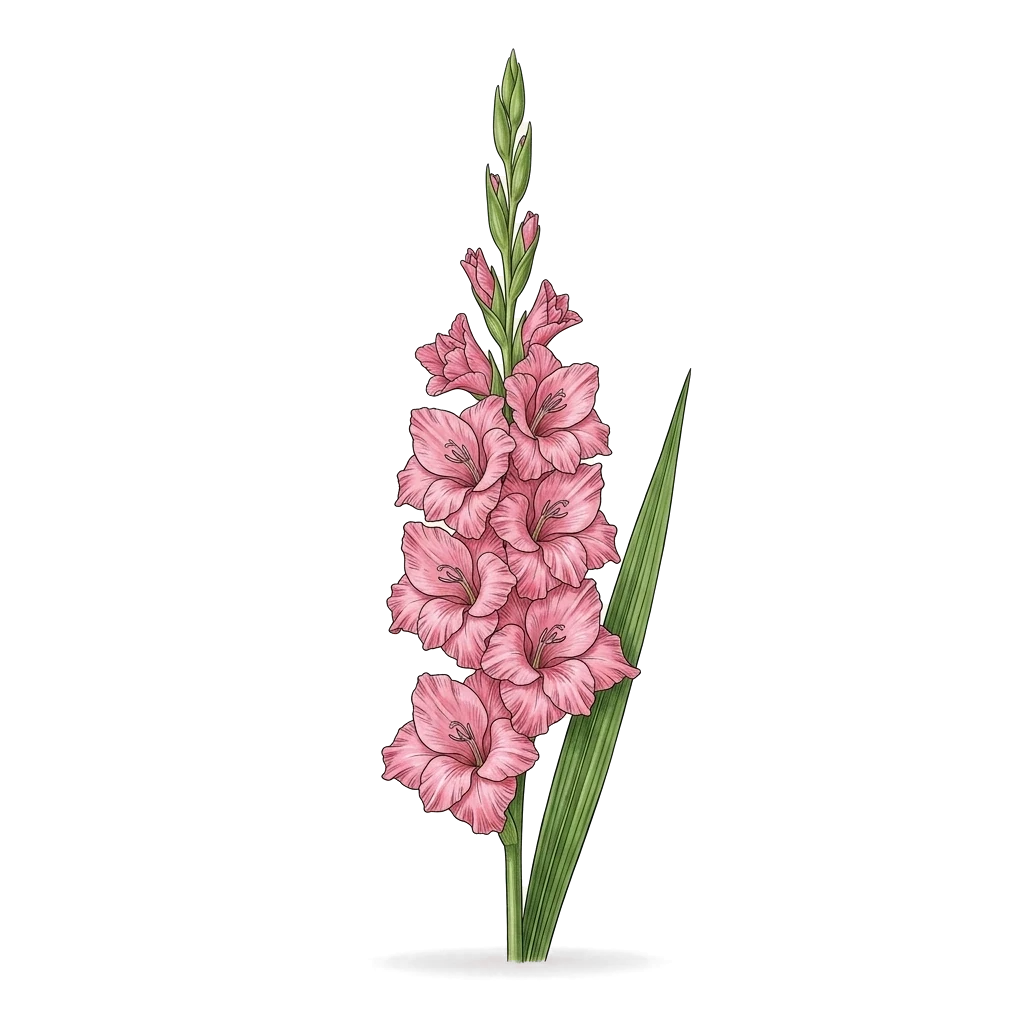
What is a gladiolus flower?
A gladiolus is a plant of the iris family that grows from a corm. Its sword-shaped leaves stand in upright fans, and its funnel-shaped flowers line one side of a tall spike, opening from the bottom of the spike to the top. That family makes it a cousin of the iris, despite the lily in its old name.
That name, sword lily, is one of several: corn flag, sword grass and afrikanders are others. NC State Extension even lists Aunt Eliza Rat’s Rail. The botanical name comes from Latin, where gladiolus meant a wild iris, and is a diminutive of gladius, a sword.
Gladiolus corms, not bulbs
What gardeners buy as gladiolus bulbs are corms, and a corm is a modified stem. The one you plant doesn’t come back itself. By the time it’s lifted after flowering it has shrivelled, and a new corm has formed in its place, with tiny cormlets, or cormels, around the base.
Size matters, too: a bigger corm gives bigger flowers.
Where gladiolus grows wild
In 2009 the botanists John Manning and Peter Goldblatt put the genus at some 262 species, with 168 in southern Africa, 82 in tropical Africa, eight in Madagascar and a scant 10 in Eurasia. Southern Africa is the center of its diversity. Other references round the total quite differently, from about 180 to over 300.
The basic pattern in the wild is pollination by long-tongued bees that come for nectar, but many species have switched to sunbirds, moths, long-tongued flies or a butterfly. In southern Africa such shifts have happened as often as once for every five or six species.
Britain has a wild gladiolus too: Gladiolus illyricus, which there is largely restricted to the New Forest in Hampshire. It often grows under bracken and can be hidden by the time it flowers, and whether it is truly native there is still debated.
The glads in gardens and flower shops are something else: hybrids, usually labeled Gladiolus × hortulanus, bred from at least eight species, and for most cultivars nobody knows the exact parentage.
Gladiolus flower meaning
The usual gladiolus flower meaning is strength of character: the Old Farmer’s Almanac pairs strength with moral character. The University of Illinois Extension’s guide to flower meanings uses it for funerals, where it gives gladioli “strong character,” and also calls the gladiolus the flower of the gladiators.
The same guide adds two lighter gladiolus meanings, “Give me a break” and “I’m really sincere.”
Gladiolus colors and what they mean
| Color | Meaning today |
|---|---|
| Pink | Compassion, a mother's love |
| Red | Love, romance, passion |
| White | Innocence, purity |
| Yellow | Friendship, joy |
| Purple | Fortune, beauty |
Today’s range runs from white and green to salmon, rose, violet and tan, in shades from pale to deep, but it took breeders a long time to get there. In 1911 growers were still hoping for a good yellow, which they expected from Gladiolus primulinus, a yellow species just introduced from Africa. Victor Lemoine’s crosses with G. papilio had given purples and what growers called “heliotrope blues,” but no true bright blue yet.
Gladiolus history: from Ghent to the florist’s bucket
By 1911 the European species had been grown in gardens for about 400 years, but the modern gladiolus starts in Belgium. Around 1840 a hybrid seedling at the Van Houtte nursery in Ghent, whose parentage has long been disputed, was named Gandavensis in honor of the city.
From 1845 to 1880 the Gandavensis seedlings ruled the garden, and more than 400 varieties were named. In 1878 Victor Lemoine of Nancy, France, crossed them with another species for the deep reds, purples and yellows breeders had been after.
The next big strain crossed the Atlantic. Max Leichtlin of Baden-Baden bred very large, richly colored glads. An American bulb firm bought the stock and worked on it for years, then sold it to John Lewis Childs of Floral Park, New York, who introduced it as Childsii. Today the gladiolus is a mainstay of the florist trade.
Types of gladiolus
Garden gladioli are sorted by the size of the plant and the size and shape of their flowers, into three main groups of hybrids, beside a few species grown in their own right.
-
Grandiflora hybrids
Gladiolus × hortulanus
The classic tall glad: funnel-shaped flowers 4 to 6 inches wide, up to 30 to a spike, on stems 3 to 6 feet tall. The hardest group to grow well in an ordinary garden
-
Primulinus hybrids
Hooded flowers set loosely along stems 2 to 4 feet tall
-
Butterfly hybrids
Ruffled petals with contrasting blotches and markings in the throat, on stems 2 to 3 feet tall. Often counted among the primulinus hybrids
-
Nanus hybrids
Miniatures with flaring flowers up to 3 inches wide on stems about 1½ feet tall. Planted in early spring, they flower as early as June
-
Byzantine gladiolus
Gladiolus communis subsp. byzantinus
A hardy species from southern Spain and Sicily, with deep magenta flowers in late spring and early summer. It can stay in the ground year after year
-
Abyssinian gladiolus
Gladiolus murielae
Fragrant, star-shaped white flowers with a dark purple throat in late summer, from the mountains of East Africa. Also called peacock orchid, and long sold as Acidanthera bicolor
-
Dragon's head sword lily
Gladiolus dalenii
A wild species of tropical and southern Africa, Madagascar and Arabia, with hooded orange to red flowers and yellow throats. G. primulinus is one of its old names
Growers also class glads by the width of their flowers:
| Size class | Flower width |
|---|---|
| Giant | Over 5½ inches |
| Large | 4½ to 5½ inches |
| Medium | 3½ to 4½ inches |
| Small | 2½ to 3½ inches |
| Miniature | Under 2½ inches |
Miniatures aren’t simply small plain flowers: they are scaled-down versions of the ruffled and frilled large-flowered glads.
How to plant gladiolus, then lift and store the corms
Growing gladiolus
- Type
- Corm (bulb)
- Blooms
- Summer to fall
- Sun
- Full sun to part shade
- USDA zones
- 7–10
- Native to
- Africa, Madagascar and Eurasia
When to plant gladiolus
Plant the corms outdoors after the last frost, or start them indoors in early spring for earlier flowers. They take 60 to 120 days to bloom, depending on the cultivar, and a plant usually stays in bloom for up to two weeks. For flowers all summer, plant a batch every two weeks until June.
How to plant gladiolus corms
Set the corms 4 to 6 inches deep and 5 to 6 inches apart, in full sun and rich, well-drained soil, out of strong wind. Gladiolus adapts to most soils except heavy clay, and it wants steady moisture while it grows.
Don’t plant too shallow. Shallow corms tend to make lots of small offspring rather than one good corm for next year, and on light, sandy soil a little extra depth helps the spikes stand up to wind. Staking is optional, but it keeps tall hybrids from flopping: give each spike a cane, pushed in away from the corm, or let a whole row grow up through horizontal mesh.
When you cut spikes for the house, leave as much foliage on the plant as you can, because the leaves build up next year’s corm.
Lifting and storing gladiolus corms
Gladiolus isn’t usually winter hardy in the Midwest, so there the corms have to be dug every fall. Even in zones 7 to 10, where they can stay in the ground, they are generally thought to flower best if they’re dug every year.
- Lift after the foliage yellows and before the first significant frost. For summer hybrids that need a frost-free winter, the RHS suggests about six weeks after flowering, while the leaves are still green.
- Trim and dry. Cut the leaves back to a short stub and dry the corms in a warm, airy place for a few weeks.
- Clean. Remove the old shrivelled corm, take off the cormlets and throw away any corm that is diseased or damaged.
- Store in mesh bags with good air flow at 35 to 41°F, or packed in dry vermiculite or peat moss somewhere cool and dry.
The cormlets will grow into flowering corms in a year or two if they’re planted about 2 inches deep in a nursery bed in spring.
Storage is also where the most common pest, gladiolus thrips, can wait out the winter. The thrips overwinter on stored corms as well as in the ground, and their feeding can ruin the flowers, so clean the corms carefully before they go into storage. On the leaves and flowers the damage shows as mottling.
Are gladiolus poisonous to cats and dogs?
Gladiolus
- Pets
- Toxic to dogs, cats and horses
- People
- Listed as poisonous (low severity) Highest in the corms.
In the US, if a pet may have eaten part of a plant, call your vet or the ASPCA Animal Poison Control Center at (888) 426-4435. If a person has, call Poison Control at 1-800-222-1222.
The ASPCA lists the signs as salivation, vomiting, drooling, lethargy and diarrhea, with the highest concentration in the corms (bulbs).
Gladiolus bouquet ideas
A gladiolus bouquet is built around line rather than mass: the spikes give an arrangement its structure and a strong upright sweep, and they look spectacular on their own. For a mixed vase, the spikes of larkspur echo that shape, and red poppies bring in August’s other birth flower.
The spikes are sensitive to ethylene, too, so take care what they’re stored beside. For the house, cut them once the lowest two or three flowers show color.
-
Three stems, one tall vase
A few spikes in a glass cylinder make the whole arrangement. Drop an inch or two of pebbles in first, since tall glads are top-heavy.
-
Florets for a buttonhole
Single flowers pulled from the bottom of a spike can be wired into boutonnieres and small bouquets. The half-open buds suit a lapel better than the big open flowers.
-
A late-summer jug
Pink glads, blue larkspur and a few red poppies make a tall, loose arrangement for a birthday at the turn of July and August.
-
For sympathy
Gladioli stand for strong character in funeral flowers. White spikes in a standing spray carry that meaning.
Gladiolus tattoo ideas
A gladiolus tattoo has a shape no other flower quite shares: a long spike with tight buds at the tip and open flowers at the bottom, all turned to one side.
-
Bud to bloom
Draw the spike the way it flowers, closed buds at the top and the widest flowers at the base. Read upward, it becomes a design about growth or time passing.
-
Sword leaves
A fan of narrow, pointed leaves behind the spike is where the name comes from. Drawn crisp and straight, they make the strength in the meaning easy to see.
-
One hooded floret
A single flower, hooded like the primulinus glads or blotched in the throat like a butterfly type, works small where a whole spike won’t fit.
-
Glad and poppy
The two August flowers side by side: the upright gladiolus for strength of character, the poppy for remembrance.