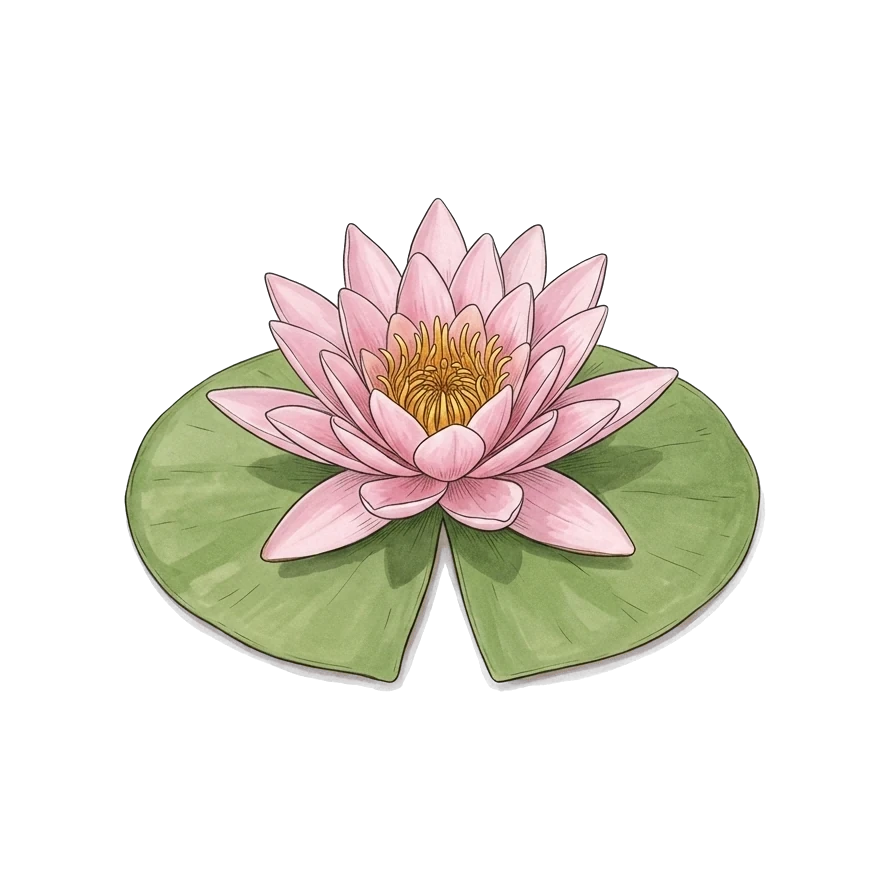
What does a water lily symbolize?
The water lily stands for purity. Kate Greenaway’s Language of Flowers of 1884 put it a little more warmly: “Purity of heart.”
The flower’s oldest story is about its name. Pliny the Elder reported that the nymphaea “owes its name, they say, to a Nymph who died of jealousy” over Hercules, which is why some people called it heracleon. Others called it rhopalon, a club, because its root looked like one. He described large leaves floating on the water and a flower “very similar to a lily,” and his 19th-century translators identify the plant as the white water lily, Nymphaea alba.
Greenaway kept the water lily and the lotus apart, and gave the lotus three messages of its own: eloquence for the plant, estranged love for its flower and recantation for its leaf. Which name you use changes what a Victorian would have read into it.
Water lily colors and what each one means
| Color | Meaning today |
|---|---|
| Pink | Joy and friendship |
| White | Purity, innocence |
| Yellow | Energy and new beginnings |
| Red | Passion and romance |
| Blue | Calm and wisdom |
The colors in a garden pond are fairly new. The French nurseryman Joseph Bory Latour-Marliac bred the first colorful hardy water lilies, crossing Europe’s wild white water lily with species from more temperate regions to get yellows, apricots, pinks and reds. His ‘Marliacea Carnea’, ‘Marliacea Ignea’ and ‘Marliacea Chromatella’, in pale pink, red and yellow, still carry his name.
Blue took longer. The vivid blues and purples belong to the tropical water lilies, and for a long time they wouldn’t cross with the hardy ones, so a blue hardy water lily was a breeder’s dream. In 2009 a hybridizer finally crossed the two and got a blue-purple hardy plant, the start of a new class, the hardy intersubgeneric water lilies. Blue petals are a rare trait among ornamental plants of any kind.
Water lily vs lotus: how to tell them apart
In everyday English the two names overlap. “Lotus” can mean Nelumbo, the sacred lotus of Asia and its North American cousin, or any of several water lilies, especially Nymphaea caerulea and N. lotus. “Water lily” means plants of the water lily family, the Nymphaeaceae, with large leaves that float on the water.
| Feature | Water lily | Lotus |
|---|---|---|
| Genus | Nymphaea | Nelumbo |
| Leaves | Rounded, floating flat on the water | Can lie flat, or rise on stalks more than 5 feet above the water |
| Flowers | Pointed petals in a star-like bloom, on or just above the water | Rounder, sometimes ruffled petals, on stalks up to about 6 feet tall |
| Seed head | None to speak of | Large and flat-topped |
| Family | Water lily family | Lotus family |
The New York and Missouri botanical gardens both use these features to tell the two apart. The seed head is the quickest tell: the Missouri Botanical Garden calls it one of the most easily observed differences between the two plants.
The likeness is only skin deep. The lotus’s closest relatives are shrubs and trees of the protea and plane-tree families. Water lilies belong to one of the oldest branches of the flowering-plant tree: of the flowering plants alive today, only Amborella split off earlier.
The Egyptian blue lotus is a water lily
The “blue lotus of the Nile,” also called the Egyptian lotus, is Nymphaea caerulea, a true water lily. Museum records keep the old name and the right plant side by side. The Metropolitan Museum of Art holds five “lotus buds” found on the mummy of Prince Amenemhat, from about 1080 to 945 BCE, and catalogues them as Nymphaea caerulea, the blue water lily. A painted wooden “lotus” flower from the temple of Mentuhotep II, about a thousand years older, is listed as a model water lily.
Green Tara’s blue lily
The mix-up reaches Buddhist art too. In a 14th-century Tibetan bronze at the Rubin Museum of Art, the blue lily, or utpala, in the goddess’s left hand is what marks her as Green Tara. In a 9th-century sculpture from Bihar, India, the Los Angeles County Museum of Art names that “blue lotus” as Nymphaea nouchali, a water lily.
Water lily symbolism in art and history
Monet’s water lilies
In 1893 Claude Monet bought a plot of land below his house at Giverny, across the road and the railway, and turned the small pond on it into a water garden, for “the pleasure of the eye” and for subjects to paint. He filled it with new hybrid water lilies from the Latour-Marliac nurseries, in yellows, pinks, whites and violets, and put a Japanese bridge over its western end. The water garden became the subject of some 250 paintings.
The cycle ends in Paris. On November 12, 1918, the day after the Armistice, Monet wrote to Georges Clemenceau to offer the state two panels, and the gift grew: the contract he signed in 1922 covered 19. Eight great compositions now fill two oval rooms at the Musée de l’Orangerie, hung as he planned in 1927, a few months after his death.
He wanted them to give “the illusion of an endless whole, of a wave with no horizon and no shore.” For decades, though, the public stayed away from the rooms.
The shapla of Bangladesh
The constitution of Bangladesh describes the national emblem as “the national flower Shapla (nymphaea nouchali) resting on water,” with an ear of paddy on each side and three jute leaves above. Banglapedia, the country’s national encyclopedia, names a different species: two water lilies grow in almost all its shallow natural waters, the blue N. nouchali and the white N. pubescens, and it gives the white one as the national flower.
Types of water lilies
There are about 70 species of Nymphaea. Gardeners sort them by what they need: hardy water lilies that stay out all winter, and tender tropical ones, which split again into day and night bloomers.
-
Hardy water lilies
The most widely available kind, grown outdoors all year. They go dormant in winter and come through it if the rhizomes sit below the freeze line. Most flower by day, in red, white, pink, yellow, peach and orange
-
Tropical day-blooming water lilies
Tender, needing water of at least 70°F (21°C) in summer, so grown as annuals where winters are cold. The flowers open between about 7:30 and 9:30 in the morning and close between late afternoon and sunset
-
Tropical night-blooming water lilies
Open in the evening and close between dawn and late morning the next day. The flowers are usually fragrant and held above the water
-
European white water lily
Nymphaea alba
The wild water lily of Britain and Europe, with lightly scented white flowers about 8 inches (20 cm) across that open as cups and turn star-shaped
-
Fragrant water lily
Nymphaea odorata
Native to the eastern half of North America, including southern Canada. Fragrant white flowers, sometimes pink, with yellow centers
-
Blue lotus of the Nile
Nymphaea caerulea
The Egyptian “lotus” is a water lily, not a lotus. Some botanists treat it as a variety of Nymphaea nouchali
-
Giant water lilies
Victoria
Named for Queen Victoria. The Longwood Hybrid, a cross of two species, has platter-like leaves 4 to 6 feet across with upturned rims, and night flowers that open white and reopen pink
The giant water lily is a cousin rather than a Nymphaea: it belongs to the same family, the Nymphaeaceae, but to a genus of its own, Victoria, and the undersides of its leaves are covered in sharp spines, like its stems.
How to grow water lilies
Growing water lily
- Type
- Aquatic perennial
- Blooms
- Spring to fall
- Sun
- Full sun to part shade
- USDA zones
- 3–9
- Native to
- Europe, Asia, Africa and the Americas
Match the plant to the pond. Small cultivars spread 1 to 2 feet and need water 12 to 18 inches deep, medium ones spread 2 to 4 feet in 18 to 30 inches, and the largest reach 8 feet across and need 30 inches to 4 feet. Full sun gives the most flowers.
Plant from late spring to late summer, and let the leaves cover no more than half the pond’s surface. Each spring, push a slow-release aquatic feed tablet into the compost, and divide most plants every four to five years, because crowded clumps flower less.
Are water lilies poisonous to cats and dogs?
Water lily
- Pets
- Not in the ASPCA’s plant list
- People
- Not listed as poisonous
In the US, if a pet may have eaten part of a plant, call your vet or the ASPCA Animal Poison Control Center at (888) 426-4435. If a person has, call Poison Control at 1-800-222-1222.
The ASPCA’s list has plenty of other lilies, among them the Easter lily, the peace lily and the calla lily, but not the water lily.
Water lily bouquet ideas
A water lily bouquet is really a bowl: the flower grows on or just above the water, among leaves that float flat. Pair it with larkspur, July’s other flower, or with lily of the valley, which Greenaway read as the return of happiness.
-
One bloom, one bowl
Float a single flower and a leaf or two in a wide, shallow bowl, as it sits on a pond. It needs no other flowers around it.
-
Blue spikes above the water
Set a few stems of blue larkspur in a jar behind the bowl, for height. Keep the larkspur out of reach of pets.
-
Monet’s colors
Pick two or three colors from the yellows, pinks, whites and violets of Monet’s pond, for a painter or a gardener.
-
Name it on the card
Write “water lily”, not “lotus”: in the Victorian language of flowers, a lotus flower meant estranged love.
Water lily tattoo ideas
What makes a water lily tattoo read as a water lily, and not a lotus, is mostly height. Keep the flower low on its round pad, with pointed petals in a star; a tall stem, rounded petals or a seed pod turn it into a lotus.
-
Flat on the water
One open star of petals on a round pad, with a ripple line or two. It sits well on a small spot such as the wrist or ankle.
-
A bud from the Nile
A closed blue bud, in the flat profile of Egyptian art. It is the old “blue lotus”, and a water lily all along.
-
Monet’s bridge
The arc of a Japanese footbridge over a scatter of pads, in loose brushstroke shading, for someone who loves the paintings.
-
A night bloomer
Night-blooming water lilies open in the evening and stay open into the next morning. Draw one under a crescent moon, for a night owl born in July.