What does lily of the valley symbolize?
Lily of the valley is now a flower of happiness and sweetness. Its Victorian meaning is a promise more than a mood: Kate Greenaway’s 1884 Language of Flowers gives it “return of happiness.”
The old flower books didn’t all agree. Henrietta Dumont’s American Language of Flowers of 1851 gives the same “return of happiness” in its word list, but its own chapter on the flower calls it modesty, an emblem of beauty, simplicity and “love of retirement.” A tale in the same book has it spring up wherever Venus’s tears fell as she wept over the dead Adonis.
Lily of the valley colors: white bells and a pink form
- White
- Leaf green
The bells are white, and only rarely tinged with red. The pink lily of the valley is a variety of its own, Convallaria majalis var. rosea, with fragrant, pale mauve-pink bells. It is no modern novelty: the RHS keeps a watercolor of the pink form painted around 1680 by Frans George Beissner, in an album of Dutch garden flowers.
Lily of the valley symbolism in history
The flower’s meanings travel with its names, from a verse of the Bible to a Finnish national flower and a French street-corner custom.
Lily of the valley in the Bible
“I am the rose of Sharon, and the lily of the valleys,” says the speaker in the Song of Solomon. The genus name, Convallaria, comes from that verse’s Latin, lilium convallium, the lily of the valleys. Convallis is Latin for a valley, and the second name, majalis, means “of May,” for the month it flowers.
Whether this little woodland plant is really the lily of the Song is an old question. Finland’s Wild Flower Day leaflet tells how, in 1741 and 1744, Henrik Lilius, a future vicar of Messukylä in Finland, defended a two-part dissertation on the plant that asked whether it could be that lily. Linnaeus gave it its scientific name, built from the Latin words for valley and May, in 1753.
Kielo, Finland’s national flower
The lily of the valley, the kielo, became Finland’s national flower in 1967, the 50th year of the country’s independence. The same leaflet says it was chosen by a popular vote, won most likely by its pure white, strongly scented flowers, though perhaps with some lobbying by the flower trade too.
The Finnish name is about the leaves. Their tongue-like shape gave the plant folk names such as cow’s tongue, ox’s tongue and dog’s tongue, and Elias Lönnrot built the name kielo from them (kieli is tongue). Kielo has since become a girl’s name, and a favorite name for cows.
The muguet of May 1 in France
On May 1, it is the custom in France to give a sprig of muguet to the people close to you. About 85 percent of the country’s crop is grown around Nantes and in the Pays de la Loire. It is a demanding crop: the plants are only harvested from the third year after planting.
A royal wedding flower
When Catherine Middleton married Prince William at Westminster Abbey on April 29, 2011, she carried lily of the valley with myrtle, sweet William, ivy and hyacinth. The Abbey gave each flower its old meaning: lily of the valley for the return of happiness, sweet William for gallantry, hyacinth for constancy of love and myrtle as the emblem of marriage. After the wedding, she sent the bouquet back to rest on the Grave of the Unknown Warrior, a custom the Queen Mother began in memory of her brother Fergus, killed at the Battle of Loos in 1915.
Types of lily of the valley
Most gardens grow the common white species, but a few forms change its color, its leaves or its size, and the Appalachians have a lily of the valley of their own.
-
Common lily of the valley
Convallaria majalis
The white-flowered species, wild from Europe to the Caucasus. It grows up to 10 inches (25 cm) tall, forms wide colonies and holds the RHS Award of Garden Merit
-
Rosy lily of the valley
Convallaria majalis var. rosea
The pink form: fragrant, pale mauve-pink bells on a plant about 8 inches (20 cm) tall, from central and eastern Europe
-
'Hardwick Hall'
Convallaria majalis 'Hardwick Hall'
A robust, spreading form whose broad leaves have a fine, irregular yellow-green edge, with fragrant white bells in late spring
-
'Bordeaux'
Convallaria majalis 'Bordeaux'
A robust form up to about a foot (30 cm) tall, with deep green leaves and fragrant white bells
-
Double lily of the valley
Convallaria majalis 'Pleniflora'
Double flowers. Like the pink and variegated forms, it is mostly a collector’s plant, and fussier than the species
-
American lily of the valley
Convallaria pseudomajalis
A wildflower of the southern Appalachians, from northern Virginia and West Virginia to northern Georgia. Its leaves are larger and longer, and it doesn’t grow in dense colonies
A plant sold as the plain species may well be ‘Grandiflora’, a particularly fine selection, according to a planting guide from BOKU University in Vienna. If you want a lily of the valley that is native to the United States, the American species is the one, from the mountains of Virginia and West Virginia down to Georgia.
How to grow lily of the valley
Growing lily of the valley
- Type
- Perennial ground cover
- Blooms
- Spring to summer
- Sun
- Part shade to deep shade
- USDA zones
- 3–7
- Native to
- Europe and Asia
Give it fertile, moist soil rich in humus, and top-dress it with leaf mold in fall. It is hard to raise from seed, so plant it “in the green,” as you would snowdrops, or divide an established clump in fall. A seedling usually takes about eight years to flower, and only about 2 to 3 percent of the shoots in a patch bloom.
Once settled, a patch creeps outward about 6 inches (15 cm) a year on its rhizomes. NC State reports it as invasive in Wisconsin and Arkansas, where its dense rhizomes can choke out other plants, and suggests considering a native alternative.
Is lily of the valley poisonous to cats and dogs?
Lily of the valley
- Pets
- Toxic to dogs, cats and horses
- People
- Listed as poisonous (low severity) Every part is listed as poisonous. It contains cardiac glycosides, which can slow and upset the heartbeat.
In the US, if a pet may have eaten part of a plant, call your vet or the ASPCA Animal Poison Control Center at (888) 426-4435. If a person has, call Poison Control at 1-800-222-1222.
The ASPCA lists the signs as vomiting, an irregular heartbeat, low blood pressure, disorientation, coma and seizures, caused by cardenolides such as convallarin.
Lily of the valley bouquet ideas
Cut stems don’t last long, which is why lily of the valley is often sold with its roots still on. Florists have it all year, though it flowers outdoors in late spring. In May, pair it with the month’s other birth flower, hawthorn; in summer, with roses or sweet peas.
-
The 2011 wedding mix
Copy the royal bouquet: lily of the valley with myrtle, sweet William, ivy and hyacinth. Each one adds its own old meaning, from gallantry to constancy of love.
-
Hope and happiness for May
Hawthorn means hope, and lily of the valley the return of happiness, so a few sprigs of each make a May birthday bunch with a message.
-
A rooted bunch in a pot
Ask for stems with their roots. They keep better than cut ones, and the pot itself becomes the gift.
-
One sprig on May 1
Do as the French do and give a single sprig for luck on May 1. Tie it with a ribbon and leave out everything else.
Lily of the valley tattoo ideas
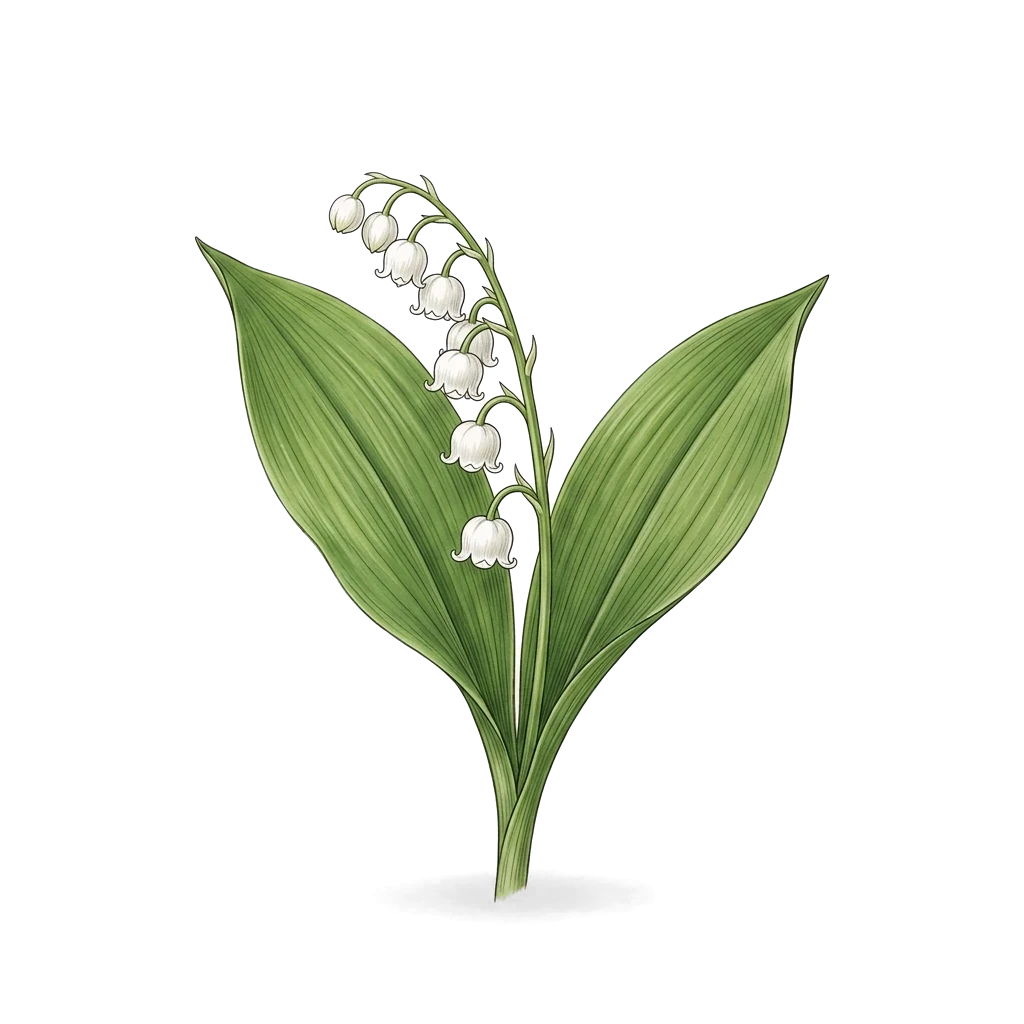
Six to 16 small, nodding bells hang from one side of a slender stalk, each with six lobes curling outward at the rim, and the stalk is tucked in below a pair of long leaves. Keep the bells in a row down one side of the stalk, the way they grow, and even a tiny design looks right.
-
Every bell on one side
Hang the bells in a row from one side of a curved stalk, getting smaller toward the tip, and give each a flared, scalloped rim.
-
Framed by two leaves
Draw the pair of long, broad leaves around the stalk like cupped hands. A name or a date fits in the space between them.
-
Pink for something rarer
Shade the bells a pale mauve-pink, after the pink form painted for an album of Dutch garden flowers around 1680, if white feels too plain.
-
A red berry for later
Add one small, round red berry beside the bells. The plant seldom sets fruit, so it makes a quiet detail for anyone who knows it.