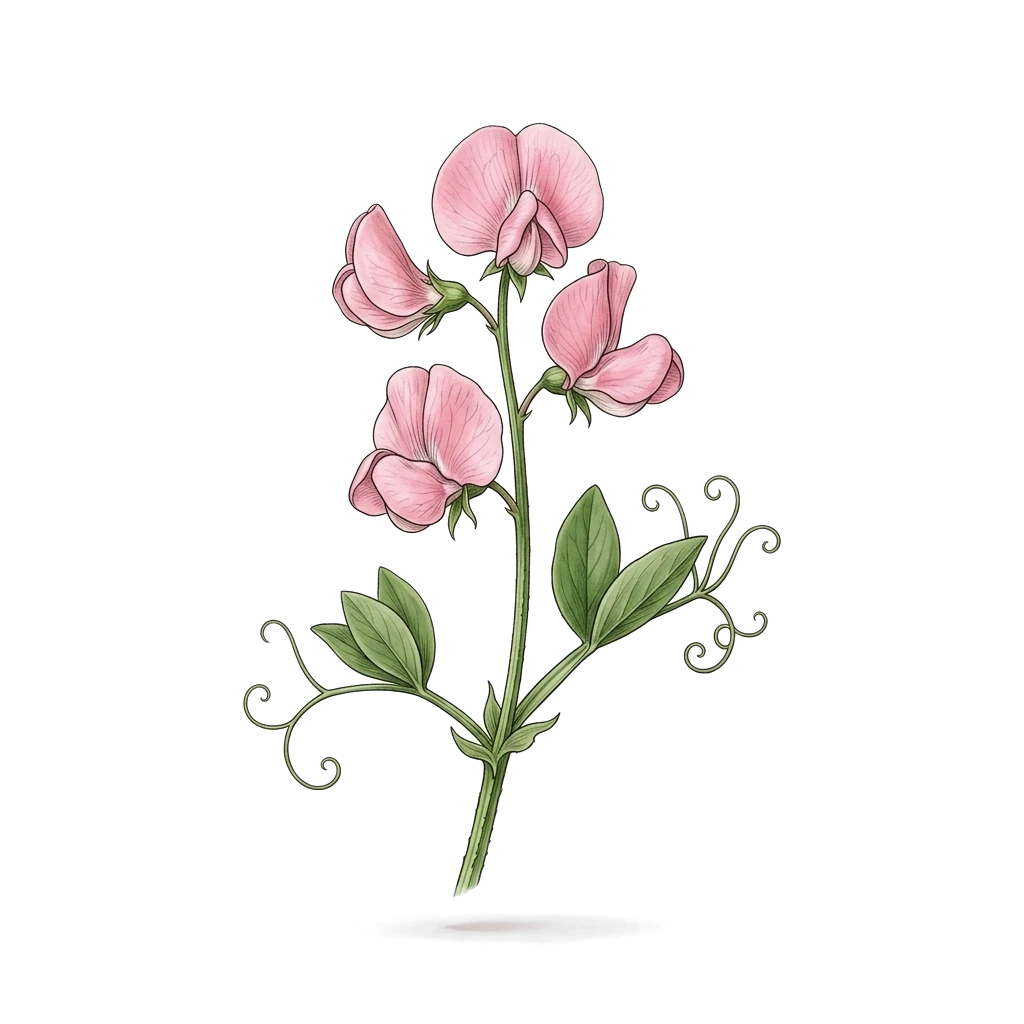
What a sweet pea flower looks like
A sweet pea flower has three parts that are easy to tell apart. The broad petal standing up at the back is the standard, the two at the sides are the wings, and between them sits the keel. Each flower is 1 to 3 inches across, and they open in long clusters.
The name says what matters most. Lathyrus comes from the Greek for pea or pulse, and odoratus means fragrant. The genus has well over 150 species, and the sweet pea is the only one with that scent.
It’s a climbing annual of the bean family. The leaves end in tendrils that wind around any support, and the stems carry thin wings along their length. Most climb to about 6½ feet.
Sweet pea meaning: departure and delicate pleasures
In the nineteenth-century language of flowers, a sweet pea said goodbye: an American book of 1851 pictures one beside a pansy, captioned “I depart. Think on me.” Kate Greenaway’s 1884 Language of Flowers gives it two entries that don’t agree, “Pea, Sweet” for departure and “Sweet Pea” for delicate pleasures. Its perennial cousin did better there: the everlasting pea stood for “an appointed meeting” and “lasting pleasure.”
The goodbye has stuck, and modern flower lists give it company: blissful pleasure, thanks for a lovely time, good wishes, kindness and friendship.
Sweet pea colors
Sweet pea colors run from white and pink to coral, red, violet and blue, though Greenaway gives none of them a meaning of its own. Some flowers are two-toned, and some have petals edged in a darker shade, which growers call picotee.
- Pink
- Lavender
- White
- Red
Sweet pea history and symbolism
The Franciscan monk Francesco Cupani first recorded the wild sweet pea of Sicily in 1695 and described it in his Hortus Catholicus of 1696. He sent seed to Dr. Robert Uvedale of Enfield, near London, who had it in flower by 1700. By the early 1700s it was growing in Oxford and Amsterdam too, apparently from Cupani’s seed.
Cupani’s flowers were small, short-stalked, two-toned and sweetly scented, and they came in pairs. A century on, gardeners still had only a handful of sorts: purple, red, white, black and one called Painted Lady.
Henry Eckford changed that. He began crossing sweet peas in the 1870s, as gardener to Dr. Sankey in Gloucestershire, and from ‘Bronze Prince’ in 1882 brought out new ones year after year, later from his own nursery at Wem in Shropshire. The National Sweet Pea Society still calls him the Father of the Sweet Pea.
In July 1900 an exhibition at the Crystal Palace in London marked 200 years of sweet peas in Britain. It was such a success that it led to the founding of the National Sweet Pea Society.
At the society’s show in 1901, Silas Cole, gardener to Earl Spencer at Althorp Park, showed a sweet pea with large, waved petals, ‘Countess Spencer.’ The frilly form had cropped up in several places at about the same time, out of the same variety, ‘Prima Donna.’ Cole got the credit, and every later sweet pea of that shape is called a Spencer.
By 1911 the craze was big enough for the Daily Mail to offer a prize for the best bunch of sweet peas. About 38,000 entries came in, and a Scottish minister’s wife took first prize, with her husband in third.
Poets saw the wings too. In “I stood tip-toe upon a little hill,” published in 1817, John Keats wrote: “Here are sweet peas, on tip-toe for a flight: / With wings of gentle flush o’er delicate white.”
Types of sweet peas
Sweet peas are grouped by the shape and size of the flower, the height of the plant and the age of the variety.
-
Cupani
Still sold as ‘Cupani’s Original’, after the monk who first recorded the sweet pea in Sicily
-
Old-fashioned
Varieties from before 1914, with smaller flowers than the Spencers and a very strong scent
-
Grandiflora
Henry Eckford’s larger, more vigorous sweet peas of the late 1800s, a name that now covers any flower with plain petals and a clamped keel
-
Spencer
Tall plants with large, frilly flowers, named after ‘Countess Spencer’ of 1901, and the most popular kind grown today
-
Multiflora
More than five flowers to a stem, and some varieties bloom early
-
Dwarf and intermediate
Shorter plants, the dwarfs short and bushy to about 18 inches, used as bedding
-
Everlasting pea
Lathyrus latifolius
A perennial cousin, not a sweet pea: it comes back year after year but lacks the scent
Scent is the trade-off: the big, frilly Spencers that took over the sweet pea world are less scented than the wild flower.
How to grow sweet peas
Growing sweet pea
- Type
- Annual climber
- Blooms
- Spring to summer
- Sun
- Full sun
- Native to
- Southern Italy and Sicily
For long stems in a vase, grow each plant as a cordon: one stem tied to a cane, with the tendrils pinched off. The plant puts its energy into bigger flowers on longer stalks. A liquid feed every week or two keeps any sweet pea flowering.
Sweet peas can also be sown in pots in October and kept in a cold frame or greenhouse, and spring-sown plants run about three weeks behind them. Grow them in a new spot each year rather than in the same bed twice running.
Are sweet peas poisonous to cats and dogs?
Sweet pea
- Pets
- Not in the ASPCA’s plant list The ASPCA’s “sweet pea” entry is the everlasting pea (Lathyrus latifolius), a perennial cousin it lists as toxic to horses.
- People
- Listed as poisonous (low severity) The seeds are the poisonous part.
In the US, if a pet may have eaten part of a plant, call your vet or the ASPCA Animal Poison Control Center at (888) 426-4435. If a person has, call Poison Control at 1-800-222-1222.
Sweet pea bouquets
Sweet peas are a cut-and-come-again flower: seed pods slow the plant down, so every stem cut for the house, or every spent flower taken off, brings on new ones. They need little help in a vase, though a few white daisies give the loose, ruffled stems a center.
-
The jam-jar bunch
A handful of mixed colors in a jam jar on the kitchen table needs nothing else. Cut the stems short, leave them loose and skip the foam and wire.
-
Scent over size
If the big frilly Spencers in the bunch smell faint, slip in a few stems of an old-fashioned variety. The jar looks much the same and smells far sweeter.
-
White to deep violet
One run of shades, white through lavender to the darkest purple, looks generous with no other flower in the jar.
-
Thanks, or goodbye
A small bunch suits a thank-you note or a leaving present, since thanks and departure are the two things a sweet pea is said to mean.
Sweet pea tattoo ideas
A sweet pea tattoo starts with a flower that already looks like it’s about to fly off, which suits a design about leaving or remembering.
-
Standard, wings and keel
Draw the flower side-on so all three parts show: the standard upright at the back, the wings spread, the keel tucked between them. Face-on it could be any ruffled bloom; from the side it is plainly a sweet pea.
-
Tendrils and a winged stem
Let the plant do the linework. A few tight coils spring from the leaf tips, and the thin wing running down the stem gives a second line beside the first.
-
On tip-toe for a flight
Keats’s line fits a spray of flowers angled upward as if lifting off, with the words in small script along the stem.
-
A farewell, with a pansy
For a goodbye or a memorial piece, set a sweet pea beside a pansy as the 1851 flower book did, with its caption, “I depart. Think on me,” or just the two flowers.