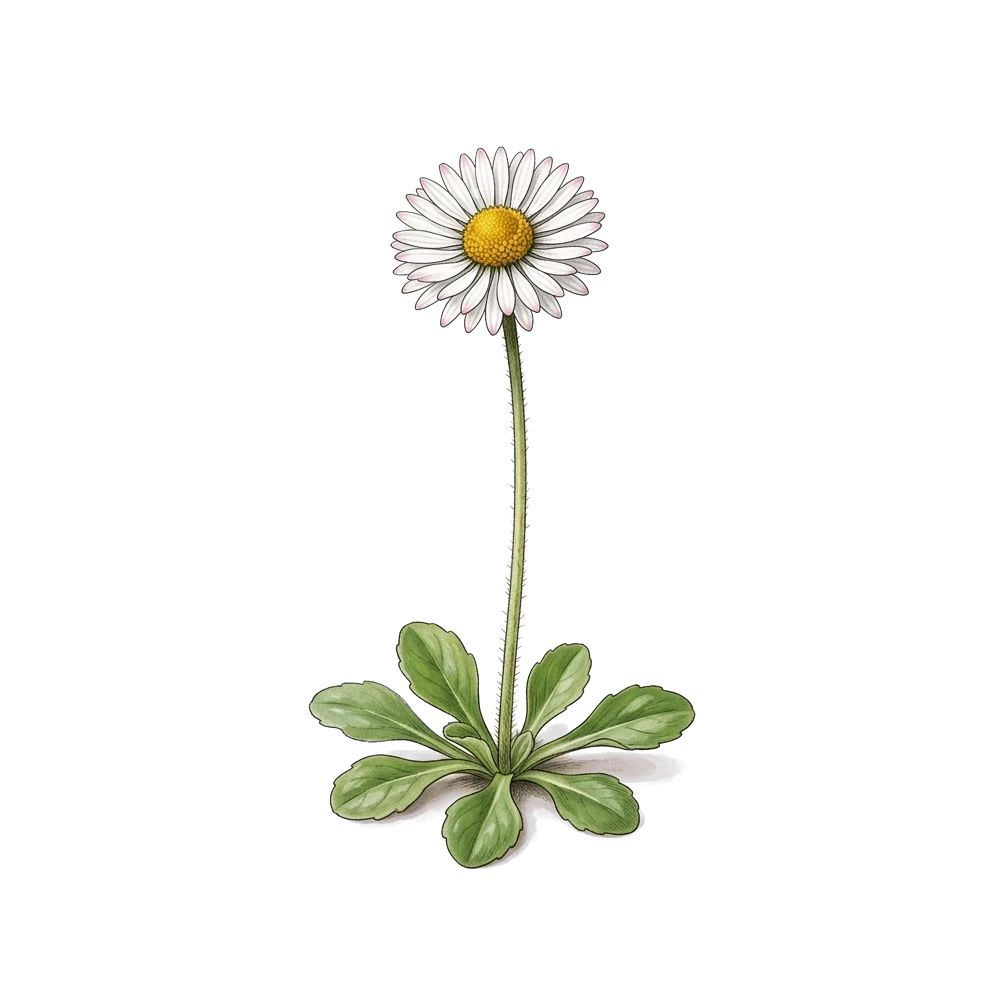
What does a daisy symbolize?
Few flowers look as guileless as a daisy, and its meanings follow the look: innocence, purity and, often, true love. Kate Greenaway’s 1884 Language of Flowers keeps it to a single word, innocence.
The name is older than any of those meanings: daisy comes from the Old English dæges ēage, “day’s eye.” The scholar Walter Skeat thought the day’s eye was first of all the sun, and that the flower took the name because it looks like one: white rays around a golden center.
It behaves like one too: English daisy flower heads close at night and in wet weather. Chaucer watched it happen in the 1380s and wrote that when the sun goes west the daisy shuts, “so sore hit is afered of the night.”
Daisy meaning by color
The English daisy’s own rays come in white, pink or red, always around a yellow center. Gerberas, the big cut-flower daisies, widen the range: usually red, more rarely yellow, orange, white or pink.
| Color | Meaning today |
|---|---|
| White | Purity and innocence |
| Yellow | Joy and friendship |
| Pink | Affection |
| Red | Love and romance |
Daisy symbolism in poetry, art and folklore
Chaucer’s daisy
The daisy’s great English poem is the prologue to Chaucer’s Legend of Good Women, written around 1385. Of all the flowers in the meadow, Chaucer says, he loves best “these floures whyte and rede, swiche as men callen daysies in our toun,” and in May he is up at dawn to watch them open. He even explains the name himself, calling the flower “the ‘dayesye’ or elles the ‘ye of day,’” and he had it right.
In the same poem, Queen Alceste, who chose to die in her husband’s place, is turned into a daisy. Her white crown, Chaucer writes, holds as many small flowers as she had virtues. The transformation seems to be Chaucer’s own invention, though the daisy poems of the French poets Guillaume de Machaut and Jean Froissart may have turned his attention to the flower.
The marguerite and the name Margaret
Those French poems praised the marguerite, the French word for the daisy, which comes from the Old French margarite. The French editor Tarbé traced the French cult of the flower to the many Marguerites in the royal family of France, starting with Marguerite de Provence, wife of Louis IX.
The pun reached the English court too: the Talbot Shrewsbury Book, made in Rouen around 1445 as a wedding gift for Margaret of Anjou, bride of Henry VI, is painted with daisies that the British Library describes as referring to her name.
Goethe’s heroine is a Margaret too: in Faust, she plucks a star-flower, which Goethe never names, and pulls off its petals one at a time, murmuring “He loves me—loves me not,” until the last one lands on “He loves me!”
Shakespeare, Burns and the meadow daisy
In Shakespeare the daisy is a flower of spring and of fair skin. The spring song that ends Love’s Labour’s Lost begins “When daisies pied and violets blue,” Ophelia hands one out with “There’s a daisy,” and Lucrece’s white hand on a green coverlet shows “like an April daisy on the grass.”
Robert Burns wrote “To a Mountain Daisy, on turning one down with a plough, in April 1786,” addressed to a “wee, modest, crimson-tipped flow’r.” Greenaway printed it in her flower book, along with a Burns verse that gives the daisy “simplicity and unaffected air,” and she ended her selection of poems with Chaucer’s daisy lines.
The daisy in the Victorian language of flowers
Greenaway’s list splits the daisy by kind: a garden daisy said “I share your sentiments,” a wild daisy “I will think of it,” and a party-colored daisy “Beauty.” Her entry for Ox Eye reads “Patience.”
The book doesn’t always agree with itself: the garden daisy turns up a second time as “I partake your sentiments,” and the Michaelmas daisy means “Farewell” in one entry and “Afterthought” in another. Her China aster gets the same word, “Variety. Afterthought.”
William Morris’s Daisy, registered in 1864, was the first wallpaper he designed to be put into production, and its flat, frontal motif may come from a wall hanging shown in a 15th-century copy of Froissart’s Chronicles.
Types of daisies
“Daisy” covers several plants of the composite family. The daisy of the birth-flower lists is the English daisy, Bellis perennis, and most of this page is about it.
Every daisy is a crowd of flowers posing as one: the white “petals” are small ray flowers, and the yellow center is made of tiny disk flowers. Chaucer’s line about the small flowers in Alceste’s crown was more exact than he needed it to be.
-
English daisy
Bellis perennis
The low lawn daisy of Europe, sometimes semi-double or double
-
Oxeye daisy
Leucanthemum vulgare
A wildflower of Europe and Asia and a parent of the Shasta daisy, a Class C noxious weed in Washington
-
Shasta daisy
Leucanthemum × superbum
Luther Burbank’s hybrid of the oxeye with other daisies, named for Mount Shasta
-
Marguerite
Argyranthemum frutescens
A bushy, frost-tender subshrub from the Canary Islands, also called Paris daisy, with small white flower heads
-
Gerbera daisy
Gerbera jamesonii
The big florists’ daisy, native to southeastern Africa and grown for cutting
-
African daisy
Osteospermum ecklonis
A South African subshrub whose white rays are indigo underneath, around a dark blue disc
The Shasta daisy began with the oxeye. According to the Luther Burbank Home & Gardens in Santa Rosa, California, Burbank planted oxeye seed from New England there in 1884, crossed it with three other daisies for 17 years and introduced the Shasta daisy hybrids in 1901, named for the glistening white of Mount Shasta. NC State has the work done near Mount Shasta in the 1890s, from three parent species in all.
English daisy vs. oxeye daisy
Look at the leaves. The English daisy stands 3 to 6 inches tall, with all its spoon-shaped leaves in a rosette at the base and none on the stem. Its flowers sit on leafless, hairy stalks.
The oxeye daisy grows 1 to 3 feet tall, with toothed, lance-shaped leaves along the stem that get smaller toward the top, and the whole plant smells disagreeable when crushed. Native to Europe and Asia, it reached the US in the 1800s and is considered an invasive weed outside its native range, where it crowds out native plants.
In Washington it’s on the state quarantine list, so its plants and seed can’t be sold or moved there, and the state’s weed board warns buyers to be careful with wildflower seed mixes. NC State suggests native alternatives such as lanceleaf coreopsis, purple coneflower and black-eyed Susan.
How to grow English daisies
Growing daisy
Facts for English daisy (Bellis perennis)
- Type
- Perennial, also grown as an annual or biennial
- Blooms
- Spring to summer
- Sun
- Full sun to dappled shade
- USDA zones
- 4–8
- Native to
- Europe
English daisies like cool, moist, fertile soil and sun with some afternoon shade, and they fade in summer heat. In the northern US many gardeners treat them as annuals. They have no major pest or disease problems and resist deer.
They also wander: English daisies often escape from flower beds into lawns, where they count as a weed. They spread by short rhizomes and wind-blown seed, and a thick, healthy lawn is the main way to keep them out, although some park managers leave the patches because the flowers are pretty.
Are daisies poisonous to cats and dogs?
Daisy
- Pets
- Not in the ASPCA’s plant list The ASPCA’s “daisy” entry is chrysanthemums, a different plant.
- People
- Listed as poisonous (medium severity) Stomach upset if eaten, and it can irritate skin.
In the US, if a pet may have eaten part of a plant, call your vet or the ASPCA Animal Poison Control Center at (888) 426-4435. If a person has, call Poison Control at 1-800-222-1222.
Daisy bouquets
-
A posy from the lawn
English daisies come on short, bare stalks, so they are a jam-jar or egg-cup flower: pick a fistful with the first violets and primroses and leave them loose, the way they grew.
-
Shastas for a tall vase
For a jug with some height, go to the oxeye’s garden-bred descendant. Shasta daisies give the same white-and-gold face on a long stem, and look best massed on their own with plenty of leaves.
-
Gerberas for color
When the bouquet shouldn’t be white, the florists’ gerbera keeps the daisy shape at a much larger size, one bold head per stem, and a handful reads across a room.
Daisy tattoo ideas
-
Rays around a dotted disc
Draw the center as a cluster of tiny dots and each ray as its own thin stroke, the way the head is really built. A flat yellow circle reads as a cartoon; dots read as a daisy.
-
Open by day, shut by night
The day’s eye in two states: one head spread wide, one folded up for the night, side by side or under a small sun and moon. It is the daisy Chaucer rose at dawn to watch.
-
A daisy chain
Small heads linked stalk through stalk make a band that closes on itself, with no beginning and no end.
-
Loves me, loves me not
One head with a few rays drifting off and one left on, for the petal-pulling game. Script the words along the stem, or let the falling rays say it.