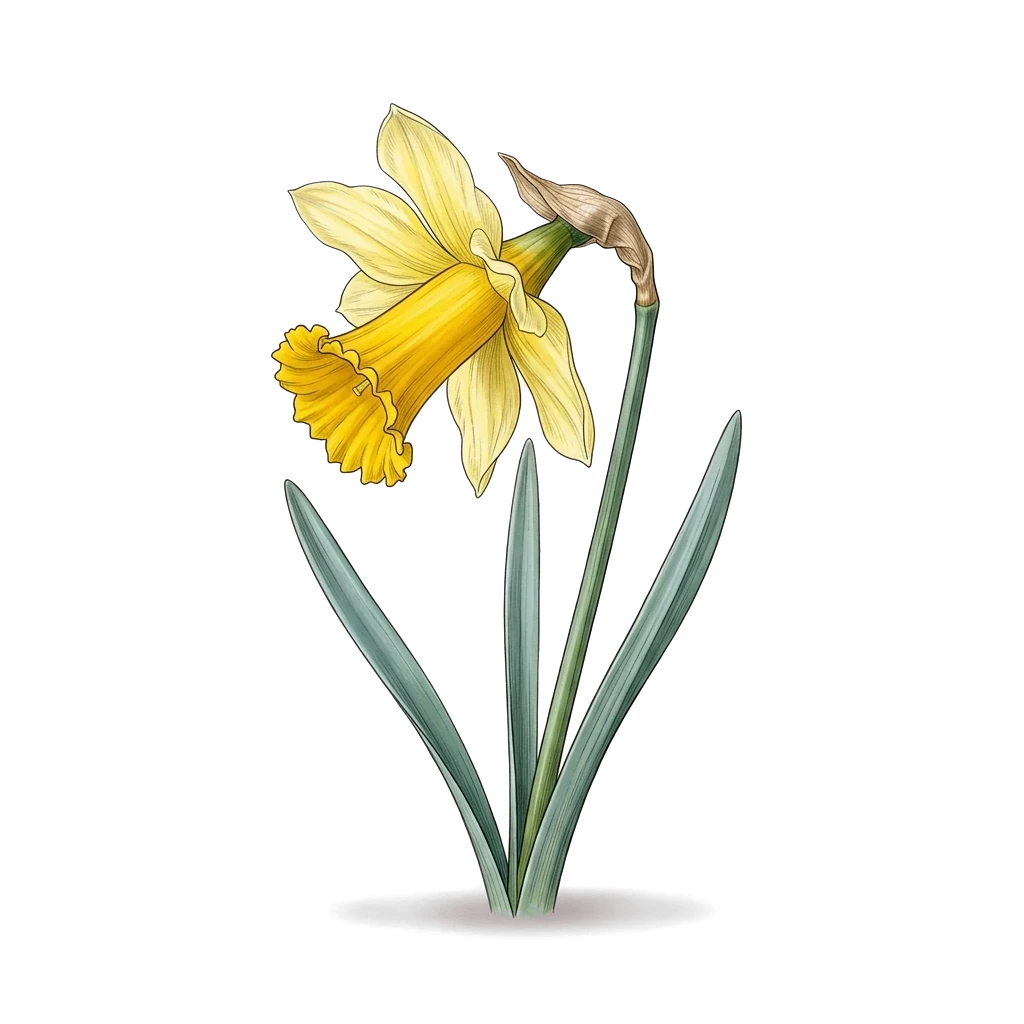
What does the daffodil mean?
Daffodils are among the first signs of spring, so the flower has come to stand for rebirth and new beginnings, and it is strongly associated with Easter. In Kate Greenaway’s 1884 Language of Flowers, the daffodil means “regard.”
Not every old reading is so sunny. In medieval times, a daffodil that drooped as you looked at it was taken as an omen of death, while in France the flower was a sign of hope. Its darker associations trace back to its Latin name, Narcissus, and the myth that goes with it.
Daffodil flower meaning by color
- Yellow
- White
- Orange cup
Greenaway gives the daffodil one meaning whatever its color, and the jonquil its own, “I desire a return of affection.” Growers have their own color language: registered daffodils carry a code that names the colors of their petals first and then those of their cup, from base to rim, so a flower with white petals and a green, yellow and red cup is written W-GYR. The Royal Horticultural Society adopted that system in 1975.
Daffodil symbolism in myth, poetry and faith
Narcissus and Echo
The best-known telling is Ovid’s, in the Metamorphoses. A seer warned that the beautiful Narcissus would live to old age “if he never recognizes himself,” and the nymph Echo, cursed by Juno to repeat only the last words she heard, fell in love with him and was turned away. When one more spurned admirer prayed that he might love and never have what he loved, the goddess of retribution agreed, and Narcissus wasted away gazing at his reflection in a spring.
His sisters came to prepare his funeral, but the body had gone. In its place, in Henry Riley’s translation, they found “a yellow flower, with white leaves encompassing it in the middle.” Greenaway’s book carries the story’s moral into the language of flowers, where the narcissus means “egotism.”
An older Greek story makes the flower a trap. In the Homeric Hymn to Demeter, Earth grows a radiant narcissus, a hundred blooms from one root, to lure Persephone, and when she reaches for it the ground opens and Hades carries her off to the underworld.
Daffodils in Shakespeare, Wordsworth and Housman
In The Winter’s Tale, Perdita wishes she had the spring flowers Proserpina (Persephone) let fall when she was carried off: first “daffodils, that come before the swallow dares, and take the winds of March with beauty,” then violets and pale primroses. Earlier in the same play, the peddler Autolycus enters singing “When daffodils begin to peer.”
English poetry’s best-known daffodils were seen on April 15, 1802, when William Wordsworth and his sister Dorothy walked by Gowbarrow Park on the shore of Ullswater, in the Lake District. Dorothy wrote in her journal of “a long belt” of flowers that “tossed and reeled and danced.”
William made the poem “I wandered lonely as a Cloud” from that walk in 1804 and published it in 1807 in Poems, in Two Volumes. In it the poet comes upon “a host, of golden daffodils.” Two of its lines, “They flash upon that inward eye / Which is the bliss of solitude,” were suggested by his wife, Mary, and the 1815 version, with an added stanza, is the one most people read today.
The wild daffodil of Britain, Narcissus pseudonarcissus, flowers in March and April, and among its other names are the Lent lily and the Easter lily. A. E. Housman gave it a poem in A Shropshire Lad, “The Lent Lily,” about a flower that “dies on Easter day.”
The daffodil and the leek in Wales
Wales has two national emblems, the leek and the daffodil, and people wear one or the other on St David’s Day. The leek is far older: by 1536 it was already linked to St David’s Day, and legend says David told his soldiers to wear leeks on their helmets.
The daffodil is the newcomer. It grew popular in the 19th century, especially among women, and its standing rose when David Lloyd George, the Welsh-born prime minister, wore one on St David’s Day. In Wales the wild daffodil is also called Peter’s leek, a name that ties the two emblems together.
A spring emblem for cancer charities
The daffodil has become the symbol of cancer charities around the world. In the UK, the charity Marie Curie runs its Great Daffodil Appeal each spring, and supporters wear a daffodil pin in March to raise money for end of life care. The Canadian Cancer Society holds its Daffodil Month each April, and its 2026 appeal described daffodils as among the first flowers to bloom each spring, “resilient, vibrant and hopeful.”
Types of daffodils
“Daffodil” is the everyday name for the flowers of the genus Narcissus. Gardeners now grow several thousand named kinds. The Royal Horticultural Society keeps the register of every named daffodil, and daffodil societies around the world sort them with its classification.
That classification has 13 divisions, set by the shape of the flower and the plant’s ancestry. The first 12 hold the hybrids, and Division 13 holds the wild species, their variants and wild hybrids. Jonquils are Division 7, which makes every jonquil a daffodil.
The tender paperwhites forced indoors in winter are daffodils too, and our narcissus page covers them.
-
Trumpet daffodils
Division 1. One flower to a stem, with a trumpet as long as the petals or longer
-
Large-cupped daffodils
Division 2. One flower to a stem, its cup more than a third as long as the petals but shorter than them
-
Double daffodils
Division 4. One or more flowers to a stem, with the petals, the cup or both doubled
-
Cyclamineus daffodils
Division 6. Usually one flower, its petals swept back from the cup so it looks a little like a cyclamen
-
Jonquilla daffodils
Division 7, the jonquils. Several fragrant flowers on each stem, above narrow, dark green leaves
-
Tazetta daffodils
Division 8. Many musky, sweet-scented flowers per stem, the paperwhites among them
-
Poeticus daffodils
Division 9. Usually one flower, with pure white petals around a small cup that is usually disc-shaped
-
Split-cupped daffodils
Division 11, also called split-corona daffodils. The cup is split for more than half its length, and some call them butterfly daffodils
How to grow daffodils
Growing daffodil
Facts for daffodils (Narcissus)
- Type
- Bulb
- Blooms
- Winter to spring
- Sun
- Full sun to part shade
- USDA zones
- 4–8
- Native to
- Northern Africa, Europe and parts of Asia
Plant the bulbs deep: Iowa State Extension gives 6 to 8 inches, about 6 inches apart, and the RHS puts it as three times the height of the bulb. They resist deer and rabbits and put up with salt, which suits a bed beside a road or path.
When daffodils stop flowering, the bulbs often haven’t stored enough food. The leaves keep feeding the bulb for four to six weeks after the flowers fade, and cutting them off early can leave it without enough food to bloom the next spring. Crowded clumps can be lifted and divided just after the foliage dies back.
Are daffodils poisonous to cats and dogs?
Daffodil
- Pets
- Toxic to dogs, cats and horses
- People
- Listed as poisonous (medium severity) The bulbs are the most poisonous part, and handling them can irritate skin.
In the US, if a pet may have eaten part of a plant, call your vet or the ASPCA Animal Poison Control Center at (888) 426-4435. If a person has, call Poison Control at 1-800-222-1222.
Keep spare bulbs in labeled bags: the RHS warns that daffodil bulbs are regularly mistaken for onions.
Daffodil bouquet pairings
A daffodil bouquet needs a little planning, because cut daffodil stems ooze a slimy sap that shortens the vase life of other flowers in the same water. Stand fresh daffodils in their own vase for a few hours, pour that water away, and they can then join an arrangement.
-
Perdita’s spring posy
Daffodils with violets and primroses, three of the spring flowers Perdita names in The Winter’s Tale: a small, low bunch for the table.
-
All daffodils, every shape
Mix the divisions: a trumpet, a double, a white poeticus and a few scented jonquils make a bunch that is all daffodil and still varied.
-
Tulips for the missing colors
Daffodils keep to whites, yellows and oranges, so tulips bring the reds and purples the bunch is missing.
-
Yellow against blue
Blue grape hyacinths or forget-me-nots make the strongest contrast with daffodil yellow, and the two together look like spring in a jar.
Daffodil tattoo ideas
A daffodil tattoo starts from a shape most people know at a glance: a central trumpet surrounded by six petal-like tepals. From there a design can play with that shape or borrow one of the flower’s public lives, in a poem, a nation or a charity.
-
Trumpet or cup
The ring of six petals stays; the center changes the mood. A trumpet daffodil’s trumpet is as long as its petals or longer, while a poeticus has a small, flat cup ringed in white, for a rounder, quieter mark.
-
A host, not a single bloom
Wordsworth’s “host, of golden daffodils” suits a loose drift of small heads all turned the same way, with a line of the poem running beneath them.
-
For Wales
A daffodil on its own, or crossed with a leek, the country’s older emblem: a way to wear Welsh roots all year, not only on St David’s Day.
-
The appeal pin
Marie Curie’s supporters wear a daffodil pin each March. A small, flat daffodil drawn as simply as that pin can stand for someone who lived with cancer, or for the people who cared for them.