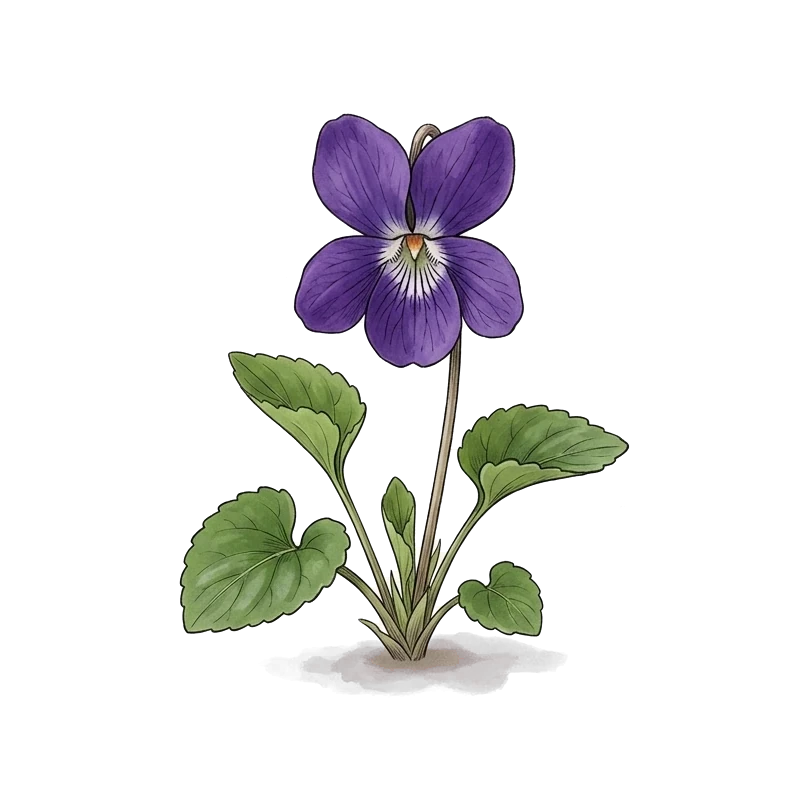
What does the violet flower mean?
The violet grows low to the ground with its flower bowed, which is how it came to stand for modesty, and it has long been an emblem of love and faithfulness as well. Over the centuries it also picked up everlasting love, innocence and remembrance, and most lists now add loyalty and dependability.
The Victorians kept the modest reading. Kate Greenaway’s 1884 Language of Flowers gives the sweet violet modesty and prints Robert Burns’s song “The Posie,” in which a lover gathering flowers for his sweetheart says “the violet’s for modesty which weel she fa’s to wear.”
Violet symbolism has a sadder side too. The flowers come early and don’t last, and Shakespeare used them for exactly that: in Hamlet, Laertes warns his sister that Hamlet’s love is “a violet in the youth of primy nature, / Forward, not permanent, sweet, not lasting.”
Violet meaning by color
Each color carries its own shade of meaning on today’s lists, and Greenaway named two of them.
| Color | Meaning today | Victorian (1884) |
|---|---|---|
| Purple | Truth and loyalty | |
| Blue | Faithfulness and devotion 1884: Faithfulness | |
| White | Innocence and purity | |
| Yellow | High worth 1884: Rural happiness |
The colors are old. The Roman naturalist Pliny the Elder ranked the violet next after the rose and the lily and knew it in purple, yellow and white, though his translators’ notes suggest his yellow violet may have been a wallflower or a pansy. The purple one, he says, had its own Greek name, ion, and gave its name to violet-colored cloth.
What do violets symbolize across cultures?
Violet-crowned Athens
The Greeks tied the violet to Athens itself. In Aristophanes’ comedy Acharnians, the chorus jokes that envoys from other cities had only to call the Athenians “the people crowned with violets” for them to sit bolt upright at the word “violets.”
Sappho and love between women
The poet Sappho of Lesbos often wrote of garlands of violets in her poems of love for women, and the words “sapphic” and “lesbian” come from her name and her island. Most of her work is lost. One surviving fragment, about women wearing garlands, remembers “many crowns of violets, roses and crocuses.”
The meaning came back in the 1920s with Édouard Bourdet’s Broadway play The Captive, about two women in love, in which one sends the other a bouquet of violets. Soon the violet was being called “the Lesbian flower,” and the play’s supporters wore violets pinned to their lapels.
Shakespeare’s violets
Violets turn up in Shakespeare wherever love and loss meet. Twelfth Night opens with the lovesick Orsino comparing a piece of music to “the sweet sound / That breathes upon a bank of violets, / Stealing and giving odour.” In A Midsummer Night’s Dream, Oberon knows “a bank where the wild thyme blows, / Where oxlips and the nodding violet grows.”
The same play hides a violet’s cousin. Oberon’s love potion comes from “a little western flower, / Before milk-white, now purple with love’s wound, / And maidens call it love-in-idleness,” and love-in-idleness is a name for the wild pansy, Viola tricolor.
Hamlet gives the violet to grief. The mad Ophelia hands out flowers, a daisy among them, and says “I would give you some violets, but they wither’d all when my father died.” At her burial Laertes answers: “from her fair and unpolluted flesh / May violets spring.”
The violet in Christian tradition
The violet isn’t named in the King James Bible. Christian tradition made it a flower of the Virgin Mary’s humility, and told that violets bloomed at the Annunciation, when the angel Gabriel brought Mary his message. A legend has violets growing on Mount Calvary around the cross, bowing their heads when its shadow reached them.
Napoleon’s violets
In the spring of 1815 the violet came out into the open. Under the restored monarchy it had been a secret rallying sign of loyalty to the exiled emperor, and on March 21, 1815, the Gazette d’Anvers reported that Bonaparte’s supporters carried a sprig of violet to recognize one another, with “princesse” as their rallying word. Loyal soldiers had long called him “la Violette,” and they expected him back from Elba in the spring.
Royalists answered with the lily, the old flower of the French kings, and one of their writers sneered that the violet loses its scent once its leaves are gone. Jean-Dominique-Étienne Canu’s print Violettes du 20 mars 1815 hides the profiles of Napoleon, Marie-Louise and the King of Rome in the outline of a bunch of violets.
Toulouse and the Gardner’s Parma violets
Toulouse, in southern France, has a violet of its own. It is a double one with 30 to 50 petals, grown under glass from cuttings, and the city celebrates it on the first weekend of February on the Place du Capitole. The story that an officer of Napoleon III brought the first one home from Parma for his fiancée is, in the words of the city’s tourist office, an urban myth.
In Boston, the violet was Isabella Stewart Gardner’s favorite flower. She and her husband grew Russian and Parma violets in their greenhouses at Green Hill, in Brookline.
A state flower chosen by schoolchildren
Illinois children picked the violet over the wild rose in a 1907 school vote, 16,583 to 12,628, and a law the next year made the blue violet the state flower. Rhode Island’s schoolchildren had chosen it back in 1897, though the state took until March 11, 1968, to adopt it. New Jersey followed with a law of 1971, and Wisconsin has the wood violet.
Types of violets
Violets, violas and pansies all belong to one genus, Viola, in the violet family, the Violaceae. The sweet violet is the scented one: a 2024 study found it intensely fragrant next to the other violet species tested, giving off the most scent between 6 a.m. and 7 p.m.
-
Sweet violet
Viola odorata
The scented violet of old London nosegays and of perfume, native to Europe and western Asia, spreading by runners
-
Parma violet
Viola alba subsp. dehnhardtii
Double, scented cultivars such as ‘Duchesse de Parme’. A 2007 study traced their origin to Viola alba
-
Common blue violet
Viola sororia
The dooryard violet of lawns and woods in eastern and central North America, also called wood violet and sister violet: sororia is Latin for “sisters”
-
Bird’s-foot violet
Viola pedata
An eastern North American native whose deeply lobed leaves look like a bird’s foot. It needs well-drained, sandy or gravelly soil
-
Canada violet
Viola canadensis
An eastern North American wildflower with white flowers, yellow at the base and tinged purple, that self-seeds freely
-
Downy yellow violet
Viola pubescens
A yellow woodland violet of northeastern North America, with brownish-purple veins on its lowest petal
-
Horned violet
Viola cornuta
A Pyrenees native grown as a bedding plant, with blue, violet or lavender flowers, sometimes two-toned. Its name, “horned,” may refer to its spur
-
Wild pansy
Viola tricolor
Heartsease or Johnny jump-up, with small violet, white and gold flowers. It is the parent of the modern pansy hybrids
The Parma violets are the puzzle of the group. NC State lists ‘Duchesse de Parme’ among the sweet violet’s cultivars, but a 2007 study placed their origin within Viola alba, in a cross between eastern and western Mediterranean plants, and historical sources suggest Turkey and Italy for the two parents.
African violet vs violet
The African violet isn’t a violet at all. The houseplant, Streptocarpus ionanthus (formerly Saintpaulia ionantha), is native to eastern and southwestern Tanzania and belongs to the gloxinia family, the Gesneriaceae. Its species name only means “having the flower of a violet.”
Two wildflowers borrowed the name too. The dog-tooth violet is a trout lily, Erythronium, in the lily family, and dame’s violet is Hesperis matronalis, in the mustard family. Greenaway lists a “dame violet,” for watchfulness, apart from her true violets.
Violets, violas and pansies
The garden pansy, Viola × wittrockiana, is grown as an annual: plant it in fall for flowers through winter and early spring. It has a meaning of its own in Greenaway, “thoughts,” the same one Ophelia gives it in Hamlet: “there is pansies, that’s for thoughts.” The wild pansy has also come to symbolize queerness.
How to grow violets
Growing violet
Facts for sweet violet (Viola odorata)
- Type
- Perennial
- Blooms
- Spring
- Sun
- Part shade to dappled shade
- USDA zones
- 4–9
- Native to
- Europe
Sweet violets spread by runners, and in the wrong spot they can turn weedy. Trim the runners and weak growth in late fall for a neater show in spring, and start new plants by division or from seed. Each seed carries an oily white appendage that ants feed on, and the leaves feed the caterpillars of fritillary butterflies.
The common blue violet is even less fussy. It grows in anything from full sun to deep shade, and it self-seeds so freely that it can turn weedy in fertile, moist ground. Most of its seed comes from a second set of small flowers near the ground that never open.
Are violets poisonous to cats and dogs?
Violet
- Pets
- Not in the ASPCA’s plant list The ASPCA’s “African violet” entry is Saintpaulia, a different plant.
- People
- Not listed as poisonous
In the US, if a pet may have eaten part of a plant, call your vet or the ASPCA Animal Poison Control Center at (888) 426-4435. If a person has, call Poison Control at 1-800-222-1222.
The sweet violet, the common blue violet and the garden pansy are all missing from the ASPCA’s plant list, under their common names and their botanical ones.
A violet bouquet
A violet bouquet is a posy, small enough to hold in one hand, and floral dictionaries once let those in the know trade secret messages in such “talking bouquets,” called nosegays. Isabella Stewart Gardner began the custom of setting fresh flowers, often violets, in a Norwegian silver cup before her favorite painting, in the Titian Room.
Shelley’s “The Sensitive Plant,” which Greenaway prints, has them come up in the garden right after another flower: “The snowdrop, and then the violet.”
-
Sweet violets for the scent
The sweet violet is the fragrant one, so build the posy from it, bunch the flowers tight and ring them with their own heart-shaped leaves.
-
A cup, not a vase
Do as Gardner did and give a small bunch a silver cup, a tumbler or a teacup, where it fills the rim instead of getting lost.
-
Doubles for a fuller bunch
Double violets like the one Toulouse celebrates each February pack so many petals into a flower that a few stems look generous.
-
Snowdrops, then violets
A ring of white snowdrops around the purple keeps Shelley’s order of the garden and gives a late-winter posy some light.
A violet tattoo
A violet has a face: five petals, two upper and three lower, and the lowest is often streaked or veined in a darker color. The sweet violet’s leaves are heart-shaped and grow in a rosette.
-
The face and its dark lines
Draw the flower straight on and keep the streaks on the lowest petal. They are what make it read as a violet and not just any five-petaled bloom.
-
A heart without drawing one
Set one or two of the heart-shaped leaves under the flower. They name the plant and carry a heart quietly.
-
Napoleon’s sprig
In 1815 a sprig of violet was how Bonaparte’s supporters knew one another, so a lone stem can stand for a loyalty you keep to yourself.
-
A gift between women
From Sappho’s garlands to the bouquet in The Captive, violets have passed between women in love. A small tied bunch tells that story.