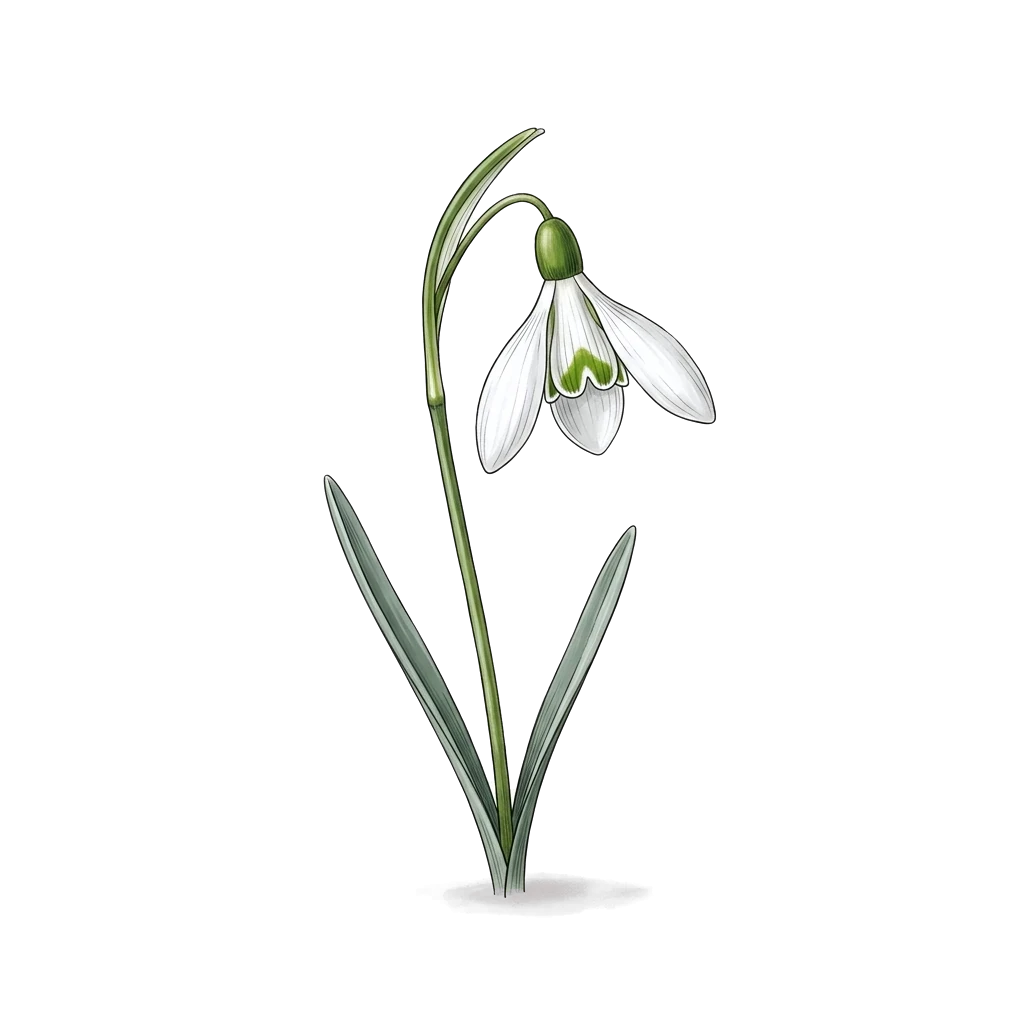
What is a snowdrop flower?
A snowdrop is a small bulb of the amaryllis family, and one of the earliest flowers of the year. Each stem holds a single nodding white flower over two or three strap-like leaves, on a plant 4 to 10 inches tall.
The flower has no true petals. It has six tepals: three long, pure white outer ones, and three short inner ones, notched at the tip and marked with green. That mark changes from one snowdrop to the next, from a small inverted V on the common snowdrop, Galanthus nivalis, to a heart on ‘Atkinsii’ and something like a cloven hoof on Galanthus woronowii.
The genus, Galanthus, has about 20 wild species, from the woods and damp mountain grasslands of southern Europe and Asia Minor. For all its famous snowdrop woods, Britain isn’t part of that range. Snowdrops were possibly grown in British gardens by the 1500s, but weren’t recorded in the wild there until the late 1700s.
In the US the common snowdrop has escaped from gardens too, and grows wild in North Carolina, Virginia and several other states.
Snowdrop vs snowflake, and lily of the valley
Snowflakes (Leucojum) are the usual mix-up. Their six tepals are all the same length, each with a green or yellow-green spot near the tip, and one stem often carries two or three flowers. They also flower later and grow bigger, up to 2 feet tall.
Lily of the valley hangs white bells too, but each stalk carries 6 to 16 small fused bells in late spring. A snowdrop’s one bell, split into its long and short tepals, is in flower months earlier.
Snowdrop flower meaning
The snowdrop opens before winter is over, and it has long been read as an early sign that winter is ending: that timing is why it stands for hope. Kate Greenaway’s 1884 Language of Flowers gives it that single word, and hope is still what it means today.
Its other meanings pull two ways. The Old Farmer’s Almanac gives it both sympathy and celebration, sent with optimism in good times and with compassion after a death or a misfortune, and its white has made it a flower of innocence as well.
Snowdrop meaning by color
- White
- Green tips
Snowdrops are white, though rarely only white: besides the green on the inner tepals, ‘Viridi-apice’ carries green blotches on its outer tepals too. The yellow snowdrops of the Sandersii Group swap that green for yellow, and in Greenaway the markings change nothing.
Snowdrop symbolism: Candlemas, poems and collectors
Candlemas bells, one of the snowdrop’s old English names, ties the flower to the Christian feast of Candlemas on February 2. The link is a long one, and by tradition snowdrops were often used to decorate churches for the feast.
Not everyone is convinced about the churches. Writing for the Metropolitan Museum of Art’s Cloisters gardens, Deirdre Larkin noted that the custom of laying snowdrops on the altar at Candlemas, for the purity of the Virgin, is often mentioned but has never been found in a medieval source.
Poets took up the hope. William Wordsworth’s 1819 sonnet “To a Snow-Drop” greets a “Lone Flower, hemmed in with snows” and, near its close, hails the “venturous harbinger of Spring.”
Galanthophiles and the snowdrop craze
A galanthophile is a snowdrop collector, and the hobby began with a handful of Victorians in Britain who collected and shared snowdrops. The people in its histories include James Atkins, E. A. Bowles and Henry John Elwes, after whom the giant snowdrop is named. British soldiers are said to have brought bulbs home from the Crimean War in the 1850s, and the craze is thought to have started with them.
Those few wild species have since given rise to more than 2,000 named cultivars. New ones are slow to spread, because snowdrops multiply slowly: a clump takes a few years to settle in, and seedlings take about four years to flower.
Growers speed that up by twin-scaling or chipping, cutting a bulb into pieces that each grow a new bulblet.
Types of snowdrops
The leaves are often the quickest clue to a species: narrow and grey-green on the common snowdrop, broad with folded edges on the pleated snowdrop, glossy and bright green on G. woronowii.
-
Common snowdrop
Galanthus nivalis
The snowdrop of woods and gardens in February, up to 6 inches (15 cm) tall
-
Giant snowdrop
Galanthus elwesii
Bigger flowers and leaves than the common snowdrop, up to a foot tall. Named for the English botanist Henry John Elwes
-
Pleated snowdrop
Galanthus plicatus
Also called the Crimean snowdrop. Rounded flowers with broad, heavily textured outer tepals, and a parent of 'Diggory' and 'Three Ships'
-
Galanthus woronowii
Flowers from January to March, up to 8 inches (20 cm) tall
-
Queen Olga’s snowdrop
Galanthus reginae-olgae
Flowers in fall, usually in October, when its leaves are missing or still very short
-
Double snowdrop
Galanthus nivalis f. pleniflorus 'Flore Pleno'
Double flowers, packed with extra green-tipped inner tepals inside the outer ones. Known since at least 1703
-
Yellow snowdrops
Galanthus nivalis Sandersii Group
Yellow instead of green on the ovary and the marks of the inner tepals. Selected from a population of yellow snowdrops in Northumberland
For a warmer garden, the giant snowdrop is the better pick, since it copes with hot weather better than the common snowdrop. Even so, it may be short-lived south of USDA zone 7.
Wild snowdrops and the bulb trade
Every snowdrop species is listed in Appendix II of CITES, the treaty that governs international trade in wild plants and animals. That isn’t a ban or a list of endangered species. It covers species that could become threatened without trade controls, and they cross borders only with the right permits.
Bulbs are still dug from the wild. In Turkey the giant snowdrop is the most important wild-collected bulb the country exports, and the government has controlled its collection and trade since the late 1980s. Wild-collected G. woronowii bulbs have been sold too, so the RHS advises checking that what you buy comes from cultivated stock.
How to grow snowdrops in the green
Growing snowdrop
- Type
- Bulb
- Blooms
- Winter to spring
- Sun
- Full sun to part shade
- USDA zones
- 3–9
- Native to
- Europe and southwestern Asia
Snowdrops move best while they still have leaves. The best start is freshly lifted clumps, planted as the leaves die back in late spring, and the next best is plants bought “in the green,” just after flowering. Dry bulbs are the harder start: they dry out easily, so buy them as soon as they’re on sale and plant them at once.
They want moist, well-drained soil with leafmould or compost. Advice on summer differs: the RHS says the soil shouldn’t dry out, while UW–Madison Extension suggests letting it dry when possible. In a lawn, hold off mowing for about six weeks after flowering so the leaves can finish.
Left alone, snowdrops spread by themselves, as the bulbs divide into clumps. Ants help too, carrying off the oil-rich seeds.
Are snowdrops poisonous to cats and dogs?
Snowdrop
- Pets
- Not in the ASPCA’s plant list
- People
- Listed as poisonous (low severity) Nausea and stomach upset if eaten in quantity.
In the US, if a pet may have eaten part of a plant, call your vet or the ASPCA Animal Poison Control Center at (888) 426-4435. If a person has, call Poison Control at 1-800-222-1222.
Snowdrop bouquet pairings
At a few inches tall, snowdrops are flowers for a posy, not a bouquet, and a few stems go a long way in something small. For cutting, the RHS picks out the large-flowered ‘S. Arnott’.
To give snowdrops in a pot, plant four bulbs an inch deep in a 4-inch pot in the fall and keep it cold for 10 to 12 weeks. Bring it into a cool, bright room once buds show.
-
A posy for one hand
A small bunch tied with a few of its own leaves suits a flower this modest. Keep it tight so the bells hang together.
-
Egg cups and bud vases
Stems too short for a vase stand up well in an egg cup or a shot glass. Line a few along a windowsill or set one by each plate at a birthday breakfast.
-
A pot that goes on growing
A forced pot in flower makes a gift that carries on after the day: once the bells fade, it can go out into the garden in the green.
-
With carnations for January
A ring of small white or pale pink carnations around a center of snowdrops brings the month’s two flowers together and gives the posy a little height.
The violet and the primrose belong to February, so adding them to carnations and snowdrops makes a posy for a birthday at the turn of the two months.
Snowdrop tattoo ideas
A snowdrop tattoo can be very small and still read clearly, because the flower is so simple: one bell hanging from the top of a thin stalk, with a few narrow leaves at the base.
-
Let the bell hang
The nod is what makes it a snowdrop at a glance. Draw the flower facing down from the tip of its stalk; one bell is enough.
-
The green mark inside
Show the three short inner tepals between the long outer ones, with their green mark: a small V, or the heart of ‘Atkinsii’. It is the one touch of color the design needs, and what keeps it from being read as a snowflake.
-
Coming up through snow
A bell rising out of a drift, or leaf tips just breaking the ground, tells the late-winter story behind the flower’s hope. Leave the snow as bare skin, outlined with a few soft lines.