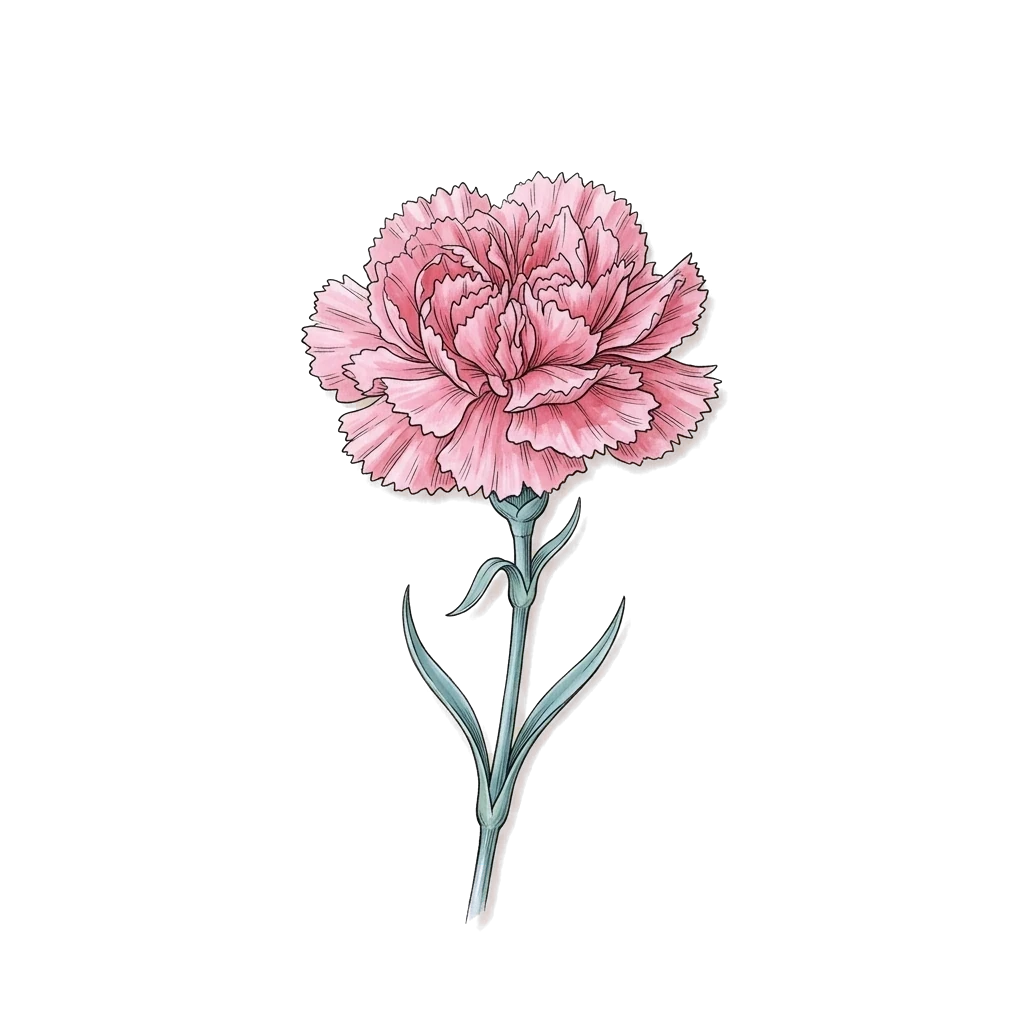
What do carnations symbolize?
Carnations are flowers of love and remembrance, and the color of each bloom narrows the message.
The name itself is about color. “Carnation” comes from an obsolete French word for flesh-colored, and before that from the Latin caro, flesh. The genus name, Dianthus, probably goes back to the Greek diosanthos, a word for the carnation built from Dios, “of Zeus,” and anthos, “flower.”
Kate Greenaway’s 1884 Language of Flowers lists the carnation twice: by color, and again among the pinks, its smaller cousins, where “Pink, Carnation” means woman’s love. The pinks get their own messages: pure love for a single pink, pure and ardent love for a double red one and talent for a white one.
Carnation colors and what each one means
| Color | Meaning today | Victorian (1884) |
|---|---|---|
| Light red | Admiration | |
| Dark red | Deep love 1884: Alas! for my poor heart | |
| Pink | Affection, a mother's love | |
| White | Innocence, pure love, remembrance | |
| Purple | Capriciousness | |
| Yellow | Disappointment, rejection 1884: Disdain |
Two-tone flowers carry a message of their own: a striped carnation says regret now, while Greenaway gave refusal to both the striped carnation and the variegated pink.
Some colors are new. The violet-purple carnations of the Moon series are genetically modified: their shades come from the blue genes of a common garden petunia, and the Australian company Florigene brought out the first of them in the mid-1990s.
Carnation symbolism around the world
From one country to the next, the carnation has been a promise of marriage, a president’s lucky lapel flower and the emblem of a revolution.
Red carnation meaning in Renaissance art
Carnations, especially red ones, were symbols of betrothal in European art, probably from a Flemish wedding custom. In 15th- and 16th-century portraits, a carnation held in the sitter’s hand carried that meaning, and the Victoria and Albert Museum has a 16th-century Italian portrait of a young man holding a red carnation over his heart.
In religious painting the same flower meant something larger. In Raphael’s Madonna of the Pinks, painted around 1506 to 1507 and now in London’s National Gallery, Mary and the infant Christ exchange carnations, which stood for divine love and for Christ’s Passion.
Carnations in Shakespeare
In The Winter’s Tale, Perdita calls “our carnations and streaked gillyvors” the fairest flowers of the waning year, then says she won’t plant them, because some call them “nature’s bastards.” She has heard that their streaks come partly from the gardener’s art. Polixenes argues back that grafting is nature’s own work, “The art itself is nature,” and tells her to make her garden rich in them.
White carnation meaning and Mother’s Day
Anna Jarvis, who founded Mother’s Day, began wearing a white carnation, her mother’s favorite flower, after her mother died in 1905. She gave 500 of them to honor the mothers of the Andrews congregation in Grafton, West Virginia, and the first Mother’s Day observance was held in that church on May 10, 1908. In her words, the flower’s whiteness stood for purity and its lasting qualities for faithfulness, “all a true mother’s attributes.”
Mother’s Day made the carnation famous: after Jarvis died in 1948, a Grafton newspaper wrote that before Mother’s Day the carnation had never been “exalted as the rival of the rose or the lily.” Jarvis came to resent the trade that followed: she denounced florists for gouging the public, and when carnation prices went up she made a celluloid button the day’s emblem instead.
Ohio’s scarlet carnation
Ohio adopted the scarlet carnation as its state flower in 1904, and its law still gives the reason: “as a token of love and reverence for the memory of William McKinley.” The story starts in Alliance, Ohio, where in 1866 Levi Lamborn, a doctor and amateur horticulturist, raised scarlet carnations from French seedlings.
Lamborn ran against McKinley for Congress in 1876 and gave his rival one of his carnations before each debate. McKinley did well in those debates, kept the flower as a good-luck charm and, as president, wore one in his lapel.
Portugal’s Carnation Revolution
The revolution of April 25, 1974, owes its flower to a restaurant in Lisbon. Its owner had bought carnations to give customers on its first anniversary, then closed for the day because of the troops in the streets. One of the staff, Celeste Caeiro, took her bunch of carnations into the city, and when a soldier asked her for a cigarette, she gave him a carnation instead and he put it in the barrel of his gun.
She went on handing them out to the soldiers, and the carnation became the symbol of the day. She died in 2024, at 91.
Parents’ Day in South Korea
In South Korea, carnations are worn for Parents’ Day, May 8. Older people wear them at events held for the day, and at a Parents’ Day ceremony in 2024 the president pinned one on a senior citizen.
Types of carnations
Gardeners sort carnations into groups by where they grow best, and florists by how many flowers a stem carries.
-
Border carnation
Hardy garden carnations, mostly with fully double blooms up to about 3 inches (8 cm) across, flowering in midsummer in a sunny, open spot
-
Perpetual-flowering carnation
Tender and taller, with larger blooms. In a greenhouse with good light and above 50°F (10°C) they can flower all year
-
Malmaison carnation
Highly fragrant, peony-like flowers in pink, red or white, for a short spell in summer. Grown under glass, without winter heat
-
Standard carnation
The florist's single large bloom on a stem, grown by removing all but one bud and sold in bud
-
Spray carnation
Left alone, a carnation stem carries a spray of around six smaller flowers. Florists also call sprays miniature carnations
-
Pinks
The carnation’s smaller relatives: much shorter, self-supporting and mostly hardy, from ground-hugging alpines to garden and bedding pinks
The florists’ kinds owe their success to stamina: the carnation is one of the top-selling cut flowers, largely because it can be stored for a long time in tight bud and still last well. If scent matters to you, check the label: Malmaisons are richly scented, but not every perpetual-flowering carnation is.
How to grow carnations
Growing carnation
- Type
- Perennial, often grown as an annual
- Blooms
- Summer
- Sun
- Full sun to part shade
- USDA zones
- 6–9
- Native to
- The Mediterranean
Give border carnations sun and an open spot, since they flower poorly in shade and dislike very wet or very dry soil. Most dianthus prefer neutral to alkaline soil, and carnations need support for their large flower heads on tall, narrow stems: the traditional way is wire rings held up on thin canes.
For fewer, bigger flowers, gently pinch off all but one bud on each stem. Cut faded flowers back to the next bud or side shoot, and make new border carnations by layering the stems after flowering. Pinching out the center of a young plant makes it bushier, and rust and crown rot are the problems to watch for.
Are carnations poisonous to cats and dogs?
Carnation
- Pets
- Toxic to dogs, cats and horses
- People
- Listed as poisonous (low severity) Mild stomach upset and skin irritation.
In the US, if a pet may have eaten part of a plant, call your vet or the ASPCA Animal Poison Control Center at (888) 426-4435. If a person has, call Poison Control at 1-800-222-1222.
The ASPCA lists the signs as mild stomach upset and mild skin irritation, caused by an irritant it hasn’t identified.
Carnation bouquet pairings
Carnations hold up well in a mixed bouquet, as long as they stay away from the fruit bowl: ripening fruit gives off ethylene, and ethylene makes carnations wilt before their time. In January, tuck a few snowdrops among white carnations; in summer, sweet peas and roses are the easy partners.
-
Pink and white for a mother
Pink for a mother’s love, with a few white stems if the bouquet also remembers someone who has died.
-
Dark red, and no yellow, for love
Dark red says deep love, and a few stems fill out a bunch of roses without changing its message. Leave out yellow, which reads as disappointment.
-
Spray stems in the gaps
Spray carnations, with their clusters of small heads, fill the spaces between bigger blooms better than extra foliage.
-
A scented jar from the garden
If you grow a scented kind such as a Malmaison, cut a few in summer for a jar with sweet peas, and keep it out of the sun.
Carnation tattoo ideas
The carnation’s signature is the edge of its petals, fringed and ruffled, on a stiff flower stalk, with narrow, strap-like leaves in opposite pairs. Get those right and even a small carnation tattoo reads clearly.
-
Let the edge do the work
Draw the bloom side-on, as a cup of short zigzag cuts over a slim calyx. That cut edge is what tells a carnation from a rose at a glance, even in a single line.
-
Pink or white, for a mother
Pink for a mother’s love, white for one who is remembered. Her name can run along the stem instead of a banner.
-
The revolution flower
Portugal’s revolution gave the carnation its boldest image. A stem and a few fringed petals in a gun barrel tell the whole story.
-
Held over the heart
For a partner, borrow the Renaissance portrait: one red carnation held in a hand, the old sign of betrothal.