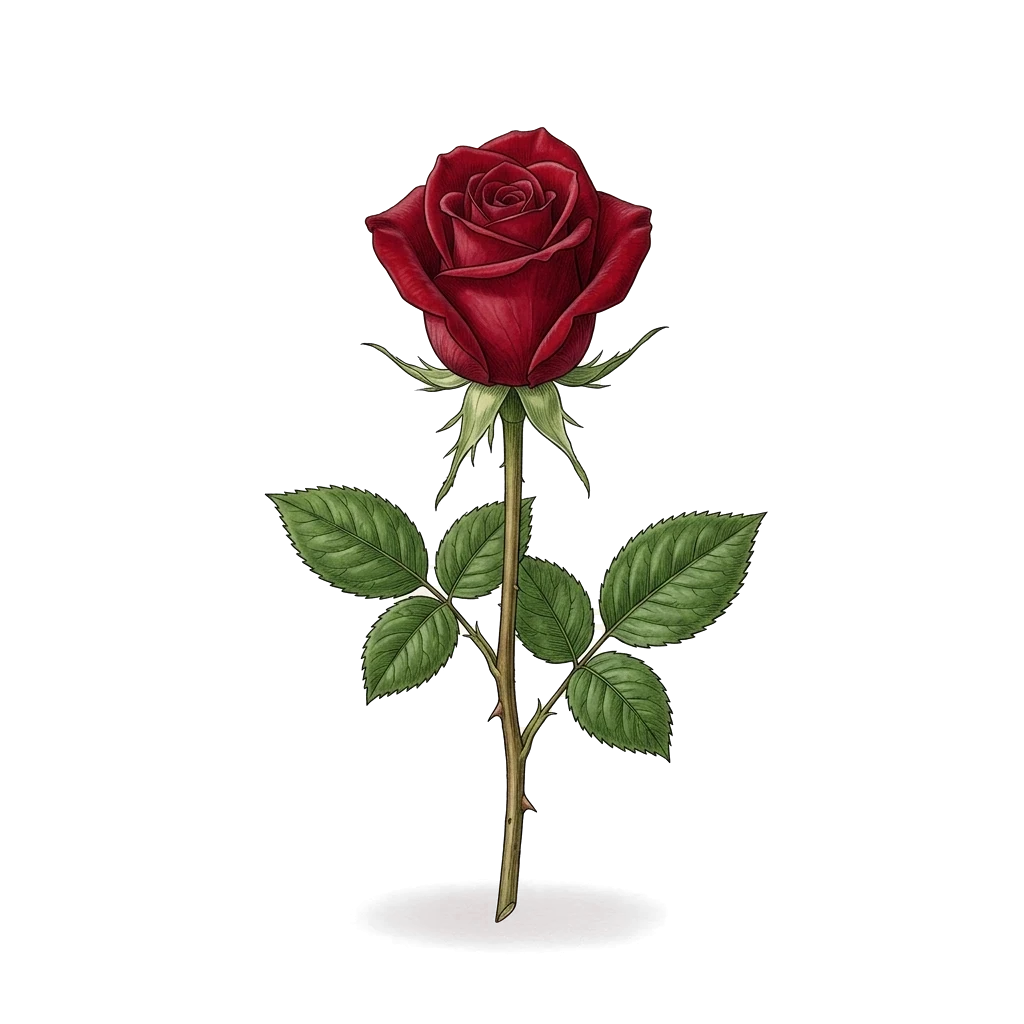
What do roses symbolize?
A rose says love, and a red one desire as well. Its color shifts the message, and so can the way it’s given: a single stem, a bouquet in full bloom or a bud each carry a meaning of their own.
The word came into Old English straight from the Latin rosa, which is still the genus name.
Kate Greenaway’s Language of Flowers (1884) gives the plain rose one word, love, and follows it with 33 more rose entries in a row, from the Austrian rose’s “thou art all that is lovely” to the moss rosebud’s “confession of love.” Not all of them are roses, as we’ll see.
Rose color meanings, from red to lavender
| Color | Meaning today | Victorian (1884) |
|---|---|---|
| Red | Love and romance 1884: Pure and lovely (red bud) | |
| Deep red | Mourning 1884: Bashful shame | |
| Pink | Happiness and admiration | |
| White | Innocence and purity 1884: I am worthy of you | |
| Yellow | Cheer and happiness 1884: Decrease of love, jealousy | |
| Lavender | Love at first sight | |
| Orange | Desire and excitement | |
| Coral | Friendship, modesty, sympathy |
Most of these color meanings are newer than they look. Greenaway’s colors are few: deep red, white, yellow, red and white together, and red and white rosebuds; pink, orange, coral and lavender have no entry at all.
Today’s lists don’t always agree either. One extension guide gives a purple rose enchantment, while a Utah State horticulturist and the Almanac give lavender love at first sight. The same guide gives a peach rose modesty, a word the Almanac gives coral. Some lines come straight from the Victorians: a burgundy rose means “unconscious beauty” in one modern list, which is Greenaway’s meaning for the Burgundy rose, filed among named kinds such as the Damask, the Musk and the China rose.
Red rose meaning
A red rose says “I love you.” Greenaway’s book prints Robert Burns’s song “A Red, Red Rose,” which opens “O, my luve’s like a red, red rose, / That’s newly sprung in June.”
The darkest reds go by names like Black Baccara, a hybrid tea whose velvety blooms the RHS describes as “unusually very dark, burgundy-red.”
White rose meaning
Greenaway’s white roses follow a whole life. A white rosebud stands for girlhood, a white rose says “I am worthy of you,” a withered one means “transient impressions,” and a dried one “death preferable to loss of innocence.”
One modern list gives white roses secrecy as well as purity, which ties them to the old phrase sub rosa, below.
Yellow rose meaning
Yellow has changed the most. Greenaway read it as “decrease of love” and jealousy, but in 2005 a Utah State University Extension horticulturist said yellow means friendship, and the Almanac now calls it friendship “in modern flower symbolism.” Its June list goes further, to cheer and happiness, and keeps the jealousy as folklore.
Why there are no blue roses
No color on the chart is blue, and that’s chemistry, not taste. Roses lack the enzyme that makes delphinidin, the pigment behind most violet and blue flowers, so crossing roses has never produced a blue one.
Researchers at Suntory got there by adding a gene from a pansy. Their genetically modified rose was developed in 2004 and went on sale in Japan as Applause on November 3, 2009.
Rose symbolism in history and legend
Roses have kept secrets, named a civil war and become a national emblem, and some of the best-known “roses” aren’t roses at all.
Sub rosa: why the rose keeps secrets
To say something sub rosa is to say it in confidence. The Latin means “under the rose,” from the practice of hanging a rose over a meeting as a symbol of confidentiality. Greenaway has a bouquet version: a full-blown rose placed over two buds means “secrecy.”
The Wars of the Roses
Shakespeare gave the roses their famous scene. In Henry VI, Part 1, Richard Plantagenet plucks a white rose in the Temple Garden and Somerset a red one, and Warwick prophesies that the quarrel “Shall send, between the red rose and the white, / A thousand souls to death and deadly night.”
The emblems are older than the play. Red and white roses appear now and then as insignia of the families later tied to Lancaster and York from at least the early 14th century, but it was Shakespeare’s scene that put them in the popular imagination.
Henry VII’s reign brought the two together. For his entry into York in 1486, a pageant at Micklegate Bar was planned to show “a royal, rich, red rose” and “another rich, white rose, unto whom all the flowers shall bow.” Together they became the red and white Tudor rose, England’s national emblem.
The national floral emblem of the United States
American law settles it in one sentence: “The flower commonly known as the rose is the national floral emblem.” Congress designated the rose by joint resolution, and President Ronald Reagan proclaimed it on November 20, 1986.
His proclamation calls roses symbols of life and love, devotion, beauty and eternity. It notes that Americans give them to those they love and bring them to altars, civil shrines and final resting places.
Roses that aren’t roses
The best-known false rose may be the Bible’s. “I am the rose of Sharon, and the lily of the valleys,” runs Song of Solomon 2:1 in the King James Version, but the Hebrew word behind “rose,” ḥăbaṣṣelet, names a beautiful flower of Canaan, possibly a sea daffodil or a bulb such as a crocus, narcissus or tulip.
In American gardens, the rose of Sharon is something else again: Hibiscus syriacus, a large shrub of the mallow family from south China and Taiwan.
Greenaway’s list has two more impostors. Her Christmas rose, listed both as “relieve my anxiety” and as “tranquillize my anxiety,” is a hellebore of the buttercup family, and her guelder rose, “winter, age,” is a viburnum named after Gelderland in the Netherlands.
Types of roses
Rose growers sort roses into three big groups, species roses, old garden roses and modern roses, and 1867 is the line between the last two. That year the French breeder Guillot brought out ‘La France’, the hybrid tea that opened the modern era.
-
Species roses
The wild roses, listed by their Latin names. Most have single flowers of four to eight petals and bloom once a season
-
Old garden roses
Roses of the classes that existed before 1867, among them the Damask, China, Bourbon, Moss, Noisette and Tea roses. Damasks are known for their heavy scent
-
Hybrid tea
Large, shapely double flowers of 30 to 50 petals on long stems, alone or in small clusters. The first, ‘La France’, came out in 1867
-
Floribunda
Double flowers in large clusters, usually cup-shaped, that keep coming more steadily than a hybrid tea’s. Generally hardier and easier to look after
-
Grandiflora
Hybrid tea flowers in clusters, on a plant that can reach 6 to 8 feet or more. The first was ‘Queen Elizabeth’
-
Miniature and patio roses
Small bush roses, typically 15 to 30 inches tall, with flowers like small hybrid teas or floribundas. The best roses for pots
-
Climbers and ramblers
Long canes to train up walls, fences and arches. Climbers tend to flower again through the season, ramblers only once, usually in June
-
Shrub and English roses
Vigorous modern roses, often sprawling, with many clusters of flowers. English roses look like old garden roses but repeat-flower and are often fragrant
Scent varies as much as shape. NC State sorts rose fragrance into five groups, old rose, fruity, tea, myrrh and musk, and for fragrance the RHS suggests the shrub rose ‘Gertrude Jekyll’.
How to grow roses
Growing rose
- Type
- Woody shrub or climber
- Blooms
- Summer
- Sun
- Full sun
- USDA zones
- 5–11
- Native to
- The temperate and subtropical Northern Hemisphere
Sun comes first. NC State asks for six hours or more of direct sun a day, the RHS for at least four, in rich, moist but well-drained soil.
Plant bare-root roses while they’re dormant, in late fall or from late winter to early spring; container roses can go in at any time of year, as long as the ground isn’t frozen, waterlogged or parched. If a new rose is taking an old one’s place, take extra steps against rose replant disease.
Most roses need pruning once a year, in late winter. Snip off fading flowers about once a week, then stop in mid to late summer, so the plant can harden off before winter and the roses that make decorative hips can form them. Watch for aphids, black spot and powdery mildew.
Are roses poisonous to cats and dogs?
Rose
- Pets
- Non-toxic to dogs, cats and horses
- People
- Not listed as poisonous
In the US, if a pet may have eaten part of a plant, call your vet or the ASPCA Animal Poison Control Center at (888) 426-4435. If a person has, call Poison Control at 1-800-222-1222.
The ASPCA’s entry covers all Rosa species, for dogs, cats and horses alike.
Rose bouquet ideas
How a rose is arranged can say as much as its color. One extension list reads two roses as an engagement, a bouquet in full bloom as gratitude and a rosebud as young and beautiful. Greenaway gives the bridal rose “happy love” and a crown of roses “reward of virtue.”
For a June birthday, honeysuckle, the month’s other flower, is the rose’s natural partner, and a few carnations or sweet peas fill out a mixed bunch.
-
Two stems for a proposal
Two roses side by side are read as an engagement. Red says the rest, and a rosebud between them, read as young and beautiful, keeps it light.
-
Lavender for a new romance
Lavender says love at first sight, a lighter touch than a dozen reds for a second or third date.
-
Coral or yellow for a friend
Coral carries friendship and sympathy, and yellow now means friendship more than jealousy. Neither says romance.
-
Rosebuds for a young birthday
To the Victorians a red rosebud was “pure and lovely” and a white one meant girlhood, a gentle bunch for a teenager.
Rose tattoo ideas
Rose flowers are built on fives, and each leaf is a row of toothed leaflets. The stems carry prickles rather than true thorns, and after the flowers come the hips. A good rose tattoo keeps a detail or two of the real plant: a hip, a prickle, a leaf of toothed leaflets.
-
Prickles, drawn right
Botanically they’re prickles, and their size and number vary from rose to rose. A few on the stem look truer than a neat row of spikes.
-
The Tudor rose
A flat, heraldic rose in red and white, Lancaster and York in one flower. It suits a design about two families becoming one.
-
Under the rose
A rose above a name or a date, after sub rosa: something kept between two people.
-
A red, red rose
One open bloom with a line of the Burns song, “till a’ the seas gang dry,” running along the stem.