What is a hawthorn flower?
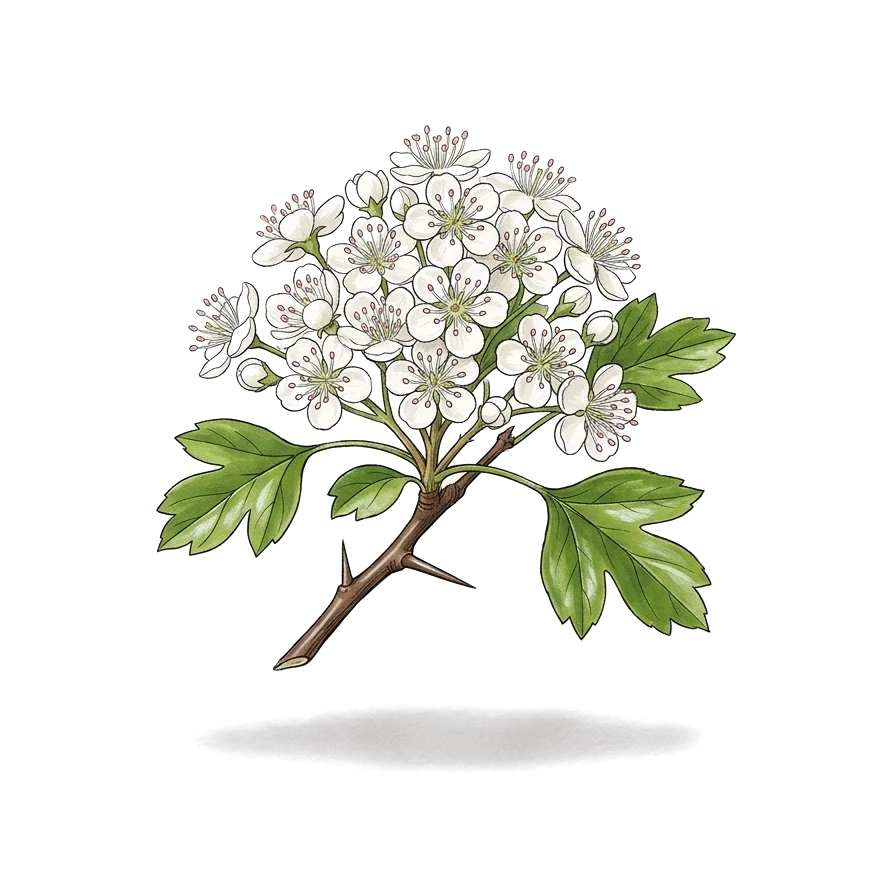
A hawthorn flower is the blossom of Crataegus, a genus of small thorny trees and shrubs in the rose family, related to apples. Each flower has five petals, and they open together in flat-topped clusters that look like small apple blossoms. In the middle sits a ring of stamens, 10 to 20 or more, whose anthers can be white, yellow, pink or purple.
In late spring the hawthorn tree flowers in a profusion of blossom, hard to miss in the pastures where it is common. Small fruits called haws follow in fall, usually red or orange-red, sometimes yellowish or greenish, and birds and small mammals eat them.
Nobody agrees on how many hawthorns there are. Trees and Shrubs Online cites about 140 species, Penn State Extension more than 380, and well over a thousand American thorns were given names as species, many later judged to be hybrids or varieties. Missouri alone has more than 75 kinds, counting species, subspecies and hybrids.
Hawthorn, may and the mayflower
The name explains itself once you know that haw also means hedge: a hawthorn is a thorny hedge. Britain gives the same tree a crowd of other names, among them may, May tree, whitethorn and quickthorn.
“May” is where the confusion starts. Mayflower is a common name for a different plant altogether, trailing arbutus, Epigaea repens, a creeping evergreen of the heath family with pink to white flowers in early spring. The mayapple, Podophyllum peltatum, is a woodland plant of the barberry family, named for its May flowering and its apple-like blossom.
Even “English hawthorn” can mean two things: the Missouri Botanical Garden uses it for Crataegus laevigata, which the RHS calls Midland hawthorn, while the hedgerow tree of Britain is Crataegus monogyna, the common hawthorn.
Hawthorn flower meaning
The hawthorn meaning has been hope for well over a century: Kate Greenaway’s Language of Flowers gave the hawthorn that one word in 1884. Flower guides today still put hope first, with love and protection beside it.
Poets used it more plainly, as the flower of country life. In Shakespeare’s Henry VI, Part 3, the king, watching a battle from a molehill, asks whether the hawthorn bush doesn’t give “a sweeter shade / To shepherds looking on their silly sheep” than a rich canopy gives to kings who fear treachery. In A Midsummer Night’s Dream, the workmen rehearsing their play in the wood take a green plot for their stage and “this hawthorn brake” for their tiring-house.
Robert Burns put it in a lover’s posy. Among the poems Greenaway’s book prints after its lists is his “O Luve Will Venture In,” where the hawthorn, “wi’ its locks o’ siller grey,” goes in with the primrose, the pink, the rose, the daisy, the violet and more, and the singer leaves the songbird’s nest in the bush alone.
Hawthorn blossom colors
- White
- Pink
- Red
Wild hawthorn blossom is white, occasionally pink. The deeper colors come from the garden: cultivars of Midland hawthorn flower pink, rose and red as well as white, some of them double. One old double white, ‘Plena’, grown since the late 1700s, turns pink as its flowers age.
Hawthorn symbolism and folklore
Much of hawthorn’s lore belongs to the turn from spring to summer, which its blossom was taken to mark.
May Day, the maypole and the Green Man
The Woodland Trust calls hawthorn an old pagan symbol of fertility with ancient links to May Day, and the ancestor of the maypole, and it appears in the wreath of the Green Man. May celebrations in Ireland and beyond had a tree of their own, usually a hawthorn, cut down and decorated with flowers, candles and ribbons, then paraded and sometimes burned.
The fairy thorn of Ireland
In Ireland hawthorn is best known as a fairy tree, and people were said to come to harm for damaging one, especially a hawthorn standing alone in a field. The respect is old: early Irish law ranked hawthorn among the “Commoners of the Wood,” and damaging one meant a fine of a milch cow, plus compensation.
It still counted in 1999. A bypass of Newmarket-on-Fergus and Ennis in County Clare would have meant destroying a fairy thorn at Latoon, and the storyteller Eddie Lenihan warned that destroying it could bring misfortune, even deaths, to people using the road. The county engineer found the road could be built around it, and the bush still stands beside the bypass.
The Glastonbury thorn
The Glastonbury thorn is a common hawthorn that flowers twice, once in spring and again in winter. By legend, Joseph of Arimathea thrust his staff into the ground on Wearyall Hill, and it burst into leaf and flower, although it was Christmas Day.
Every tree of it now has to be grafted onto a common hawthorn, since it won’t grow from seed or cuttings. Each December pupils from a local school cut a sprig of the Holy Thorn at St John’s Church in Glastonbury, and it goes to the monarch, a custom dated to the reign of Charles II.
The Missouri state flower, and the daisy it beat
Missouri took decades to choose. As the Missouri State Archives tells it, crabapple blossom won a newspaper poll for the 1893 Chicago World’s Fair, schoolchildren picked goldenrod, and two tries for the crabapple and a daisy campaign failed before an anonymous petition put forward the hawthorn, the “red haw,” in 1921.
The debate that year, in the Archives’ account, was a contest of flowers. Daisy supporters pinned daisies on the legislators who backed them, the hawthorn’s spokesman called the daisy an “alien flower,” and neither bill passed. In 1923 the hawthorn went through 130 to 0 in the House and 25 to 1 in the Senate, and Governor Arthur M. Hyde signed it on March 16.
The law names no single species. It makes the blossom of the tree “commonly called the ‘red haw’ or ‘wild haw’” Missouri’s floral emblem, for “the beauty of its flower, fruit and foliage.” The downy hawthorn, Crataegus mollis, is the one the state’s conservation department names.
Types of hawthorn
The hawthorns grown in American gardens include the European Midland hawthorn, mostly as its pink, red and double cultivars, and eastern natives such as the Washington, cockspur and green hawthorns. The two European species are easiest to tell apart by the flower: common hawthorn has a single style in the center, Midland hawthorn two or three.
-
Common hawthorn
Crataegus monogyna
Native to Britain and Ireland, where it is also called may. Fragrant, creamy-white flowers with pink anthers in late spring, and a single style in each flower
-
Midland hawthorn
Crataegus laevigata
Also called English hawthorn. Two or three styles in each flower, and many cultivars, some double, in pink, rose, red and white
-
'Paul's Scarlet'
Crataegus × media 'Paul's Scarlet'
Fully double, light red flowers in spring. It arose around 1858 as a sport on a double pink hawthorn
-
Glastonbury thorn
Crataegus monogyna 'Biflora'
A common hawthorn that flowers in winter as well as at the usual time in spring. It grows only from grafts, never from seed or cuttings
-
Washington hawthorn
Crataegus phaenopyrum
Native from Virginia to Missouri, Arkansas and Alabama. The last hawthorn to flower, with fragrant white blossom in June
-
Cockspur hawthorn
Crataegus crus-galli
Named for its thorns, 1½ to 3 inches long, said to look like a rooster’s spurs. Thornless forms are sold too
-
Green hawthorn 'Winter King'
Crataegus viridis 'Winter King'
A selection of a largely thornless southeastern native, and one of the most disease-resistant hawthorns, with silvery stems and purple and scarlet fall color
-
Downy hawthorn
Crataegus mollis
One of the largest hawthorns, 20 to 40 feet tall, with soft, hairy leaves. It illustrates the state flower in Missouri’s 1923–24 Official Manual
The two European species also hybridize, and their crosses can be hard to place.
How to grow a hawthorn tree or hedge
Growing hawthorn
Facts for English hawthorn (Crataegus laevigata)
- Type
- Small tree
- Blooms
- Spring
- Sun
- Full sun
- USDA zones
- 4–7
- Native to
- Europe and North Africa
Hawthorn is hardy and grows on a range of soils, in full sun or part shade, even in exposed spots and wet ground, though not where the soil stays waterlogged. As a tree it usually reaches 16 to 33 feet and needs little pruning beyond broken, crossing or diseased branches, best done in midwinter.
For a hedge, plant 18 inches to 2 feet apart, in a double row for a wider one, and trim it at least once a year. For a looser hedge, cut it only once a year or every other year: it often flowers and fruits better, and thicker growth gives nesting birds cover. Take particular care between March and August, when birds may be nesting.
In much of the US the trouble is rust. Cedar-hawthorn rust strikes where eastern red cedars grow nearby, and NC State advises against planting downy hawthorn near them. ‘Winter King’ is one of the most disease-resistant hawthorns, and Washington hawthorn shows good resistance to cedar-apple rust. English hawthorn struggles in hot, humid summers like St. Louis’s, where leaf spot and rust can disfigure it.
Is hawthorn poisonous to cats and dogs?
Hawthorn
- Pets
- Non-toxic to dogs, cats and horses
In the US, if a pet may have eaten part of a plant, call your vet or the ASPCA Animal Poison Control Center at (888) 426-4435. If a person has, call Poison Control at 1-800-222-1222.
Hawthorn bouquet pairings
Hawthorn makes a loose, country bouquet rather than a formal one, and Burns’s posy is as good a guide as any to what goes with it.
-
Burns’s posy
Hawthorn with primroses, pinks, roses and violets, the flowers his singer gathers for his love. Tie it with a ribbon, as he ties his with a silken band.
-
Both May flowers
A few short sprays of white hawthorn around a bunch of lily of the valley, its tiny bells hanging below the flat clusters. Two whites, one month.
-
Pink for a spring birthday
A branch of a pink or red garden hawthorn such as ‘Paul’s Scarlet’ in a tall jar, by itself. Its double flowers look more like little roses than may.
-
A hawthorn to plant
A young tree or a bundle of hedging whips keeps the old superstition outside and gives blossom every spring after. A winter-flowering Glastonbury thorn makes a gift with a story.
The month’s other flower, lily of the valley, has a page of its own, and so do most of the song’s flowers: the primrose, the rose, the daisy and the violet.
Hawthorn tattoo ideas
A hawthorn tattoo has two halves to play with: soft clusters of five-petaled flowers, and a hard branch armed with thorns that can run 1½ inches long. Finish the branch with a leaf or two, toothed and on many species lobed.
-
Blossom on the thorn
Draw the flowers and the spines on the same twig. Blossom out of something sharp is a fair picture of hope, the flower’s meaning, and the contrast carries well in black line.
-
Pink anthers
On the common hawthorn the stamens end in pink dots. Inked as tiny points of color in an otherwise white or bare-skin flower, they make it read as hawthorn and not as apple blossom.
-
The lone thorn
A single wind-bent hawthorn in an empty field, the fairy tree of Irish lore. It suits a round or square frame on the forearm or the back of the shoulder.
-
A winter sprig
A sprig of the Glastonbury thorn in flower with a little snow on the branch: a hawthorn that blooms in winter, for a design that isn’t only about spring.