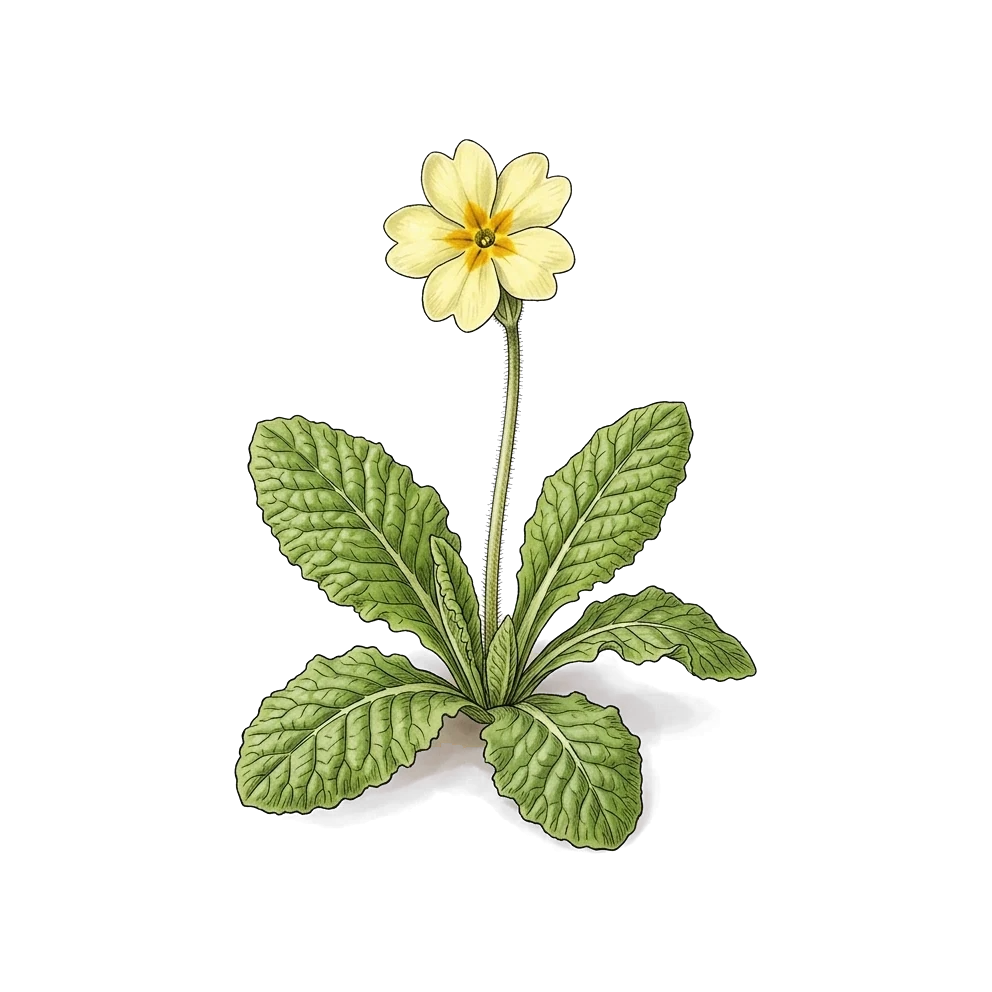
What does a primrose flower look like?
The common primrose grows low, from a rosette of crinkled, tongue-shaped leaves 6 to 8 inches long. From late winter into spring it opens small, fragrant flowers, pale yellow to cream and about an inch across. Across the genus the flower is a tube that opens into five lobes, bell-shaped in some species and flat in others.
The name has nothing to do with roses. “Primrose” came into English through Old French from the Medieval Latin prima rosa, “first rose,” and the plant belongs to a family of its own, the Primulaceae.
The word also covers the whole genus, Primula, and that genus is big: more than 450 species by one count, more than 500 by another.
Pin and thrum: the primrose’s two kinds of flower
Look into a handful of wild primroses and you’ll find two designs. A pin-eyed flower has a long style and short stamens, and a thrum-eyed flower has it the other way around. “Pin” and “thrum” were the florists’ words, while Charles Darwin, who studied them, called the two forms long-styled and short-styled.
In wild cowslips and primroses Darwin found the two forms in about equal numbers, and never both on one plant. His experiments, published in 1862, showed why it matters: in his cowslips, a cross between the two forms set more seed than a cross within one, and plants kept away from insects set little or none. He came back to the subject in his 1877 book The Different Forms of Flowers on Plants of the Same Species.
Primrose meaning and symbolism
The primrose is one of the first flowers of spring, and it stands for youth; Kate Greenaway’s 1884 Language of Flowers narrows that to “early youth.” The poets added the other half of primrose symbolism: how soon the flowers are gone.
Shakespeare did it in a few words. In The Winter’s Tale, Perdita speaks of “pale primroses, / That die unmarried ere they can behold / Bright Phoebus in his strength,” flowers that fade before the summer sun is at its height. In Cymbeline, Arviragus promises “the flower that’s like thy face, pale primrose” for the grave of a young friend he believes is dead.
Wordsworth made the flower a test of feeling. Of Peter Bell, a man nature had tried for years to reach, he wrote: “A primrose by a river’s brim / A yellow primrose was to him, / And it was nothing more.” He wrote the poem in 1798 and published it in 1819.
Primrose colors and what they mean
The wild flower is pale yellow, but garden primroses also come in white, pink, red and violet, nearly always with a yellow center. Of those colors, only the red gets a Victorian meaning of its own.
- Pale yellow
- Pink
- Purple
- Red
Cowslips, polyanthus and auriculas in the language of flowers
Greenaway gave the primrose’s relatives meanings of their own, and none of them is about youth.
| Flower | Victorian meaning (Greenaway, 1884) |
|---|---|
| Cowslip | Pensiveness. Winning grace |
| Polyanthus | Pride of riches |
| Crimson polyanthus | The heart’s mystery |
| Lilac polyanthus | Confidence |
| Auricula | Painting |
| Scarlet auricula | Avarice |
The primrose path, Disraeli and the Primrose League
A “primrose path” is an easy life of pleasure, or a course that looks easy but can end in calamity. Shakespeare used the image in two of his tragedies. Ophelia tells her brother not to preach the “steep and thorny way to heaven” while he treads “the primrose path of dalliance” himself, and the Porter in Macbeth jokes about “the primrose way to th’ everlasting bonfire.”
In Britain the flower is tied to Benjamin Disraeli. For years Queen Victoria sent him spring flowers, often primroses, and he wrote that he liked them “so much better for their being wild.”
He died on April 19, 1881, and was buried at Hughenden, his house in Buckinghamshire. Protocol kept the queen away from the funeral, but she sent two wreaths, one of them of fresh primroses, and a dried spray from it is still kept at Hughenden.
The Primrose League was founded in his honor in 1883, to promote his Conservative ideals, and by 1891 it had more than a million members. They wore primrose badges, and on April 19 each year they went to Hughenden and laid primrose wreaths on his grave and on his statues around the country.
Types of primrose
Primroses are classified into 37 groups, by where they come from and by the shape of their flowers and leaves. These are the ones you’re most likely to meet.
-
Common primrose
Primula vulgaris
The wild primrose of Britain, Ireland and most of southern Europe, and the parent of the acaulis hybrids
-
Cowslip
Primula veris
Each stem carries 10 to 30 small, fragrant, drooping yellow flowers. A parent of the polyanthus
-
Oxlip
Primula elatior
Soft yellow, fragrant, nodding bells that all face the same way. Threatened in Great Britain
-
Polyanthus
Primula × polyantha
Hybrids of the primrose, cowslip and oxlip, in a rainbow of colors, even green and brown, with single or double flowers
-
Auricula
Primula auricula
European alpines with a leaf rosette on a stout rhizome. They want more sun than the polyanthus and suit a rock garden
-
Candelabra primrose
Primula japonica
Four to six tiers of flowers up a tall stem in summer. It grows wild in bogs, so the ground must never dry out
-
Drumstick primrose
Primula denticulata
A Himalayan primrose with round heads of mauve, pink, magenta or white flowers, among the first to open in spring
-
German primrose
Primula obconica
A species from China, grown as a winter-flowering houseplant, in pale lilac or purple with a yellow eye
Primrose, cowslip or oxlip?
The common primrose, the cowslip and the oxlip are close cousins in one section of the genus. The oxlip is easily mistaken for the cowslip, but the cowslip’s flowers are a deeper yellow, and they don’t all face the same way, as the oxlip’s do. The cowslip has even gone wild in eastern North America, from Quebec south to Connecticut.
Primrose vs evening primrose: two different plants
The common evening primrose, Oenothera biennis, isn’t a primrose at all: it’s a wildflower of eastern and central North America, in another family, the Onagraceae. Its name comes from its timing, since each pale lemon-yellow, bowl-shaped flower opens at dusk and closes later the next day. Greenaway gives it a meaning of its own, inconstancy.
How to grow primroses
Growing primrose
- Type
- Perennial
- Blooms
- Winter to spring
- Sun
- Part shade to dappled shade
- USDA zones
- 5–8
- Native to
- Europe and western Asia
Polyanthus primroses need constant moisture, since letting them wilt sets them back badly, and a mulch of old compost or leaf mold, 3 to 5 cm (1 to 2 inches) deep, helps hold the water in. Every three or four years, lift and divide the clumps and replant them in fresh soil. New plants also come from root cuttings or seed.
Slugs and snails are the usual pests, along with aphids and red spider mites. Gray mold, root rot and powdery mildew can show up too.
Is primrose poisonous to cats and dogs?
Primrose
- Pets
- Toxic to dogs, cats and horses
- People
- Listed as poisonous (low severity) Mild vomiting.
In the US, if a pet may have eaten part of a plant, call your vet or the ASPCA Animal Poison Control Center at (888) 426-4435. If a person has, call Poison Control at 1-800-222-1222.
For people, the one to handle with care is the German primrose, a winter houseplant: its leaves can cause contact dermatitis, so wear gloves when you repot or tidy it.
Primrose bouquet pairings
A primrose sits close to the ground on short stems, so it gives more as a pot or a tiny posy than in a tall vase. Its companions are the other small flowers of its season, from snowdrops to violets and the first daffodils.
-
A pot that keeps going
Give the plant rather than the flowers. Once it has finished blooming, a common primrose can go out into a cool, part-shaded bed and flower there again next spring.
-
A woodland handful
A few primroses with snowdrops or violets, ringed with some of their own crinkled leaves, fit an egg cup on the kitchen table.
-
A bowl of polyanthus
Plant three or four colors of polyanthus together in one wide, shallow bowl for a bright gift at the gray end of winter.
-
For a new baby
With "early youth" as its Victorian meaning, a small pot of pale yellow primroses suits a christening or a first visit.
Primrose tattoo ideas
-
Pin eye or thrum eye
Draw the flower face-on and choose its center: a single round dot for a pin, a tight ring of anthers for a thrum. Few people will notice, and anyone who knows primroses will.
-
The leaf rosette
The crinkled, tongue-shaped leaves fan out from one point, which makes a ready-made round frame for one or two flowers and a bud.
-
Down the primrose path
A trail of small flowers along a winding line, perhaps with Ophelia’s words "the primrose path of dalliance" in script: a pretty design with a warning inside it.
-
A wild spray for Disraeli
A loose bunch of wild primroses tied with a ribbon, like the ones Queen Victoria sent Disraeli, for anyone who loves British history or politics.