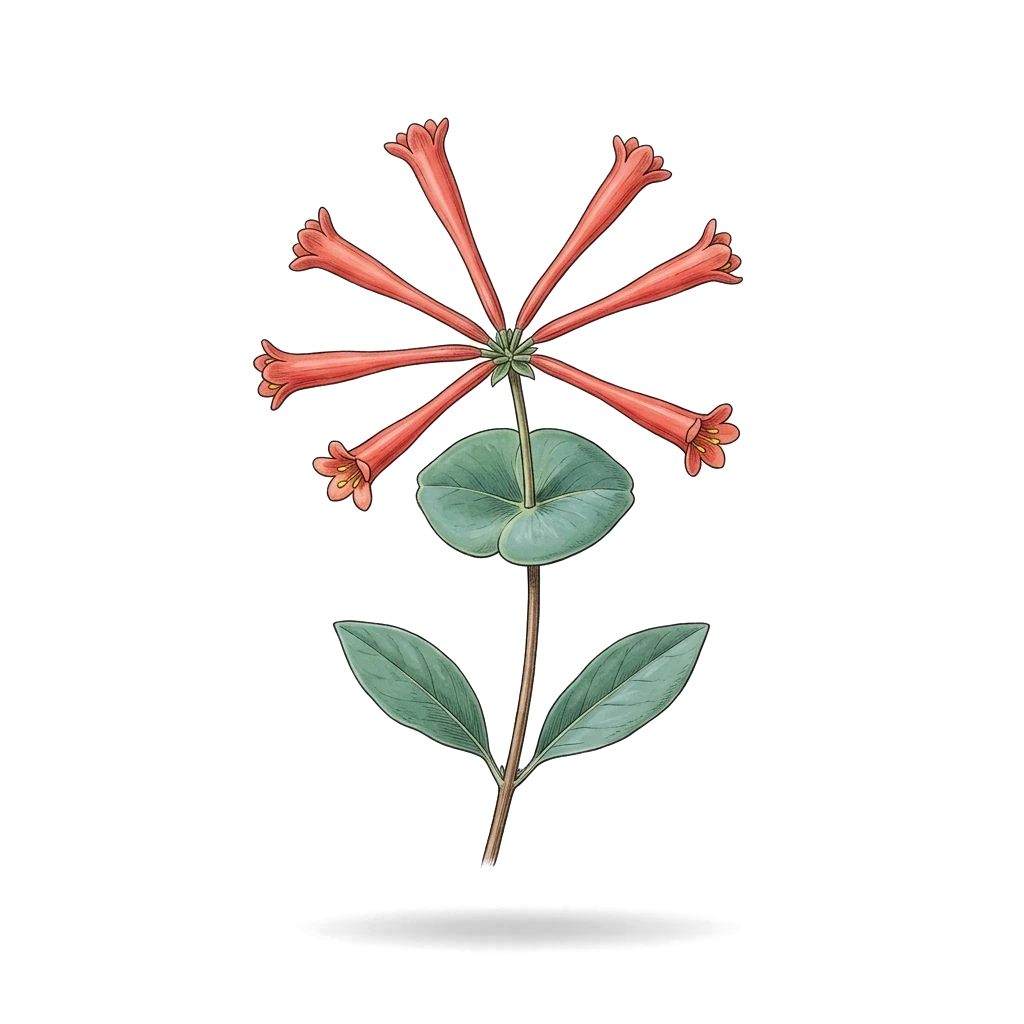
What does honeysuckle symbolize?
Honeysuckle is a flower of affection. In Kate Greenaway’s 1884 Language of Flowers, its entry reads “generous and devoted affection.”
An American flower book of 1851 says where the idea came from. Henrietta Dumont wrote that the honeysuckle was chosen as the emblem of affection for the way it clings to trees and lattices “with all the ardour and constancy of a weak, confiding woman,” holding on to “the stronger, sterner sex” in prosperity and in adversity. Keep the constancy, perhaps, and leave the rest in 1851.
One of the plant’s nicknames makes the same point. As the Alte Pinakothek in Munich puts it, honeysuckle is commonly known as “the longer the better” and symbolizes love’s durability.
Not every honeysuckle in the old lists is the same plant, or the same message. Greenaway gives the woodbine, the English name for Europe’s wild honeysuckle, “fraternal love,” and the French honeysuckle “rustic beauty.” That French honeysuckle isn’t a Lonicera at all: Dumont identifies it as a Hedysarum.
Honeysuckle colors and what they mean
- Coral pink
- Yellow
- Cream
Coral honeysuckle, the one color Greenaway singled out, is still a common name for the trumpet honeysuckle, the native vine of the eastern US.
Many honeysuckles change color as they age, so one vine wears two at once. Japanese honeysuckle opens white and fades to buff or yellow, and one of its common names is gold-and-silver honeysuckle. Europe’s common honeysuckle opens white or ivory and darkens to yellow.
Why is it called honeysuckle?
The word goes back to the Old English hunisuce, from hunig, honey, and sucan, to suck. The honey is the nectar, which can easily be sucked from the flower.
Its other English name, woodbine, comes from the Old English wudubinde, from “wood” and “wreath,” a word tied to the verb to bind. In the 12th century, Marie de France gave the name of her Lay of the Honeysuckle in two languages: goatleaf in English, chèvrefeuille in French.
The botanical name, Lonicera, honors Adam Lonitzer (1528–1586), a German naturalist and the author of a popular herbal.
Honeysuckle symbolism in stories and art
Writers and painters have used the vine for lovers who can’t be parted, and for the green shade where love is overheard or sealed.
Tristan, Isolde and the hazel
Marie de France, writing in the second half of the 12th century, told one episode of Tristan and Isolde (Isoude in the 1911 translation) as the Lay of the Honeysuckle. Banished by King Mark, Tristan hides in the forest and leaves a peeled hazel wand carved with his name on the road the queen will ride.
His message is the honeysuckle wound around the hazel: part them and the hazel withers at the root and the honeysuckle fails, and so it is with the two of them, “nor you without me, nor I without you.”
Shakespeare’s woodbine
In A Midsummer Night’s Dream, the fairy queen sleeps on a bank “quite overcanopied with luscious woodbine.” Later, under a spell, Titania winds her arms around Bottom, who wears an ass’s head, as “the woodbine the sweet honeysuckle / Gently entwist.”
In Much Ado About Nothing, Beatrice is lured into a “pleachèd bower / Where honeysuckles ripened by the sun / Forbid the sun to enter,” to overhear talk of Benedick’s love for her.
Rubens in the honeysuckle bower
Peter Paul Rubens came home to Antwerp in 1608 after eight years in Italy, and the following year he married Isabella Brant. His portrait of the two of them in a honeysuckle bower, painted around 1609 or 1610 and now in the Alte Pinakothek, was probably made to mark the marriage.
A plaque on the Charles River
In 1965, a Harvard graduate, his wife and a friend fixed a small plaque to the Anderson Memorial Bridge for Quentin Compson, of William Faulkner’s The Sound and the Fury, on the 55th anniversary of his death in the novel. It reads “Drowned in the fading of honeysuckle.” A 1983 replacement changed the line to “odour of honeysuckle,” and the plaque put up in 2017 went back to the original words.
Types of honeysuckle
There are about 180 species, bushy, twining or creeping, deciduous or evergreen, all native to the Northern Hemisphere. The climbers flower mostly from summer into early autumn, and the shrubby kinds include winter-flowering ones and evergreens that can be clipped into a low hedge.
-
Trumpet honeysuckle
Lonicera sempervirens
The eastern US native, also called coral honeysuckle: a twining vine with unscented scarlet to orange-red trumpets, pollinated mainly by hummingbirds, then small red berries
-
Western trumpet honeysuckle
Lonicera ciliosa
The native climber of the West, from British Columbia south to California, with narrow orange-yellow trumpets in clusters and translucent orange-red berries
-
Common honeysuckle
Lonicera periclymenum
Europe’s wild woodbine: white or ivory flowers that age to darker yellow and smell strongest after dark, then deep red berries
-
Goldflame honeysuckle
Lonicera × heckrottii
A garden hybrid of two European honeysuckles and the American trumpet honeysuckle, with pinkish-purple flowers that open to show yellow. It rarely sets berries
-
Japanese honeysuckle
Lonicera japonica
Very fragrant white flowers that age to yellow, then blue-black berries. From East Asia, it is invasive in North Carolina and prohibited in Wisconsin; Hall’s honeysuckle is the same species
-
Amur honeysuckle
Lonicera maackii
A shrubby honeysuckle from eastern Asia, up to about 15 feet tall, with white flowers that turn yellow and dark red berries that birds spread. Naturalized across much of eastern North America
-
Winter honeysuckle
Lonicera fragrantissima
A shrub from China whose lemon-scented, creamy-white flowers open from December to March, before the leaves. Considered invasive in many states
-
Box honeysuckle
Lonicera nitida
An evergreen shrub from China with small, fragrant cream flowers in spring, clipped as a low hedge or topiary in place of boxwood
Native honeysuckle vs. invasive honeysuckle
Japanese honeysuckle, native to Japan, Korea, Manchuria and China, is an invasive species in North Carolina, where NC State’s weed specialist classes it as highly invasive. In Wisconsin it is a prohibited species. The vine can kill shrubs and young trees by girdling them, and birds and mammals spread its berries.
The shrubby Asian honeysuckles are the other trouble. Amur, Morrow’s and Tatarian honeysuckle, mostly from eastern Asia, came to the US in the 1800s as ornamentals, wildlife cover and erosion control, and now form thickets that crowd out native plants. Their fruit lacks the high fat content that migrating birds need, yet birds and deer still spread the seeds.
NC State doesn’t recommend Amur honeysuckle for any garden, and it notes that winter honeysuckle is considered invasive in many states.
How to tell a native honeysuckle
Look at where the flowers sit and what follows them. Native honeysuckle vines flower at the tips of the stems, then bear red or orange berries, and their leaves are joined around the stem like a collar. Japanese honeysuckle flowers where the leaves meet the stem, its berries are purple-black, and its leaves aren’t joined.
For a native vine, the trumpet honeysuckle comes from the eastern US, and the western trumpet honeysuckle grows wild from British Columbia south to California. A label reading Hall’s honeysuckle is Japanese honeysuckle under another name.
How to grow honeysuckle
Growing honeysuckle
Facts for trumpet honeysuckle (Lonicera sempervirens), a native US vine
- Type
- Woody vine
- Blooms
- Spring to summer
- Sun
- Full sun to part shade
- USDA zones
- 4–9
- Native to
- The southeastern United States
Dappled shade gives a climbing honeysuckle its healthiest growth and best flowers: a south-facing wall may scorch the leaves, and too much shade means no flowers at all. Give the stems wires or trellis about 18 inches apart, set at least 2 inches off the wall or fence. Heavy, wet soil and dry sites both leave the plant looking sickly.
Late-flowering kinds bloom on the current season’s growth, so they need only a light trim; cut early-flowering ones back by a third after they flower, in late summer. The trumpet honeysuckle blooms on new growth, so prune it after flowering.
Check young shoots for aphids in spring. Powdery mildew is likeliest in hot, dry weather, and a mulch of garden compost around the base helps prevent it.
Are honeysuckle berries poisonous?
It depends on the species. NC State lists the fruit of Japanese honeysuckle as poisonous to people, at medium severity, from saponins, and only when large amounts are eaten. Amur honeysuckle berries are rated low severity, but they cause severe diarrhea when eaten.
The native trumpet honeysuckle has no poison listing; NC State describes its small red berries as inedible, and songbirds eat them.
Is honeysuckle poisonous to dogs and cats?
Honeysuckle
- Pets
- Not in the ASPCA’s plant list The ASPCA’s “honeysuckle fuchsia” entry is Fuchsia triphylla, a different plant.
- People
- Not listed as poisonous This line is for the native trumpet honeysuckle, which NC State gives no poison listing; it calls the red berries inedible.
In the US, if a pet may have eaten part of a plant, call your vet or the ASPCA Animal Poison Control Center at (888) 426-4435. If a person has, call Poison Control at 1-800-222-1222.
The ASPCA’s plant list has no entry for any Lonicera species.
Honeysuckle bouquet pairings
A honeysuckle bouquet is easiest to make from your own vine: cut a few trailing lengths and let them spill over the rim of the jug. In June it meets its fellow birth flower, the rose, and sweet peas lend scent to the honeysuckles that have none.
-
Rose and honeysuckle
Love from the rose, devoted affection from the honeysuckle: June’s two flowers say both at once, for a June birthday or an anniversary.
-
A jug for the evening table
Cut common honeysuckle for a dinner outdoors. Its scent is strongest after dark, just when the table is set.
-
Coral trumpets and sweet peas
The native trumpet honeysuckle has the brightest color and no scent, so tuck it among sweet peas in pink or cream.
-
Hazel and honeysuckle
For someone far away, wind a length of honeysuckle around a few hazel twigs, the way Tristan and Isolde were “nor you without me.”
Honeysuckle tattoo ideas
Honeysuckle flowers are slim tubes, usually in pairs, on a vine with opposite leaves. On many honeysuckles the top pair of leaves is fused into a single disc, with the stem running through it.
-
A pair on one stalk
Honeysuckle flowers usually come in twos. Draw a single pair, slightly apart at the tips and joined at the base, for two people.
-
Nor you without me
A vine wound around a bare hazel twig tells Marie de France’s story without a word, or with her line in small script along the wood.
-
The leaf collar
The trumpet honeysuckle’s stem runs straight through a round, joined pair of leaves, with the trumpets clustered above it. Even drawn small, that pierced leaf gives the vine away.
-
White turning gold
Flowers that open white and age to yellow on the same vine suit a long marriage, or the old nickname “the longer the better.”