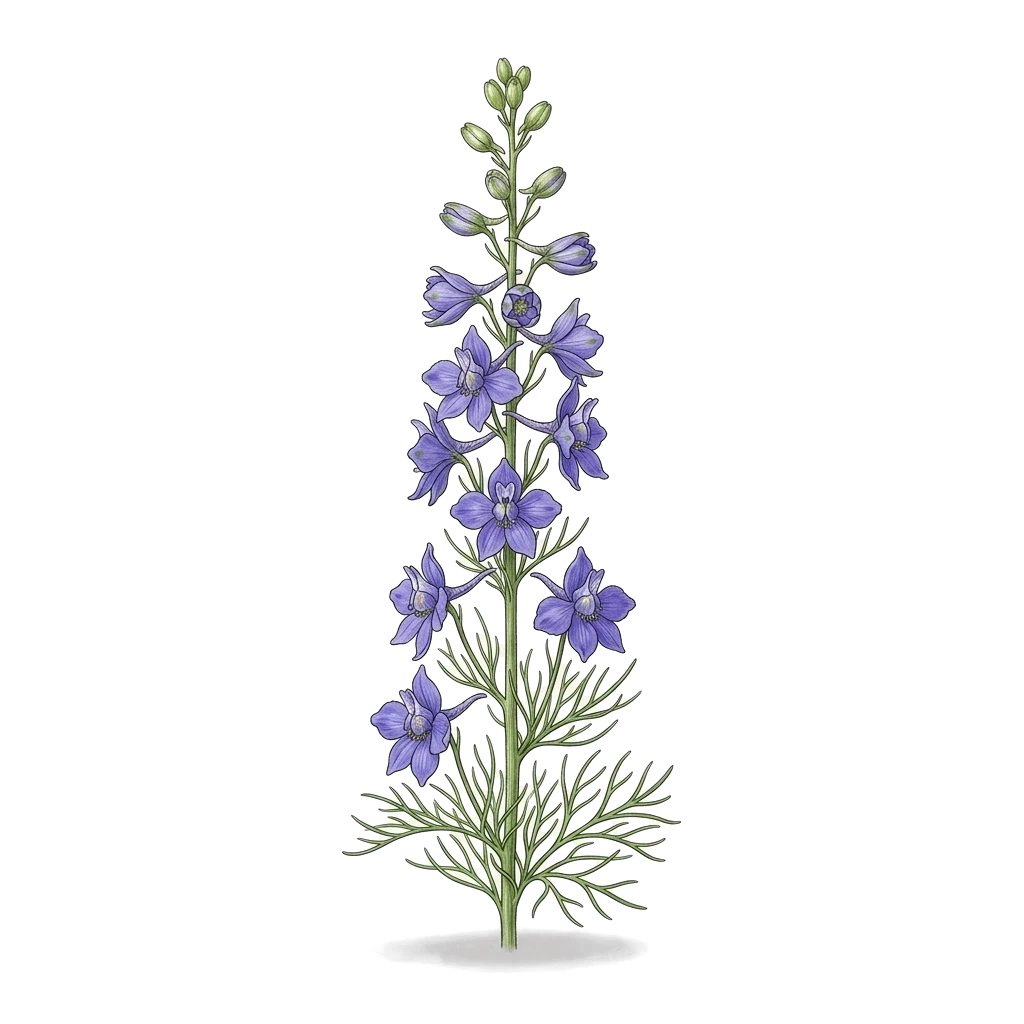
What is a larkspur flower?
Larkspur is a showy annual of the buttercup family, with stems of finely cut leaves topped by spikes of spurred flowers. The common garden one, giant or rocket larkspur, grows to about 3 feet, and its flowers are usually deep blue, sometimes pink, white, or a mix of blue and pink.
The spur gives the plant its English name. It sticks out behind each flower, holds the nectar, and looks like the long claw on the hind toe of a lark.
What look like five petals are really sepals, the top one drawn out into that spur, and the true petals are smaller ones in the middle. In the annual larkspur there are only two of them, joined into one, and the leaves are split into threads less than 1.5 mm wide.
Giant larkspur comes from southern Europe and the Mediterranean, and it has escaped from gardens to grow wild in many parts of the US. New England’s Native Plant Trust lists it as doubtful knight’s-spur, a plant of roadsides and ditches, and notes that its spires earned it the name rocket larkspur.
Larkspur vs delphinium: one name, two plants
The dictionary gives “larkspur” two meanings: the annuals of the genus Consolida, and the delphiniums, which are called larkspur too. Delphinium is the big genus, with more than 500 species of annuals, biennials and perennials from North America, Europe, Africa and Asia, and NC State gives larkspur as their common name.
That genus name is Greek for dolphin. NC State says the flower buds of some species look like one, while the American Heritage Dictionary puts it down, probably, to the shape of the nectary.
Where the botanists have put it
Linnaeus himself placed the annual larkspur in Delphinium, naming it Delphinium ajacis in 1753. Consolida started out as a section of Delphinium, became a genus of its own in an 1821 book on British plants, and took in the larkspur as Consolida ajacis in 1853.
DNA has since pulled it back. A 2011 study of the annual larkspurs found Consolida nested inside Delphinium, and concluded that tidy genera may mean moving its species into Delphinium. The RHS now lists the plant as Delphinium ajacis, with Consolida ajacis as a synonym, while the Missouri Botanical Garden still uses Consolida ajacis, so you’ll meet both names.
How to tell them apart
Whatever the label says, the plants are easy to tell apart. Annual larkspur has two joined petals and one carpel in each flower, thread-fine leaf lobes and a slender taproot; a perennial delphinium has four separate petals, three carpels and leaf lobes 5 to 25 mm wide.
Lifespan is the other clue. Larkspur is an annual that may sow itself, while most garden delphiniums are perennials that carry on in a border for years.
Larkspur flower meaning
Kate Greenaway’s 1884 Language of Flowers gives the larkspur a light touch: “Lightness. Levity.” Purple larkspur also got a picture of its own. It is the book’s illustration for the letter L, captioned with its meaning, haughtiness.
Today’s lists keep the lightness and add positivity. That’s an odd fit for a flower whose Latin name ties it to a hero’s death.
Larkspur meaning by color
| Color | Meaning today | Victorian (1884) |
|---|---|---|
| Blue | Dignity and grace | |
| Purple | First love 1884: Haughtiness | |
| Pink | Fickleness 1884: Fickleness | |
| White | Happiness and joy |
Blue is the usual color, and pink and white plants are less common. Cultivars widen the range to salmon, carmine, violet and lavender.
Larkspur in myth: the letters of Ajax
The story comes from Ovid’s Metamorphoses. When the armor of Achilles was given to Ulysses instead of him, Ajax fell on his own sword, and the earth, reddened by his blood, put up a purple flower: the same one that had sprung from the wound of Hyacinthus.
Its petals carried letters both of them could claim. For Ajax they began his Greek name, Aias; for Hyacinthus they were Apollo’s cry of grief, “ai, ai.” In Ovid’s telling, Apollo had foretold that a great hero would one day add his name to the flower.
Ovid’s flower is the one that took Hyacinthus’s name, and his translator Henry Riley noted that it isn’t clear which plant the ancients called the hyacinth. Linnaeus gave the larkspur the hero’s name all the same: ajacis, the species name he chose in 1753, comes from Ajax.
Types of larkspur
The annual larkspurs in gardens include giant and branching larkspur, and the perennial delphiniums fall into three main groups by their looks. North America has wild larkspurs of its own as well, from flowers of eastern woods to the tall larkspurs of western mountain meadows.
-
Giant larkspur
Delphinium ajacis
Also called rocket or annual larkspur, and still often sold as Consolida ajacis. An annual up to about 3 feet (1 m) tall with feathery leaves and flowers that are usually deep blue, sometimes pink, white, or blue and pink
-
Giant Imperial Series
Consolida ajacis Giant Imperial Series
Upright, branching annuals to about 4 feet (1.2 m), with long spikes of double flowers in pink, blue or white
-
Branching larkspur
Delphinium consolida
Also called forking larkspur and knight’s spur (syn. Consolida regalis). A hairy, well-branched annual about 2 feet (60 cm) tall, with loose spikes of darkest blue to purplish flowers from late spring through summer
-
Elatum Group delphiniums
Clump-forming perennials with the tallest flower spikes, up to 6⅔ feet (2 m), in early to midsummer, and often again in fall if cut back
-
Belladonna Group delphiniums
Loosely branched perennials 3 to 4 feet (1–1.2 m) tall with many side spikes, flowering in early and late summer. Especially good for cutting
-
Pacific hybrids
Close to the Elatum Group but smaller, to 6 feet (1.8 m). Short-lived, so often best grown as annuals or biennials
-
Dwarf larkspur
Delphinium tricorne
A perennial wildflower of the eastern United States, the most common Delphinium in its moist woods and thickets, with loose clusters of 6 to 12 flowers, usually bluish-purple
-
Carolina larkspur
Delphinium carolinianum
A perennial wildflower of rocky limestone glades in the Southeast, with up to 30 to 40 blue flowers on a spike, much visited by bumblebees
The Giant Imperial larkspurs have double flowers. Bees go for the single ones: pollinating insects, bumblebees above all, like to visit single-flowered delphiniums.
How to grow larkspur
Growing larkspur
- Type
- Annual
- Blooms
- Summer
- Sun
- Full sun
- Native to
- The Mediterranean
Larkspur is a cool-weather annual. It likes loose, moderately rich soil that stays moist but drains well, puts up with a little afternoon shade where summers are hot, and sulks in wet ground. The RHS adds a sheltered spot and neutral to alkaline soil.
For earlier flowers, start seed indoors in individual peat pots 8 to 10 weeks before the last spring frost, and plant out 9 to 12 inches apart. Deadheading keeps the spikes coming, and plants left to their own devices may seed themselves for next year. Pests are rarely serious, though powdery mildew can turn up.
Dried larkspur
Larkspur dries well. Illinois Extension lists it among the flowers suited to air drying, and the Missouri Botanical Garden rates it an excellent cut flower, fresh or dried. Pick spikes before they’re fully open, since flowers keep opening as they dry, and strip off the leaves.
Bind small bunches with a rubber band, which tightens as the stems shrink, and hang them upside down somewhere warm, dry, dark and airy for two to three weeks. Keep them out of direct sun. Blue flowers hold their color when air-dried, but pink ones tend to fade.
Is larkspur poisonous to people and livestock?
Yes. The leaves, flowers and seeds of giant larkspur are toxic if eaten, and NC State gives the delphiniums its high-severity poison rating.
In the West, wild larkspurs are a ranching problem. The University of Wyoming calls them perhaps the most common deadly poisonous plant problem on western US rangelands, and the USDA’s Poisonous Plant Research Laboratory says they cause heavy cattle losses there.
Their alkaloids block the junction between nerve and muscle. A poisoned cow trembles, staggers and may suddenly fall, and death comes from respiratory failure or bloat. Among the genus’s common names, NC State lists staggerweed.
Sheep and horses are rarely lost to it. Sheep need about four times as much of the toxin for their weight, and some ranches graze sheep through larkspur ahead of the cattle. The timing works against the cattle: tall larkspurs are most toxic while young, when cattle mostly leave them alone, and grow more palatable as they flower and set pods.
Are larkspurs poisonous to cats and dogs?
Larkspur
- Pets
- Toxic to dogs, cats and horses The ASPCA’s larkspur entry covers Delphinium species, and the RHS files this larkspur in that genus, as Delphinium ajacis.
- People
- Listed as poisonous Leaves, flowers and seeds are toxic if eaten.
In the US, if a pet may have eaten part of a plant, call your vet or the ASPCA Animal Poison Control Center at (888) 426-4435. If a person has, call Poison Control at 1-800-222-1222.
The ASPCA names diterpene alkaloids as the cause, and they bring on neuromuscular paralysis.
Larkspur bouquet ideas
Tall and narrow, larkspur gives a bunch height without bulk. For the vase, cut the spikes when only the lowest buds have opened.
-
Spires at the back
Stand a few spikes behind rounder flowers, the way larkspur grows at the back of a border. Three or five stems are plenty; a crowd of them just looks like a hedge.
-
Blue with white
Blue for dignity and grace, white for happiness: two colors of larkspur on their own make a cool, simple bunch for a summer birthday.
-
A bunch that keeps
Cut a few extra stems before they open fully and hang them to dry. Blue larkspur holds its color, so the birthday bunch can stay on the shelf as a dried one long after the fresh flowers are gone.
-
The two July flowers
Larkspur in a tall jug with a water lily floating in a shallow bowl beside it puts both of the month’s flowers on one table, one rising and one lying flat.
Larkspur also sits well among cottage-garden flowers: try it with roses or sweet peas, or beside July’s other flower, the water lily.
Larkspur tattoo ideas
A larkspur tattoo comes down to two details: a spur behind every flower and leaves split into fine threads.
-
The spur in profile
Turn a flower or two sideways so the spur shows, sweeping back like a lark’s claw. Seen from the front, larkspur could pass for any five-pointed blue flower.
-
Thread-fine leaves
A few forked, hair-thin lines at the foot of the spike are what say larkspur rather than delphinium, whose leaves have broad lobes.
-
Ajax’s letters
For a piece about grief or remembrance, ink ΑΙ in small Greek capitals on one petal, as Ovid tells it: the start of Ajax’s name and a cry of mourning.
-
An L for a name
Greenaway chose purple larkspur for the letter L. One spike bent into that letter makes a botanical initial for a name that starts with it.